
High-Performance Metal-Organic Framework Powders
Explore benchmark industrial MOF materials supplied with verified BET surface area metrics, crystalline purity, and batch consistency for global industrial procurement.
Executive Summary: Why MOF-801 leads Next-Generation Sorption Technology
Metal-Organic Frameworks (MOFs) represent a transformative class of ultra-porous crystalline hybrid materials composed of metal ions or clusters coordinated to organic linkers. Among the thousands of frameworks synthesized to date, MOF-801—a Zirconium-fumarate framework designated chemically as [Zr6O4(OH)4(fumarate)6]—has emerged as the paramount material benchmark for water vapor harvesting, desiccant cooling, and low-humidity moisture management.
When selecting the best MOF-801 suppliers & supplier partners, industrial engineering and R&D procurement teams must evaluate far more than basic cost per kilogram. Key critical evaluation parameters include framework crystalline fidelity, volumetric water capacity, hydro-thermal stability under thousands of adsorption-desorption cycles, residual ligand content, and supplier capacity to scale from batch-scale synthesis to continuous ton-scale manufacturing.
Crystalline Structure & Pore Topology of MOF-801
MOF-801 crystallizes in a 3-dimensional cubic lattice (space group Pn-3m or Fm-3m depending on structural modification), featuring hexanuclear zirconium oxide clusters [Zr6O4(OH)4]12+ linked together by 12 ditopic fumarate ligands. This 12-connected topology builds a highly robust fcu (face-centered cubic) framework characterized by two distinct types of micro-cavities:
- Tetrahedral Cages: Pore windows measuring approximately 4.8 Å to 5.6 Å, optimized for molecular-sieve interaction with small hydrophilic molecules.
- Octahedral Cages: Internal pore diameters reaching up to 7.6 Å, providing ample volumetric reservoir capacity for condensation of adsorbed water clusters.
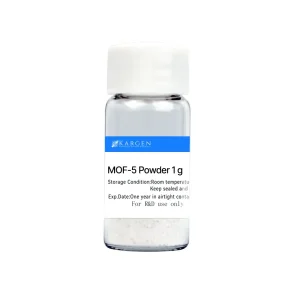
Because zirconium-oxygen (Zr-O) coordination bonds possess exceptional bond dissociation energy (~776 kJ/mol), MOF-801 exhibits chemical and hydrothermal endurance far outstripping conventional carboxylate MOFs built on copper, zinc, or iron nodes (such as HKUST-1 or MOF-5).
| Adsorbent Material | BET Surface Area (m²/g) | Water Uptake Step (RH Range) | Regeneration Temp (°C) | Hydrothermal Longevity |
|---|---|---|---|---|
| MOF-801 (Zr-Fumarate) | 850 – 1,150 | 10% – 25% RH (Steep Step) | 65°C – 80°C | Exemplary (>10,000 cycles) |
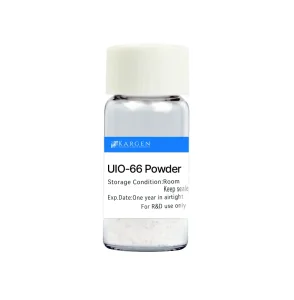
| UiO-66 (Zr-BDC) | 1,100 – 1,400 | 45% – 60% RH | 90°C – 110°C | High (>5,000 cycles) |
| ZIF-8 (Zn-2-MeIM) | 1,300 – 1,800 | Hydrophobic (Minimal uptake) | 120°C+ | Moderate (Degrades in acid) |
| Silica Gel (Type A) | 600 – 750 | Linear (Requires high RH) | 120°C – 150°C | Poor (Pore collapse over time) |
| Zeolite 13X | 500 – 700 | High initial uptake / extreme binding | 200°C – 300°C | High energy penalty for desorption |
Localized Application Scenarios & Industrial Implementations
How Tier-1 system integrators leverage MOF-801 to replace outdated silica gel and zeolite modules across diverse thermal management and water-generation domains.
Atmospheric Water Harvesting (AWH) in Arid Regions
In hyper-arid regions such as the Middle East, North Africa, and Western Australia, ambient relative humidity frequently drops below 20%. Standard condensation chillers fail or consume prohibitive power. MOF-801-based AWH devices harvest liquid potable water directly from desert air using unassisted solar-thermal energy, producing over 2.8 liters of water per kilogram of MOF daily without external electricity.
HVAC & Desiccant Cooling Energy Savings
Conventional air conditioning wastes up to 50% of electrical energy condensing moisture (latent heat load). Integrating MOF-801 desiccant wheels or MOF-coated heat exchangers into commercial HVAC units decouples sensible and latent cooling. The MOF strips moisture continuously at room temperature and regenerates using 70°C hot water recovered from server heat pumps or compressor exhaust, slashing overall building energy usage by 35–50%.
Lithium-Ion Battery Dry Room Moisture Scavenging
Gigafactory battery manufacturing requires ultra-dry air environments (dew points below -40°C to -60°C) to prevent lithium salt hydrolysis and HF gas formation. MOF-801 industrial filtration cartridges effectively capture trace ppm-level water vapor with low pressure drop, outperforming alumina beds while cutting desiccant regeneration thermal budgets in half.
Pharmaceutical & Fine Chemical Drying
Thermally sensitive active pharmaceutical ingredients (APIs) require rapid, non-destructive moisture removal at low temperatures. MOF-801 fluidized bed dryers allow vacuum drying of organic powders at 35°C–40°C, preserving molecular stability while rapidly removing bound moisture via targeted microporous adsorption.
Technical Roadmap & Future Outlook (2025–2030)
Navigating the shift from benchtop MOF synthesis to structured monoliths, continuous microfluidic manufacturing, and AI-guided ligand optimization.
Mechanochemical & Aqueous Synthesis
Historic MOF-801 production relied on toxic N,N-dimethylformamide (DMF) solvents and elevated autoclave temperatures. Leading suppliers are executing green synthesis protocols utilizing water-based mechanochemical milling or aqueous solvothermal systems, decreasing volatile organic compound (VOC) waste by 85% and lowering feedstock production expenses.
3D Monoliths, Pellets & Coatings
Raw MOF-801 microcrystalline powders suffer from high pressure drop and dusting in industrial fixed beds. Current engineering developments focus on binderless extrusion into 2mm–4mm spherical pellets, honeycomb ceramic washcoats, and high-porosity MOF-polymer composite membranes that maintain 92%+ of native crystalline BET surface area.
Continuous Ton-Scale Manufacturing
Transitioning from batch reactors to continuous flow plug-reactor arrays enables real-time temperature control, rapid crystal nucleation, and uniform particle size distribution (PSD). This roadmap milestone guarantees ultra-consistent batch-to-batch adsorption kinetics for multi-ton industrial orders.
Defect Engineering & Metal Doping
Utilizing DFT calculations and machine learning, chemical engineers deliberately introduce missing-linker defect sites into the MOF-801 lattice or partially substitute Zr nodes with Titanium or Hafnium. This defect-engineering approach tailors the water adsorption onset relative humidity precisely to custom target environments (e.g., shifting step adsorption from 20% RH down to 10% RH).
China Factory Supply Chain Resilience & Cost Efficiency
Understanding how upstream chemical cluster integration and advanced engineering scale lower financial barriers to mass commercial MOF adoption.
Historically, commercialization of Metal-Organic Frameworks was stifled by exorbitant pricing—often exceeding $1,000 to $5,000 per kilogram from Western laboratory chemical distributors. For industrial OEMs building megawatt desiccant systems or multi-ton water harvesting arrays, such pricing structures were non-viable.
China's specialized high-tech chemical manufacturing ecosystem has completely redefined the global MOF market economics. Leading Chinese MOF factories provide unmatched structural and cost advantages across four key vectors:
1. Upstream Raw Material Precursor Integration
China commands over 70% of global Zirconium refining and basic chemical processing capacity (e.g., Zirconium Oxychloride, ZrOCl2·8H2O). Furthermore, large-scale domestic production of bio-fermented and synthetic fumaric acid ensures that top domestic MOF-801 suppliers secure raw precursors at prime factory-gate prices, insulated from international geopolitical shipping shocks.
2. Ton-Scale Solvothermal Scaling
By operating state-of-the-art 5,000L to 10,000L glass-lined industrial reactors equipped with high-efficiency solvent recovery systems (recycling >98% of organic liquors), top Chinese MOF manufacturers convert bench scale recipes into scalable industrial ton-scale runs. This slashes production overhead by 60%–75% compared to small-batch European pilot units.
3. Digital Analytical QC & Compliance
Robust quality management systems integrated with automated Powder X-Ray Diffraction (PXRD), Thermogravimetric Analysis (TGA), Inductively Coupled Plasma (ICP-OES), and automated Nitrogen/Water Isotherm analyzer suites guarantee that every export batch satisfies tight specification windows (BET surface area variance < 5%).
4. Flexible OEM & Custom Formulation Support
Leading suppliers offer full OEM/ODM customization services—supplying MOF-801 not only as standard dry micro-powder (d50 ~ 1-5 µm), but also as pre-dispersed liquid slurries, functionalized coated granules, shaped extrudates, and engineered desiccant discs tailored to customer mechanical specifications.
Global Commercial & Industrial Status
Key market drivers, ESG decarbonization mandates, and regional adoption trends across North America, Europe, and Asia-Pacific.
North America
Driven by U.S. Department of Energy (DOE) grants for Net-Zero Building Technologies and atmospheric water generation for military/disaster relief, North American OEMs lead demand for structured MOF-801 monoliths. Sourcing focuses heavily on long-term supplier reliability, REACH/TSCA chemical inventory clearance, and lot-to-lot structural reproducibility.
European Union
Strict EU Green Deal and EPBD (Energy Performance of Buildings Directive) regulations force HVAC equipment manufacturers to phase out energy-intensive desiccant dehumidifiers. European engineering groups aggressively implement MOF-801 coated heat exchangers to harness waste heat (<75°C) from industrial processes, cutting commercial cooling carbon footprints.
Asia-Pacific & Middle East
The GCC region (UAE, Saudi Arabia, Qatar) represents the highest growth market for commercial off-grid solar water harvesters. Massive infrastructure investments (e.g., smart city initiatives) deploy MOF-801 arrays to supply clean water without grid connectivity. Meanwhile, APAC semiconductor and battery manufacturers utilize MOF-801 for ultra-low dewpoint cleanroom conditioning.
Localized Technical Support & Quality Compliance
Rigorous analytical verification standards protecting global buyers against structural defects, phase impurities, and regulatory non-compliance.
When procuring MOF-801 from international suppliers, chemical quality control must extend beyond simple chemical naming. Professional MOF manufacturers provide comprehensive batch-level analytical documentation, including:
- Powder X-Ray Diffraction (PXRD): Verification of sharp crystal Bragg peaks matching simulated MOF-801 Pn-3m reference patterns, confirming 0% unreacted zirconium oxide or amorphous phase contamination.
- Nitrogen (N2) & Water Vapor Physisorption: Automated volumetric adsorption isotherms establishing BET surface area (>900 m²/g) and verifying steep water sorption step pressure (P/P₀ = 0.15 - 0.20).
- Thermogravimetric Analysis (TGA): Thermal decomposition profiling confirming framework stability up to 300°C in air and quantifying residual trapped solvent content (< 2.0% wt).
- Scanning Electron Microscopy (SEM) & Particle Size Analysis: Uniform crystal morphology inspection and Laser Diffraction PSD reports (d10, d50, d90) to ensure consistent packing density.
- International Regulatory Documentation: Full Safety Data Sheets (SDS) in accordance with UN GHS standards, REACH compliance certification, RoHS non-hazardous material verification, and ISO 9001:2015 quality assurance management.
Specialized Organic Frameworks & Related Adsorbents
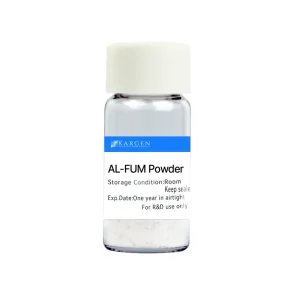
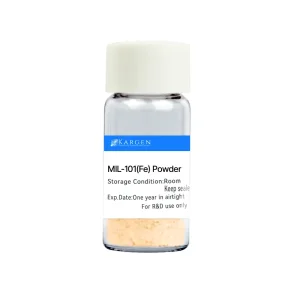
Explore our full line of advanced porous materials engineered for gas separation, carbon capture, and specialty catalytic processes.
Frequently Asked Questions by MOF Procurement Teams
Clear, engineering-backed answers addressing sampling, scale-up pricing, hydrothermal longevity, and custom synthesis terms.
What makes MOF-801 superior to standard Silica Gel or Zeolite 13X for atmospheric water harvesting?
Can I request 1–5 gram R&D evaluation samples before committing to bulk MOF-801 orders?
How many thermal water cycling loops can MOF-801 endure without structural degradation?
What physical product forms of MOF-801 are available for bulk commercial supply?
- Micronized Dry Powder: Average particle size d50 = 1 – 5 µm for slurry synthesis and dispersion.
- Extruded Pellets & Granules: 2mm to 4mm binder-optimized cylindrical pellets for low-pressure-drop packed bed columns.
- Liquid Dispersions: Pre-dispersed slurries in ethanol, water, or organic solvents for dip-coating heat exchanger fins.