Primary Industrial MOF Powders & Engineered Grades
Explore our flagship Metal-Organic Frameworks optimized for selective gas separation, carbon capture, atmospheric water harvesting, and battery separator coatings.








Application-Specific Metal-Organic Frameworks: Engineering Molecular Porosity for Industrial Scale
In modern chemical engineering and material science, off-the-shelf porous media like activated carbon, zeolites, and silica gel are reaching their thermodynamic limits. As global decarbonization mandates intensify and semiconductor purification standards reach sub-ppb thresholds, industrial engineers require highly tailorable, pore-engineered materials. Metal-Organic Frameworks (MOFs)—hybrid porous crystalline polymers composed of metal ions/clusters coordinated with organic linkers—represent the absolute frontier of advanced separation and storage technology.
As a premiere Application-Specific Products Supplier & Exporter, Guangdong Advanced Carbon Materials Co., Ltd. (KARGEN) bridges the historical gap between lab-scale synthesis and industrial-grade bulk manufacturing. Founded by returning senior researchers from prestigious academic institutions in the United States, Germany, and Sweden, KARGEN operates a state-of-the-art 10,000 m² R&D and ton-scale manufacturing facility in Zhuhai, China. We specialize in transforming complex reticular chemistry into robust, process-ready industrial adsorbents, catalytic supports, and membrane coatings.
Application-specific MOFs differ fundamentally from generic research chemicals. An application-tailored framework is designed backward from the end-user's operating conditions: gas stream partial pressures, relative humidity levels, thermal swing regeneration limits, shear stress in dynamic beds, and chemical exposure to acidic or oxidative contaminants. By controlling the coordination geometry, ligand functionalization (e.g., -NH₂, -SO₃H, -F), particle sizing, and matrix dispersion stability, KARGEN delivers scalable solutions that unlock unprecedented operational efficiency.
Technical Roadmap & Future Outlook of Reticular Materials
Transitioning from stochastic lab discoveries to machine-learning guided synthesis, continuous flow processing, and post-synthetic tailoring.
Mechanochemical & Solvent-Free Synthesis
Traditional solvothermal MOF synthesis relies heavily on toxic, high-boiling solvents like DMF (N,N-dimethylformamide), creating economic and environmental bottlenecks at ton-scale. KARGEN’s technical roadmap prioritizes twin-screw extrusion mechanochemistry and green aqueous systems. Mechanochemical ball-milling drastically reduces solvent overhead, improves energy efficiency by 65%, and delivers exceptional phase purity for flagship grades such as ZIF-8 and HKUST-1.
Continuous Microfluidic Flow Production
To eliminate batch-to-batch variations in pore diameter, crystal morphology, and BET surface area, KARGEN has implemented continuous flow micro-reactors. Continuous synthesis yields uniform crystallite nucleation, preventing localized thermal gradients. This ensures strict control over particle size distribution (PSD), vital for ultra-thin lithium-ion battery separator coatings and packed-bed column dynamics where fluid backpressure must be minimized.
Post-Synthetic Modification (PSM) & Covalent Tuning
The future of application-specific products lies in post-synthetic modification (PSM). By grafting amino (-NH₂), sulfonic, or fluorinated functional groups onto pre-assembled crystalline lattices (such as NH2-MIL-101(Fe) or UiO-66-NH₂), KARGEN tunes pore polarity and open metal site accessibility. PSM dramatically increases CO₂/N₂ selectivities, hydro-stability under steam purging, and chemical endurance against trace SOx/NOx impurities in industrial emissions.
| Synthesis Route | Yield & Scalability | Environmental Factor (E-Factor) | BET Surface Area Retention | Target Industrial MOF Families |
|---|---|---|---|---|
| Mechanochemical Extrusion | Ton-Scale / Continuous | Very Low (< 1.5) | 92% - 98% | ZIF-8, ZIF-67, HKUST-1, Al-FUM |
| Aqueous Hydrothermal | Multi-Ton / Batch | Low (< 3.0) | 95% - 100% | MIL-53(Al), MOF-303, MIL-100(Al) |
| Continuous Microfluidic Flow | High-Volume / Continuous | Moderate (< 5.0) | 98% - 100% | UiO-66, UiO-67, MOF-801 |
| Solvothermal (Recycled DMF) | Mid-Scale / Batch | Controlled (< 8.0) | 100% (Baseline) | MOF-177, MOF-5, MIL-101(Fe) |
Macro-Industry Solutions Powered by Targeted MOF Architectures
Transforming key sectors through engineered nanostructures, high thermal stability, and unprecedented gravimetric capacity.
1. Industrial Carbon Capture (Point-Source & Direct Air Capture DAC)
Traditional liquid amine scrubbing (MEA) suffers from massive thermal regeneration costs (approx. 3.5 to 4.5 MJ/kg CO₂ captured) and high corrosive degradation. KARGEN's application-specific CO₂ adsorbents—specifically customized ZIF-8, UiO-66-NH₂, and TYUT-12—exhibit steep, reversible isotherm profiles with ultra-low regeneration energies (< 2.2 MJ/kg CO₂).
These frameworks feature high thermal endurance (up to 400°C) and robust moisture tolerance, making them ideal for temperature-swing adsorption (TSA) and vacuum-swing adsorption (VSA) units attached to power plant flues, cement kilns, and steel manufacturing exhaust lines.
2. Atmospheric Water Harvesting (AWH) & HVAC Energy Reduction
Freshwater scarcity in arid zones and high energy consumption in commercial HVAC latent cooling are critical global challenges. Conventional desiccants like silica gel require heating over 120°C to desorb trapped water. KARGEN’s Al-FUM (Aluminium Fumarate) and MOF-801 / MOF-303 series exhibit classic S-shaped adsorption isotherms with step-like water uptake at low relative humidity (RH 10%-30%).
Desorption occurs rapidly under mild solar thermal energy or waste heat at low temperatures (50°C–70°C). Coated directly onto HVAC heat exchangers, our application-specific MOFs handle latent dehumidification loads independently, slashing compressor electrical power consumption by up to 50% in commercial cooling towers and desiccant wheels.
3. Lithium-Ion Battery Separators & Solid-State Electrolytes
Next-generation electric vehicle energy density demands ultra-stable battery interfaces. KARGEN supplies nano-sized MOF dispersions (e.g., customized ZIF-8 and UiO-66) tailored for lithium-ion battery separator coatings. The sub-nanometer, uniform micropores act as ion-sieves that regulate Li-ion flux, promoting homogeneous deposition and effectively suppressing lithium dendrite growth.
Furthermore, these open metal framework channels scavenge trace water, HF impurities, and dissolved transition-metal ions (Mn²⁺, Co²⁺) from the liquid electrolyte, dramatically improving capacity retention and thermal runaway safety across 2,000+ deep charge-discharge cycles.
4. Semiconductor Gas Purification & Solid-State Hydrogen Storage
The microelectronics industry requires ultra-high purity specialty gases (phosphine PH₃, arsine AsH₃, silane SiH₄, nitrogen trifluoride NF₃) with impurity levels below 1 part-per-billion (ppb). Frameworks like HKUST-1 and MIL-53(Al) feature dense arrays of open copper and aluminium coordination sites that chemically chelate trace reactive contaminants.
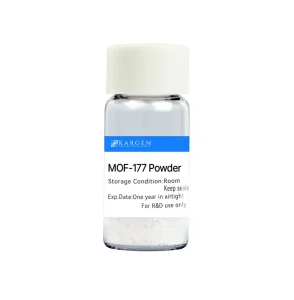
In addition, KARGEN’s ultra-high surface area frameworks (such as MOF-177 and MOF-5, exceeding 3,500 m²/g BET surface area) provide high volumetric capacity for low-pressure, solid-state gas storage, safer transport of hazardous dopants, and green hydrogen storage systems.
China Industry 4.0: Supply Chain Resilience & Mass-Scale Efficiency
For decades, the wide-scale commercial adoption of MOFs was hindered by astronomical pricing—often exceeding $5,000 to $15,000 per kilogram from Western catalog chemical suppliers. KARGEN has disrupted this bottleneck by establishing China's first fully integrated, ton-scale MOF manufacturing infrastructure in Zhuhai, Guangdong.
Backward-Integrated Raw Material Supply
KARGEN benefits from direct supply-chain integration with domestic Chinese chemical manufacturers producing key organic linkers (fumaric acid, terephthalic acid, BTC, 2-methylimidazole, trimesic acid). By sourcing high-purity precursor linkers directly at scale, we eliminate intermediate trading markups and guarantee raw material security even during global shipping disruptions.
Automated DCS & Digital Batch Consistency
Our 10,000 m² facility is governed by a Distributed Control System (DCS) monitoring temperature, pH, mixing torque, crystal growth rate, and filtration pressure in real-time. Automated washing and spray-drying systems ensure that every batch of MOF powder exhibits identical crystal morphology, BET surface area (X-ray diffraction verified), and powder tap density.
Scalable Price-Performance Curve
Through process intensification, solvent recovery loops, and high-throughput production lines, KARGEN brings the cost of commercial MOFs down to industrial tiers ($20 - $100/kg depending on framework type and volume). This unlocks viable unit economics for multi-ton deployments in carbon capture plants, HVAC manufacturing, and energy storage OEM assemblies.
Global Enterprise Procurement & OEM/ODM Co-Development
A structured, risk-mitigated adoption pathway designed to take global engineering teams from initial feasibility testing to full-scale commercial manufacturing.
Phase 1: Feasibility & 1–5 g Sampling
Qualified enterprise buyers can request 1–5 gram evaluation samples accompanied by comprehensive Certificate of Analysis (COA), PXRD patterns, TGA curves, and N₂/CO₂ adsorption isotherms. Rapid global air courier shipping ensures evaluation within days.
Phase 2: Form & Process Customization
MOFs rarely work as raw loose powders in industrial systems. KARGEN’s engineering team assists clients in shaping MOFs into extrudates, honeycomb monoliths, spherical beads, low-viscosity liquid dispersions, or thin-film slurry formulations compatible with existing roll-to-roll coating equipment.
Phase 3: Kilogram-to-Pilot Scale Up
Once material specifications are locked, KARGEN executes pilot batches (10 kg – 500 kg) under strict Non-Disclosure Agreements (NDA). We evaluate dynamic breakthrough behavior in actual flue gases, moisture cycling, or battery electrolyte slurry mixing tests.
Phase 4: Multi-Ton Supply & SLA Support
Commercial contracts are backed by long-term Service Level Agreements (SLAs), guaranteed supply lead-times, regulatory documentation, and continuous technical integration support from our dedicated PhD team.
Localization Support, Regulatory Compliance, & Global Logistics
Navigating global chemical compliance is essential for tier-1 industrial buyers. KARGEN maintains rigorous international certification standards, providing peace of mind for customs clearance and environmental auditing across North America, Europe, East Asia, and the Middle East.
ISO 9001, 14001 & ISO 45001 Certification
Our manufacturing plant operates under certified Quality Management Systems (ISO 9001), Environmental Management Systems (ISO 14001), and Occupational Health and Safety (ISO 45001). Each lot is traceable from raw linker batching to final moisture-proof vacuum packaging.
EU REACH & Global Regulatory Dossiers
KARGEN supports international export compliance with EU REACH registrations, GHS-compliant Safety Data Sheets (SDS) in 15+ languages, and full RoHS/REACH SVHC non-containment certificates. Chemical inventory status dossiers are provided upon request.
Specialized Packaging & Global Freight
Hydrophobic or moisture-sensitive MOF grades (e.g., HKUST-1, MOF-5) are packaged in aluminum-foil sealed inner bags with inert gas purging, housed within UN-approved fiber drums or air-tight steel containers. We offer DDP, FOB, and CIF shipping with dedicated freight forwarders specializing in advanced nanomaterials.
Technical & Commercial FAQ for MOF Procurement Teams
Expert answers to critical engineering, chemical stability, and purchasing questions.
What is the difference between solvothermal MOFs and mechanochemical MOFs supplied by KARGEN?
Solvothermal MOFs are synthesized in liquid solvent media under thermal pressure, yielding high crystallinity and maximal theoretical BET surface areas suitable for high-precision analytical or specialty gas applications. Mechanochemical MOFs are produced via low-solvent or solvent-free mechanical shearing. Mechanochemical synthesis offers significantly lower production costs, faster cycle times, and reduced environmental footprint, while retaining 90-98% of target adsorption capacity—making it ideal for bulk commercial applications like carbon capture and battery separator coatings.
How does KARGEN address the hydrothermal stability of water-sensitive MOFs like HKUST-1 or MOF-5?
Hydrothermal degradation occurs when water molecules attack open metal coordination bonds. KARGEN mitigates this through two primary methods: 1) Ligand functionalization (grafting hydrophobic alkyl or fluoro groups) and surface polymer encapsulation; 2) Application matching. For high-humidity environments, we recommend natively water-stable frameworks such as UiO-66, Al-FUM, MIL-53(Al), or MOF-303, which endure thousands of wet adsorption-desorption cycles without structural collapse.
Can KARGEN supply MOFs in pre-dispersed liquid form or binder-ready slurries?
Yes. Dry MOF powders can be difficult to disperse evenly in customer coating lines due to nano-agglomeration. KARGEN provides customized liquid dispersions (water, ethanol, NMP, or organic solvents) with stable zeta potentials, adjusted particle sizes (d50 from 200 nm to 5 µm), and pre-compatible surfactant additives tailored for lithium battery separator slot-die coating or membrane casting.
What is the typical lead time for evaluation samples versus bulk ton-scale shipments?
Standard catalog powder samples (1–5 grams) ship within 24 to 48 hours via express air courier. Custom synthesized or modified formulations require 1 to 2 weeks for pilot lab batching. Bulk commercial orders (500 kg to multi-ton lots) are typically fulfilled within 3 to 5 weeks from our Zhuhai production plant, depending on raw linker stock and custom packaging specifications.
Does KARGEN offer custom MOF development under Non-Disclosure Agreements (NDA)?
Absolutely. Over 60% of our production volume involves proprietary, client-exclusive formulations. We regularly sign bilateral NDAs with multinational OEMs, industrial gas companies, and automotive battery manufacturers to develop bespoke linker ratios, metal nodes, or shaped body geometries with protected intellectual property.
How are MOF materials tested and verified prior to export dispatch?
Every batch undergoes rigorous quality control testing in our analytical center. Quality verification standardly includes: Powder X-Ray Diffraction (PXRD) for crystalline phase verification, Nitrogen Physisorption (77K) for BET surface area and micropore volume calculation, Thermogravimetric Analysis (TGA) for thermal stability limits, Dynamic Light Scattering (DLS) for dispersion particle size distribution, and ICP-OES for elemental metal node ratios. Full COA documentation is attached to every shipment.
Specialty MOF Powders & Advanced Application Formulations
Select specialized frameworks optimized for high-surface area storage, sensing, environmental remediation, and custom catalyst synthesis.