
Flagship Metal-Organic Framework Powders
Explore high-purity benchmark MOF materials engineered for gas separation, carbon capture, lithium battery coatings, and atmospheric water harvesting.








Industrializing Metal-Organic Frameworks: Architecture, Reticular Chemistry & Scale
An authoritative technical analysis of MOF manufacturing, pore geometry engineering, and commercial supply chain integration.
Metal-Organic Frameworks (MOFs) represent a paradigm shift in material science. As hybrid crystalline materials composed of metal nodes (metal ions or clusters) coordinated with organic linkers (ligands), MOFs possess record-breaking internal surface areas (frequently exceeding 2,000 to 7,000 m²/g), ultra-high void volumes, and unprecedented structural tunability. Unlike conventional porous adsorbents such as activated carbon, zeolites, or silica gels, MOFs allow atomic-level engineering of pore dimensions, shapes, and chemical environments via reticular chemistry.
As global industries transition toward net-zero carbon goals, high-efficiency energy storage, and ultra-pure gas processing, the demand for industrial-grade MOF powders and dispersions has escalated. Selecting a qualified Metal Organic Frameworks Service & Supplier requires evaluating not only laboratory-scale synthesis capabilities but also the supplier’s continuous manufacturing infrastructure, batch-to-batch quality control protocols, raw material supply chain security, and intellectual property backing.
Reticular Engineering
Modular assembly of inorganic building blocks and organic struts allowing tailored pore apertures from micro- to mesoporous regimes.
Ultra-High Specific Surface
BET surface areas ranging from 1,000 m²/g to over 6,000 m²/g, vastly surpassing traditional industrial adsorbents.
Ton-Scale Reproducibility
Solvent-free mechanochemical and continuous-flow hydrothermal technologies ensuring strict crystallographic consistency.
Macro-Industry Solutions: Where MOFs Transform Commercial Performance
Engineered framework architectures solving complex engineering bottlenecks in energy, climate tech, and advanced manufacturing.
Conventional amine scrubbing for CO₂ capture requires immense thermal energy for solvent regeneration (often consuming 3.5 to 4.5 GJ/ton CO₂). MOF adsorbents like ZIF-8 and amine-functionalized NH2-MIL-101(Fe) offer low-energy swing adsorption kinetics. Their tailored binding sites selectively capture CO₂ molecules from complex gas mixtures (such as flue gas containing N₂, H₂O, and SOx) while lowering thermal regeneration energy penalties by up to 40%.
Hydrothermally stable frameworks such as Al-FUM (Aluminium Fumarate) and MOF-303 exhibit steep, sigmoidal water adsorption isotherms. They can harvest potable water directly from desert ambient air with relative humidity as low as 10-20%, driven by low-grade thermal solar energy. In HVAC applications, MOF-coated heat exchangers desorb moisture at temperatures below 70°C, drastically reducing cooling compressor latent loads and saving over 50% electrical power in commercial cooling units.
In energy storage, MOF powders suspended in liquid dispersions are coated onto polyolefin separators. The uniform sub-nanometer channels of materials like ZIF-8 regulate lithium-ion flux, promoting homogenous Li-deposition and suppressing destructive lithium dendrites. Additionally, open metal site frameworks trap dissolved transition metals (Mn, Co, Ni) leaked from cathode chemistry, shielding the solid electrolyte interphase (SEI) and extending battery cycle life by up to 300%.
Materials like HKUST-1 (Cu-BTC) and KAUST-7 feature coordinatively unsaturated metal sites that achieve olefin/paraffin separations (e.g., ethylene/ethane, propylene/propane) at room temperature, eliminating energy-intensive cryogenic distillation. For semiconductor fabs, MOF matrix purifiers adsorb sub-ppm toxic and electronic gas impurities (NH₃, H₂S, PH₃), ensuring ultra-high purity process streams.
Technology Roadmap & Future Outlook (2025–2035)
Bridging computational reticular design with green, automated high-throughput industrial manufacturing.
The next decade of MOF commercialization is anchored by three critical engineering revolutions:
- AI-Driven Machine Learning & Molecular Screening: Integrating Density Functional Theory (DFT) calculations with deep neural networks to screen billions of hypothetical frameworks, predicting guest-host binding energies, water stability, and synthesis viability prior to laboratory bench trials.
- Continuous Green Mechanochemical Synthesis: Transitioning away from organic DMF/DEF solvent-heavy hydrothermal routes toward solvent-free or water-based twin-screw extrusion (TSE) mechanochemistry, drastically lowering environmental impact (E-factor) and unit production costs.
- Advanced Structured Monolith Shaping: Moving beyond raw fine powders to engineered structural forms—such as 3D-printed honeycombs, extruded pellets, wash-coated foams, and Mixed-Matrix Membranes (MMMs)—ensuring zero pressure drop and structural integrity in commercial flow systems.
China Industry 4.0: Supply Chain Resilience & Cost-Efficiency Advantages
How Guangdong Advanced Carbon Materials Co., Ltd. (KARGEN) delivers global procurement confidence.
Historically, the high procurement price of MOFs (often exceeding $10–$50 per gram from laboratory catalog chemical vendors) severely constrained large-scale industrial deployment. KARGEN has redefined the global cost curve by leveraging China's robust petrochemical and fine chemical industrial ecosystems alongside advanced Industry 4.0 automated manufacturing.
Upstream Linker Integration
Direct sourcing and raw material synthesis of organic linkers (2-methylimidazole, fumaric acid, BTC, terephthalic acid) eliminating intermediary markups.
Automated Quality Control
Inline powder X-ray diffraction (PXRD), thermogravimetric analysis (TGA), and automated BET surface area characterization ensuring 99%+ batch purity.
Ton-Scale Continuous Supply
Operational 10,000 m² Zhuhai production base offering seamless scale-up from 1g R&D evaluation samples to ton-scale contract commercial orders.
MOF Material Technical Comparison Matrix
Engineering parameters for procurement teams and R&D specialists selecting optimized framework chemistry.
| Framework Name | Metal Node / Linker | BET Surface Area (m²/g) | Pore Size / Geometry | Primary Commercial Use Cases | Thermal / Chemical Stability |
|---|---|---|---|---|---|
| ZIF-8 | Zinc / 2-Methylimidazole | 1,300 – 1,800 | 3.4 Å aperture / 11.6 Å cage | CO₂ Capture, Li-ion Battery Separators, Catalyst Support | High thermal stability (>400°C), strong hydrophobic stability |
| Al-FUM | Aluminium / Fumaric Acid | 1,000 – 1,300 | Micro / 5.7 Å rhombic pores | Atmospheric Water Harvesting, HVAC Dehumidification, Adsorption Heat Pumps | Outstanding hydrothermal & cycling water stability |
| HKUST-1 (Cu-BTC) | Copper / Trimesic Acid | 1,500 – 2,100 | 9 Å x 9 Å square channels | Specialty Gas Storage, Olefin/Paraffin Separation, Gas Purification | Thermally stable up to 250°C; moisture sensitive |
| MIL-53(Al) | Aluminium / Terephthalic Acid | 1,100 – 1,500 | Flexible "Breathing" Pores | VOC Adsorption, Methane Storage, Gas Separation | High thermal (>500°C) and chemical stability |
| MIL-88A(Fe) | Iron / Fumaric Acid | 600 – 1,000 | Flexible iron-carboxylate network | Water Treatment, Heavy Metal Adsorption, Fenton Catalysis | Eco-friendly, non-toxic, good aqueous stability |
| MOF-303 | Aluminium / Pyrazoledicarboxylic Acid | 1,200 – 1,400 | 6 Å polar hydrophilic pores | Arid-Zone Water Generation, Low-Humidity Dehumidification | Exceptional water stability across 10,000+ absorption cycles |
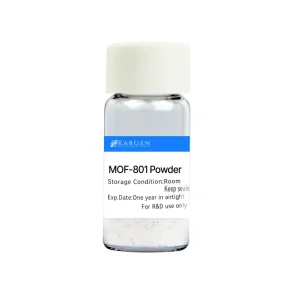
| MOF-808 | Zirconium / BTC | 1,600 – 2,000 | -[#00f2fe]--18.4 Å internal cage | Heavy Metal Capture (Pb, Hg), PFAS Removal, Catalysis | Ultra-high stability in strong acid/base environments |
Global Enterprise Procurement & Quality Compliance Standards
Ensuring seamless international regulatory compliance, environmental safety, and logistical security.
International B2B procurement demands strict adherence to global chemical safety regulations, material traceability, and packaging protocols. As a leading exporter of metal-organic frameworks, KARGEN guarantees complete standard documentation for every shipment:
- Comprehensive Analytical Certificates (CoA): Every shipment includes lot-specific Powder XRD spectra, Nitrogen Isotherm BET surface area plots, SEM micro-morphology photos, and ICP-OES elemental purity analyses.
- Regulatory & Environmental Approvals: Full compliance with EU REACH, RoHS directive, GHS-compliant Safety Data Sheets (SDS), and ISO 9001:2015 quality management certifications.
- Custom Packaging & Logistics Security: Moisture-proof vacuum sealing, inert gas purging for air/moisture-sensitive frameworks (such as HKUST-1), UN-approved hazardous/non-hazardous transport packaging, and express air/ocean freight logistics to over 60 countries.
- Flexible OEM / ODM Custom Synthesis: Tailored linker functionalization (-NH₂, -NO₂, -SO₃H, -OH), specific particle size distribution milling (nanometer to micron scale), and pre-dispersed liquid formulations in water, ethanol, NMP, or custom organic solvents.
Extended Metal-Organic Framework Portfolio
Discover specialized iron, chromium, zirconium, and aluminum framework series for advanced research and scaled industrial applications.







Frequently Asked Questions (FAQ)
In-depth engineering and procurement guidance for technical teams and strategic purchasers.