
High-Performance MOF Materials for Energy HVAC & Sorption Systems
Explore our primary ton-scale MOF powders engineered for heat pump integration, desiccant cooling wheels, and atmospheric moisture control.







The Paradigm Shift in High-Quality Energy Air Conditioning Systems
Modern commercial real estate, data centers, and advanced manufacturing complexes face an unprecedented energy crisis. Traditional vapor-compression refrigeration systems account for nearly 20% of global electricity consumption in buildings. Under global decarbonization frameworks—such as the European EcoDesign Directive, US Title 24, and global Net-Zero target commitments—HVAC OEMs must look beyond incremental mechanical compressor tweaks to structural material-level breakthroughs.
Thermodynamic Inefficiency of Traditional Cooling
Standard chillers cool air to 5°C–7°C to condense water vapor, only to re-heat the air to 18°C–22°C for occupant comfort. This double energy penalty burns vast operational budgets and drives up peak electricity demand.
Desiccant-Assisted Latent Load Decoupling
By coating heat exchangers or rotor wheels with porous Metal-Organic Frameworks (MOFs), ambient humidity is captured passively via physisorption. Chilled water temperatures can be elevated from 7°C to 16°C, boosting compressor COP by up to 40%.
Low-Grade Thermal Energy Harvesting
Conventional silica gel requires high desorption temperatures (120°C+). Engineered MOF crystals regenerate at unprecedented low thermal limits (50°C–70°C), making solar-thermal or server waste heat sufficient for continuous cycle driving.
Metal-Organic Frameworks: The Quantum Leap in Sorption Cooling
Metal-Organic Frameworks (MOFs) are ultra-porous crystalline materials composed of metal nodes coordinated with organic linkers. Their ultra-high BET surface area (exceeding 2,000–6,000 m²/g) and custom-tunable pore geometry enable step-shaped moisture adsorption isotherms ideal for energy-efficient climate control.
| Material Grade | Metal Node / Organic Linker | BET Surface Area (m²/g) | Water Uptake (g/g) | Regeneration Temp (°C) | Primary HVAC & Industrial Application |
|---|---|---|---|---|---|
| Al-FUM MOF | Aluminium / Fumarate | 1,100 - 1,300 | 0.45 - 0.52 | 60 - 70°C | Low-temp desiccant wheels & adsorption chillers |
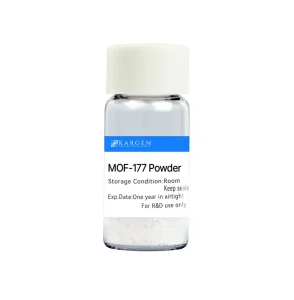
| MOF-801 | Zirconium / Fumarate | 900 - 1,050 | 0.38 - 0.42 | 65 - 75°C | Arid region atmospheric water harvesting & HVAC dehumidification |
| ZIF-8 (Mechanochemical) | Zinc / 2-Methylimidazole | 1,600 - 1,800 | Hydrophobic / Selective Gas | N/A (Gas separation) | HVAC trace chemical VOC filtration & hydrocarbon capture |
| UiO-66 | Zirconium / Terephthalate | 1,200 - 1,400 | 0.35 - 0.40 | 80 - 90°C | High-durability chemical plant air purification & catalysis |
| MIL-100(Al) | Aluminium / BTC | 1,800 - 2,100 | 0.65 - 0.75 | 70 - 80°C | High-capacity thermal energy storage & industrial sorption systems |
As a world-leading manufacturer with a 10,000 m² R&D center, Guangdong Advanced Carbon Materials Co., Ltd. (KARGEN) utilizes proprietary scalable mechanochemical synthesis routes to lower production cost by 60%, delivering metric-ton reliability for international HVAC OEM suppliers and system integrators.
Localized Application Scenarios & Energy Savings
From tropical high-humidity commercial towers to hyperscale AI data center heat rejection, energy-saving air conditioning systems powered by MOF materials deliver tailored environmental control.
Commercial High-Rise HVAC Systems
Coating cooling coils with Al-FUM MOFs allows commercial heat pumps to run at elevated evaporator temperatures. This cuts annual electricity budgets in tropical regions (e.g., Southeast Asia, Middle East, US Gulf Coast) by 35%–50%.
AI Data Centers & Chip Fabs
Hyperscale server racks discharge large amounts of waste heat at 50°C–65°C. MOF-based sorption chillers capture this zero-cost waste heat to generate chilled water for direct liquid cooling, dramatically improving PUE (Power Usage Effectiveness).
Pharmaceutical & Lithium Cleanrooms
Lithium-ion battery dry rooms require ultra-low dew points (-40°C). Conventional silica gel desiccant wheels consume immense electrical re-heat energy. MOF-coated desiccant rotors achieve low dew points at lower regeneration energy costs.
10-Year Technology Roadmap: The Next Era of Zero-Carbon HVAC
Our R&D leadership team (comprising PhD scholars from US, German, and Swedish institutes) outlines the evolution of energy air conditioning technology.
Direct MOF-Heat Exchanger Coating
Commercialization of dip-coated finned-tube exchangers utilizing binder-free Al-FUM and ZIF suspensions for hybrid rooftop AHUs and VRF systems.
Continuous Regenerative MOF Rotors
Integration of ultra-thin MOF membranes into continuous rotary enthalpy wheels, allowing 60°C waste-heat driven continuous dehumidification.
Solid-State Thermoelectric MOF Chillers
Complete elimination of mechanical compressors through solid-state MOF heat pumps that cycle water vapor using solar thermal or low-grade waste energy.
Global Supply Chain Reliability & Compliance Assurance
When sourcing advanced nanomaterials for international air conditioning export lines, consistency, batch-to-batch purity, and international chemical compliance are non-negotiable.
Digital Batch Traceability
Every shipment comes with PXRD (Powder X-ray Diffraction) crystallographic verification, BET surface area plots, and TGA thermal stability certificates certified by our digital quality inspection system.
Global Regulatory Compliance
All KARGEN MOF formulations comply with EU REACH regulations, US TSCA chemical substance inventory, RoHS Directive compliance, and ISO 9001/14001 international standards for sustainable industrial supply.
OEM / ODM Custom Formulation
We provide tailor-made particle sizing, micro-granulation, coating slurries, and active polymer dispersions to seamlessly integrate with your existing heat exchanger production line processes.
Specialized MOF Powders & Porous Materials for Industrial Export
View our extended series of specialized metal-organic frameworks for hydrocarbon adsorption, selective gas separation, and advanced thermal management.




Frequently Asked Questions for HVAC OEMs & Energy System Engineers
Get immediate technical clarity regarding MOF integration, sample procurement, thermal durability, and ton-scale export logistics.
How do MOF-coated heat exchangers improve energy efficiency in air conditioning systems?
MOF materials possess ultra-high microporosity and steep water adsorption isotherms. When applied directly onto aluminum cooling fins, the MOF absorbs atmospheric water vapor without needing cooling water below the dew point. This allows HVAC systems to separate latent cooling (dehumidification) from sensible cooling (temperature drop), raising the chiller evaporating temperature from 5°C to 15°C+ and lowering overall compressor power consumption by 30% to 50%.
Can KARGEN provide 1–5 g evaluation samples for laboratory testing and feasibility studies?
Yes. We offer complimentary 1–5 g evaluation samples of standard grades (including ZIF-8, Al-FUM, MOF-801, and UiO-66) to qualified corporate R&D teams and academic research labs. Buyers only cover international express shipping. Custom OEM modification or targeted pore engineering is supported at pilot scale.
What temperature is required to regenerate Al-FUM or MOF-801 in desiccant cooling wheels?
Unlike traditional silica gel or synthetic zeolites that require high heat (120°C–150°C), KARGEN Al-FUM and MOF-801 desiccant formulations undergo complete thermal desorption at just 60°C to 75°C. This enables direct integration with solar thermal collectors, heat pump condenser waste heat, or industrial waste heat streams.
What is KARGEN's production capacity and lead time for ton-scale industrial orders?
KARGEN operates a 10,000 m² advanced material manufacturing base in Zhuhai, Guangdong, equipped with mass-production lines capability reaching ton-scale supply. Standard catalog items ship within 3–5 business days, while bulk industrial contracts ship within 2–3 weeks following digital COA quality sign-off.
How resistant are MOFs to cyclic hydrothermal aging in high-humidity climates?
Engineered aluminum fumarate (Al-FUM) and zirconium-based frameworks (UiO-66, MOF-801) demonstrate exceptional hydrothermal stability, retaining >95% water sorption capacity even after 10,000 continuous adsorption-desorption cycles under extreme relative humidity (90% RH).
What physical product forms are available for immediate OEM export?
We supply MOF materials as fine micro-powders (adjustable particle size from 500 nm to 50 μm), aqueous or solvent-based slurry dispersions, extruded pellets/granules for packed-bed reactors, and structured coatings ready for direct application onto heat exchanger surfaces.