
Precision Engineered Nanomaterial Powders
Industrial-grade, high-surface-area metal-organic framework powders synthesized with rigorous stoichiometry, verified PXRD crystallinity, and scalable batch consistency.






The Global Scale-Up of Advanced Nanomaterials
Transitioning precision synthesis from academic benchtop discovery to reliable, high-yield commercial manufacturing.
The global demand for high-performance nanomaterials suppliers has reached a pivotal juncture. Historically constrained to gram-scale academic synthesis, nanostructured frameworks—specifically Metal-Organic Frameworks (MOFs), Zeolitic Imidazolate Frameworks (ZIFs), and Covalent Organic Frameworks (COFs)—are rapidly migrating into high-volume industrial supply chains.
Driven by urgent global mandates for net-zero carbon infrastructure, ultra-pure semiconductor gases, and advanced thermal management, commercial entities require manufacturing partners capable of delivering metric-ton volumes without compromising structural integrity or batch-to-batch surface area metrics.
Navigating the transition from benchtop solvothermal synthesis to continuous industrial production presents unique chemical engineering hurdles. It demands precise control over crystal nucleation rates, solvent recovery kinetics, and thermal activation protocols. Top-tier manufacturers bridge this gap through proprietary mechanochemical routes and continuous-flow crystallization systems.
Industrial Benchmark Metrics
Our manufacturing protocols guarantee rigorous quality control standards across all synthesized framework batches:
- BET Surface Area Retention: Over 95% theoretical yield preservation.
- Batch-to-Batch Crystallinity: Verified via Powder X-Ray Diffraction (PXRD).
- Residual Solvent Control: Volatiles reduced to < 0.5 wt% via vacuum degassing.
- Scalability Factor: Uniform morphology across 1 kg evaluation lots to 5-ton contract runs.
Macro Industry Solutions Powered by Engineered Nanomaterials
Targeted material solutions engineered to resolve complex thermodynamic and separation bottlenecks across core global industries.
Point-Source CO₂ Capture & DAC
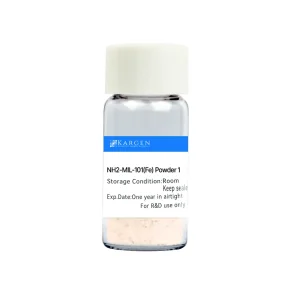
Custom hydrophobic ZIFs and amine-functionalized MIL frameworks (e.g., NH2-MIL-101(Fe), KAUST-7) provide extreme selectivity for CO₂ adsorption over N₂ and H₂O. Designed for low regeneration energy demands in post-combustion flue gas processing and Direct Air Capture (DAC) systems.
Atmospheric Water Harvesting & HVAC
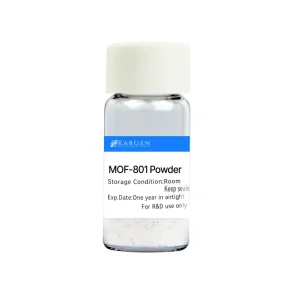
Hydrothermally resilient frameworks like Al-FUM and MOF-801 display characteristic S-shaped water sorption isotherms. They capture potable water from low-humidity desert air using ambient solar heat for thermal desorption, while dramatically cutting latent cooling loads in industrial HVAC units.
Lithium-Ion Battery Separator Coatings
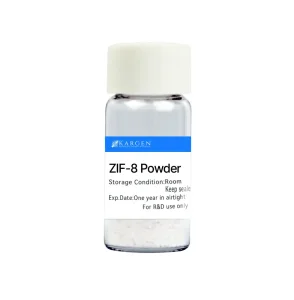
Integrating ultra-fine ZIF-8 and ZIF-67 nanodispersions into battery separators yields enhanced thermal resistance, uniform ion flux, and dendrite suppression. Micro-porous channels act as selective traps for cathode metal dissolution products, significantly extending EV battery cycle life.
Semiconductor Gas Purification
Frameworks with tailored pore apertures, such as TYUT-12 and HKUST-1, enable sub-ppm gas purification. They selectively isolate difficult hydrocarbon mixtures (e.g., C2H6/C2H4 separation) and safely store sub-atmospheric toxic hydride gases used in semiconductor microchip fabrication.
Catalytic Pollutant Remediation
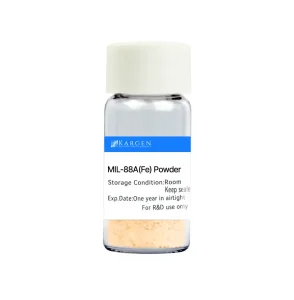
Iron-based, non-toxic MOFs (MIL-100(Fe), MIL-88A(Fe)) function as heterogeneous Fenton-like catalysts for wastewater treatment. They rapidly break down persistent pharmaceutical residues, industrial dyes, and organic pollutants under mild ambient conditions.
Solid-State Hydrogen & Methane Storage
High-pore-volume networks like MOF-5 deliver exceptional volumetric storage capacities for clean fuel transportation. By reducing operational pressures required for gas containment, MOFs enable safer, lighter-weight storage solutions for hydrogen mobility.
Precision Nanomanufacturing & Strategic Roadmap
Combining green mechanochemical processing with automated high-throughput synthesis to define the future of advanced materials production.
Green Mechanochemistry vs. Solvothermal Manufacturing
Traditional MOF production relies on large solvent volumes (DMF, DEF, Methanol) under hydrothermal pressures, presenting cost and environmental barriers. Modern industrial scale-up utilizes solvent-free or liquid-assisted mechanochemical milling.
This transition yields key benefits for bulk buyers:
- 90% Reduction in Organic Solvent Waste: Significantly lowers environmental impact and overhead.
- Enhanced Space-Time Yields (STY): Reaches STYs exceeding 1,000 kg/m³/day.
- Narrow Particle Size Distribution (PSD): Produces uniform crystals ideal for extrusion, pelletization, and membrane casting.
Post-Synthesis Activation & Form Factor Processing
Formulating crystalline powders into robust industrial shapes (pellets, monoliths, honeycomb structures, or membrane coatings) requires expert binder integration to prevent pore blockage.
Our engineering facility utilizes specialized thermal-vacuum activation chambers that preserve intrinsic microporosity while formulating materials into handling formats tailored to industrial reactors and packed beds.
Technology Roadmap: 2025 to 2035
2025 - 2027: Automated High-Throughput Screening
Integration of AI-driven atomistic simulation models with continuous flow microfluidic reactors to accelerate custom MOF formulation from months to days.
2028 - 2030: Zero-Solvent Industrial Scale-Up
Transitioning 100% of core standard MOF product lines (ZIF-8, Al-FUM, HKUST-1) to solid-state mechanochemical continuous extrusion manufacturing.
2031 - 2035: Hybrid Structured Composites & Monoliths
Commercial deployment of 3D-printed structured MOF monoliths for megaton-scale Direct Air Capture installations and solid-state battery electrolytes.
Export Controls, Compliance & Technical Validation
Ensuring seamless international procurement through rigorous analytical documentation, global compliance certifications, and dedicated engineering support.
Regulatory Assurance
Full compliance with international chemical safety standards, including EU REACH registration, US TSCA inventory compliance, OSHA SDS documentation, and RoHS/REACH environmental safety declarations.
Analytical Verification
Every commercial lot is accompanied by detailed Certificate of Analysis (COA) documentation, including Argon/N2 adsorption isotherms (BET surface area), TGA thermal degradation profiles, and high-resolution SEM crystal morphology imaging.
Localized Supply Logistics
Streamlined logistics channels support door-to-door delivery across North America, Europe, and Asia-Pacific. Sample evaluation kits (1–5g) are dispatched within 48 hours for rapid R&D qualification.
Frequently Asked Questions
Expert insights regarding procurement, customization, structural stability, and industrial deployment of metal-organic frameworks.
How do you ensure batch-to-batch consistency for ton-scale orders?
Our production facilities utilize automated continuous monitoring of reaction temperature, mixing shear rates, and precursor feed stoichiometry. Every synthesized lot undergoes Powder X-Ray Diffraction (PXRD) to confirm phase purity, along with N₂ physisorption testing at 77K to ensure the BET surface area remains strictly within a ±3% tolerance spec.
Which MOF structures are best suited for high-moisture environments?
Frameworks such as ZIF-8 (zinc imidazolate) and Al-FUM (aluminum fumarate) exhibit exceptional hydrothermal stability. ZIF-8 is naturally superhydrophobic, making it ideal for gas separations in humid streams, whereas Al-FUM offers reversible water sorption dynamics without structural degradation across thousands of adsorption-desorption cycles.
Can you provide custom MOF synthesis under OEM/ODM non-disclosure agreements?
Yes. Our scientist-led R&D division works directly with corporate partners to custom-synthesize proprietary linkers, metal nodes, and tailored pore sizes. We offer complete OEM/ODM support under strict confidentiality agreements, scaling material recipes seamlessly from laboratory screening to industrial volume supply.
What options are available for shaping and forming raw MOF powders?
Raw MOF powders can cause high pressure drops in industrial gas columns. To address this, we supply materials formulated as extruded pellets, spherical beads, liquid dispersions, or coated onto porous substrate sheets using specialized binder systems designed to preserve intrinsic surface porosity.
What standard lead times apply for evaluation samples versus bulk supply?
Standard product evaluation samples (1–5g) ship within 2 business days. Metric-ton supply contracts are fulfilled based on tailored schedules, with standard dispatch windows ranging from 2 to 4 weeks depending on the target framework synthesis complexity and custom activation specs.
How should MOF powders be stored to prevent loss of activity over time?
MOFs should be stored in their original sealed double-PE lined containers under dry, ambient conditions away from direct atmospheric moisture and corrosive vapors. Activated samples exposed to air can be regenerated using standard thermal vacuum degassing protocols prior to industrial deployment.
Specialized & Application-Specific MOF Products
Explore our comprehensive lineup of catalytic, gas-selective, and environmental-remediation framework formulations.



Accelerate Your Nanomaterial Development Project
Partner with China's premier manufacturer of high-quality metal-organic frameworks and advanced nanostructured materials. Request sample lots or consult directly with our application scientists today.