
High-Purity Metal-Organic Framework Products (Part 1)
Precision-synthesized MOF powders engineered for specific pore-size distribution, catalytic reactivity, and sorptive selectivity.






The Architecture of Metal-Organic Framework Databases: Bridging Digital Intelligence & Ton-Scale Manufacturing
How high-throughput computational screening, crystallographic metadata, and industrial-scale synthesis are resolving the commercialization bottleneck of advanced reticular materials.
Metal-Organic Frameworks (MOFs)—a class of porous crystalline polymers synthesized through the self-assembly of inorganic metal nodes (secondary building units, SBUs) and organic linkers—represent a step-change in chemical separation, carbon capture, molecular storage, and heterogeneous catalysis. With record-breaking internal surface areas exceeding 7,000 m²/g, ultra-high micropore void fractions (up to 90%), and atomistic tailorability, MOFs bypass the fundamental selectivity-permeability trade-offs that constrain legacy adsorbents such as activated carbons, zeolites, and silica gels.
However, the sheer combinatorial vastness of reticular chemistry presents a unique dilemma. With over 100,000 synthesized structures registered in databases such as the Cambridge Structural Database (CSD) and millions of hypothetical frameworks modeled via computation, bridging the gap between computational discovery and commercial procurement requires a centralized, high-fidelity Metal Organic Framework Database Service. As leading enterprise exporters, KARGEN (Guangdong Advanced Carbon Materials Co., Ltd.) integrates empirical structural informatics, thermodynamic binding data, and mechanochemical pilot scaling to deliver turnkey material solutions to global chemical, automotive, HVAC, and energy enterprises.
Information Gain Note: The Computation-to-Commodity Pipeline
Traditional material sourcing relies on trial-and-error laboratory experiments. Modern industrial procurement utilizes standardized MOF property databases containing Grand Canonical Monte Carlo (GCMC) molecular simulations, Density Functional Theory (DFT) binding energy metrics, and experimentally verified hydrothermal stability curves. This empirical intelligence reduces research and development risk from years to weeks.
Structural Parameters & Quantitative Selection Metrics
A reliable MOF database exporter must provide validated physical, chemical, and thermodynamic metrics across distinct operational envelopes.
Pore Geometry & Textural Physics
Structural database entries must record exact crystallographic parameters verified by Powder X-Ray Diffraction (PXRD) and high-precision N₂ / Ar adsorption isotherms.
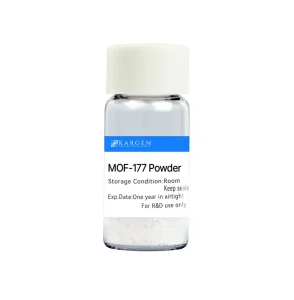
- Brunauer-Emmett-Teller (BET) Area: Range from 800 m²/g (ZIF-8) to >3000 m²/g (MOF-177).
- Pore Limiting Diameter (PLD): Aperture sizes controlling molecular sieving (3.4 Å to 18 Å).
- Largest Cavity Diameter (LCD): Internal cage dimensions governing volumetric guest capacity.
Thermodynamics & Adsorption Kinetics
Quantitative database profiling predicts breakthrough dynamics and parasitic energy ratios during thermal or pressure swing regeneration cycles.
- Isosteric Heat of Adsorption ($Q_{st}$): Binding enthalpy for CO₂, H₂O, or CH₄ molecules.
- Henry’s Law Selectivity: Low-pressure gas separation ratios ($CO_2/N_2, C_2H_4/C_2H_6$).
- Regeneration Energy Profile: Thermal desorption thresholds ($60^\circ\text{C}$ to $150^\circ\text{C}$).
Stability & Environmental Robustness
Standardized database classification guarantees industrial lifetime integrity under humid, acid gas, and thermal stress conditions.
- Hydrothermal Tolerance: Phase retention after exposure to 90%+ RH steam cycling.
- Thermal Decomposition ($T_{dec}$): TGA-verified stability limits in inert/air atmospheres.
- Chemical Resistance: Stability limits across aggressive pH ranges (pH 1 to pH 13).
Benchmark Industrial MOF Specifications Matrix
The following empirical matrix demonstrates the physical property catalog compiled within KARGEN’s high-quality database service for core industrial frameworks:
| MOF Architecture | Metal Node / Organic Linker | BET Surface Area (m²/g) | Pore Aperture (Å) | Primary Industrial Vector |
|---|---|---|---|---|
| ZIF-8 | Zn / 2-Methylimidazole | 1,300 – 1,800 | 3.4 (Microporous) | Li-ion battery separators, CO₂ capture, hydrophobic catalysts |
| Al-FUM | Al / Fumaric Acid | 900 – 1,200 | 5.8 x 6.0 | Atmospheric water harvesting, desiccant HVAC cooling |
| HKUST-1 (Cu-BTC) | Cu / Trimesic Acid | 1,500 – 2,100 | 9.0 x 9.0 | High-density gas storage, specialty gas filtration |
| MIL-101(Fe) / NH₂-MIL | Fe / Aminoterephthalic Acid | 2,200 – 3,400 | 12 – 16 (Mesoporous) | Fenton catalysis, environmental remediation, drug delivery |
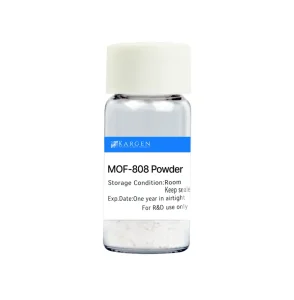
| MOF-808 | Zr / Trimesic Acid | 1,600 – 2,200 | 18.4 (Cluster void) | Heavy metal remediation, acid-catalyzed organic conversions |
Reticular Materials Development & Industrialization Horizon
Strategic technological trajectory transitioning from batch solvent synthesis to continuous green manufacturing, automated digital twins, and structured monolithic form factors.
Phase I: Green Mass Production (Current Era)
Eliminating toxic organosolvents (DMF, DEF) in favor of solvent-free mechanochemical ball milling and continuous aqueous flow crystallization.
- Ton-scale mechanochemical synthesis lowering production costs by >60%.
- Closed-loop aqueous solvent recovery yielding 98%+ recycling efficiency.
- Impurity suppression ensuring XRD phase purity without activation residue.
Phase II: AI & Generative Design (2026–2029)
Integrating generative machine learning models with automated high-throughput synthesis robotics to fast-track novel linker synthesis.
- Machine learning predictive models for gas selectivity and lifetime degradation.
- Automated ligand functionalization matching specific targeted toxic gas motifs.
- Database-driven structural tuning for high-temperature wet gas stream operations.
Phase III: Monolithic Engineering (2030+)
Moving away from microcrystalline powders toward highly structured, low-pressure-drop physical monolithic formats.
- 3D-printed honeycomb MOF monoliths for direct air capture (DAC) contactors.
- MOF-polymer mixed-matrix membranes (MMMs) for gas and solvent pervaporations.
- Washcoated metallic heat-exchangers for high-efficiency sorption cooling cycles.
Turnkey Industrial Paradigms Powered by Database Sourcing
Deploying targeted framework chemistries to solve mission-critical operational challenges across global sectors.
1. Carbon Capture, Utilization & Storage (CCUS & DAC)
Traditional amine scrubbing systems incur high parasitic energy loads, consuming up to 3.5 to 4.5 GJ/ton of captured CO₂ during thermal regeneration. Database-selected MOFs (such as ZIF-8, MOF-303, and modified Al-FUM) transform carbon management kinetics:
- Low Regeneration Temperature: Full desorption achieved between 70°C and 105°C, enabling utilization of low-grade industrial waste heat.
- Humid Flue-Gas Resilience: Selective CO₂ adsorption over H₂O and N₂ avoids competitive pore clogging in real-world combustion streams.
- Superior Working Capacity: Maintains up to 4.5 mmol/g dynamic CO₂ capacity under cyclic swing operations.
2. Next-Gen Energy Storage & Battery Interlayers
As EV battery energy density increases, dendrite formation and electrolyte thermal breakdown remain significant safety barriers. KARGEN MOF database solutions support energy storage manufacturers:
- Separator Coatings: Ultrathin ZIF-8 layers regulate lithium-ion flux, ensuring uniform ion transport and suppressing dendrite nucleation.
- Solid-State Electrolytes (SSE): MOFs act as molecular matrix fillers, immobilizing liquid anions while enhancing ionic conductivity above $10^{-3}\text{ S/cm}$.
- Transition-Metal Trapping: Functionalized MOF cages sequester dissolved manganese/cobalt ions, protecting the graphite anode SEI layer.
3. Atmospheric Water Harvesting & Ultra-Low Power HVAC
Air-to-water extraction in hyper-arid regions (10–30% relative humidity) demands sorbents with steep S-shaped water uptake isotherms. Utilizing hydrothermally stable frameworks like Al-FUM and MOF-801:
- Arid Zone Yields: Harvests up to 1.3 liters of potable water per kilogram of MOF daily using natural solar heat for desorption.
- HVAC Latent Load Reduction: MOF desiccant dehumidification wheels handle moisture loads independently, lowering air-conditioning electrical consumption by >50%.
4. Petrochemical Hydrocarbon & Specialty Gas Purification
Cryogenic distillation of light olefins and paraffins (e.g., ethylene/ethane, propylene/propane) is heavily energy-intensive. Database-guided MOF adsorbents enable ambient molecular sieving:
- Olefin Selectivity: Open Metal Site (OMS) MOFs like HKUST-1 and TYUT-12 achieve high-purity single-pass olefin separation.
- Semiconductor Gas Scrubbing: Traps sub-ppm trace corrosive acid gases ($H_2S, SO_2, NH_3$) in microelectronics fabrication environments.
China Factory 4.0: Supply Chain Resilience & Efficiency Advantages
Combining proprietary process engineering with scalable manufacturing to make high-grade MOFs economically viable for global industries.
For over two decades, the industrial deployment of MOFs was hindered by astronomical material costs—often exceeding $5,000 to $10,000 per kilogram for laboratory-grade powders. KARGEN’s state-of-the-art 10,000 m² R&D and automated manufacturing facility in Zhuhai, Guangdong, has fundamentally rewritten the global supply curve, reducing commercial MOF pricing to scale-ready industrial levels.
Integrated Linker Supply
Direct supply-chain integration with core chemical precursors (fumaric acid, imidazole, BTC, BDCA) guarantees raw material security and cost stability.
Digital Batch Control
Automated SCADA reaction Monitoring records pressure, temperature, shear, and pH curves for every batch, delivering complete lot-to-lot traceability.
Strategic Port Logistics
Situated within the Greater Bay Area tech corridor, KARGEN provides seamless air and sea freight execution through Hong Kong, Shenzhen, and Guangzhou ports.
By leveraging solvent-free continuous mechanochemical ball-milling technologies, KARGEN eliminates huge energy costs associated with traditional high-pressure solvothermal synthesis. Our production lines maintain a annual capacity exceeding hundreds of metric tons, ensuring that downstream international OEM partners receive dependable supply schedules without bottleneck risks.
Global Enterprise Sourcing & Tailored OEM/ODM Scale-Up Framework
A structured four-stage evaluation methodology designed to lower technical risk for overseas procurement teams and R&D directors.
Phase 1: Database Matching & Theoretical Screen
Customers submit target gas compositions, operating temperature/pressure envelopes, and target selectivity specs. Our application scientists match customer requirements against our empirical database to select optimal framework structures.
Phase 2: 1–5 g Validation Sample Provision
Qualified B2B enterprises receive 1–5 gram evaluation samples alongside comprehensive Certificate of Analysis (COA) documentation, PXRD phase spectra, Nitrogen BET surface area verification, and TGA decomposition charts.
Phase 3: Kilogram-Scale Pilot Customization
For OEM applications requiring specific particle size distributions ($50\text{ nm}$ nanoparticles to $50\text{ }\mu\text{m}$ micro-granules), binder formulations, or liquid dispersions, our pilot lines produce test lots for system integration trials.
Phase 4: Ton-Scale Commercial Supply
Upon pilot validation, production transitions to dedicated automated lines under strict quality control terms, backed by multi-year commercial supply contracts and locked pricing models.
Regulatory Oversight, Safety Standards & International Logistics Support
Navigating global chemical compliance framework mandates to guarantee smooth cross-border customs clearance and workplace safety handling.
Exporters of advanced nanoporous materials must meet strict international regulatory standards. KARGEN ensures that all export-grade Metal-Organic Framework materials comply fully with destination-country chemical inventory protocols and environmental protection laws:
REACH & TSCA Compliance
Registration support under EU REACH, US TSCA, and regional regulatory bodies for volume-based chemical exports.
Inert Specialized Packaging
Moisture-proof, vacuum-sealed aluminum foil barrier bags packaged inside UN-certified fiber drums with desiccant indicators.
Complete Safety Dossiers
Full 16-section Safety Data Sheets (SDS) in multiple languages according to GHS standards, alongside transport hazard certificates.
In addition, KARGEN holds ISO 9001 (Quality Management Systems), ISO 14001 (Environmental Management Systems), and ISO 45001 (Occupational Health and Safety) certifications, ensuring our export partners receive products manufactured under globally recognized industrial management standards.
Frequently Asked Questions (FAQ)
Addressing core technical, logistical, and database sourcing questions from global chemical engineers and procurement officers.
How does KARGEN’s Metal Organic Framework Database Service benefit our R&D team?
Our database service provides empirical, experimentally verified crystallographic, thermodynamic, and kinetic data (BET surface area, PXRD pattern, isotherm curves, and heat of adsorption) for over 40 synthesized MOF grades. This allows your scientists to pre-screen candidate materials digitally, cutting physical sample testing timelines by up to 80%.
What sample evaluation program is available for enterprise clients?
We provide 1–5 gram evaluation samples free of charge to qualified corporate application development teams. The client covers shipping and customs duties. Each sample shipment includes a batch-specific Certificate of Analysis (COA) containing BET, PXRD, and TGA data.
Can KARGEN produce custom MOFs under strict NDA / OEM / ODM arrangements?
Yes. Over 60% of our R&D staff hold Master’s or Ph.D. degrees in materials chemistry. We collaborate with over 70 research institutions to scale proprietary linker-metal combinations from milligram screening to multi-ton industrial batches under full non-disclosure protection.
What physical supply formats are available for bulk exports?
We supply standard MOFs as micronized dry powders, engineered pellet extrudates, granular aggregates, or stable liquid dispersions (water, ethanol, or organic solvents) tailored for direct incorporation into battery separator slurries or polymer membranes.
How are moisture-sensitive MOFs protected during international freight delivery?
Moisture-sensitive grades (such as HKUST-1) are vacuum-sealed inside multi-layer aluminum barrier bags containing inert gas flushes and moisture indicator strips before being sealed within UN-rated heavy-duty drum packaging.
What response turnaround can international buyers expect?
Our dedicated technical customer support team guarantees an initial technical response and product quotation within one business day, regardless of global time zone differences.
High-Purity Metal-Organic Framework Products (Part 2)
Explore our additional inventory of gas separation, water harvesting, and catalytic framework materials.




