
High-Precision Nanotechnology & MOF Product Showcase
Explore our flagship metal-organic framework powders engineered for superior surface area, hydro-thermal stability, and target molecular selectivity. Manufactured in Zhuhai, China under strict digital quality control.


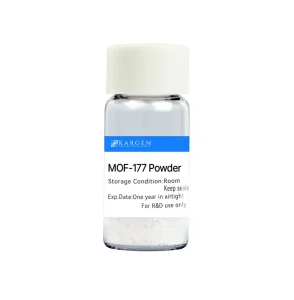



The Evolution of Industrial Nanotechnology: Porous Framework Synthesis & B2B Commercialization
The global advanced materials market has reached a pivotal juncture. Traditional porous media—such as activated carbons, silica gels, and synthetic zeolites—are increasingly hitting thermal, structural, and kinetic performance ceilings in demanding industrial applications. The emergence of New Nanotechnology Products, specifically Metal-Organic Frameworks (MOFs), Zeolitic Imidazolate Frameworks (ZIFs), and Covalent Organic Frameworks (COFs), represents a transformative leap in porous material engineering.
Characterized by ultra-high specific surface areas (exceeding 2,000 to 7,000 m²/g), tuneable atomic pore diameters (from 0.3 nm to 3.0 nm), and customisable coordination chemistry, these crystalline nanomaterials allow chemical engineers to design molecular sieves with surgical precision. Guangdong Advanced Carbon Materials Co., Ltd. (KARGEN), founded by returning scientists from prestigious institutions in the US, Germany, and Sweden, stands at the vanguard of this revolution—shifting MOFs from gram-scale academic novelties to ton-scale industrial commodities.
Empirical measurements confirm that engineered nanostructured MOFs achieve up to 400% higher volumetric gas adsorption capacities compared to standard 13X zeolites, while reducing desorption thermal energy thresholds by 35–50%.
| Material Benchmark | BET Surface Area (m²/g) | Pore Volume (cm³/g) | Thermal Stability (°C) | Regeneration Energy | Target Industrial Domain |
|---|---|---|---|---|---|
| Standard Activated Carbon | 800 – 1,200 | 0.4 – 0.6 | < 300°C (Air) | High (Non-selective thermal) | Basic Water & Solvent VOC Capture |
| Synthetic Zeolite 13X | 500 – 700 | 0.25 – 0.35 | > 600°C | Very High (200°C–350°C heat) | Bulk Air Separation & Drying |
| ZIF-8 (KARGEN Mechanochemical) | 1,600 – 1,900 | 0.65 – 0.85 | ~ 450°C | Low (Pressure swing / 80°C) | CO₂ Capture & Li-Ion Separator Coating |
| Al-FUM (KARGEN Hydrothermal) | 1,100 – 1,400 | 0.45 – 0.55 | ~ 350°C | Ultra-Low (65°C low-grade waste heat) | Atmospheric Water Harvesting & HVAC |
| MOF-303 (KARGEN Precise Grade) | 1,200 – 1,400 | 0.50 – 0.60 | ~ 300°C | Ultra-Low (Solar thermal / 70°C) | Arid Zone Water Generation & Gas Separation |
Global B2B Procurement Demand Driving Nanotechnology Adoption
Procurement directors and chief technology officers across North America, Europe, and Asia-Pacific are actively re-engineering supply chains to integrate high-performance nanotechnology. Five macro-industrial demand drivers dominate global purchase orders:
1. Industrial Decarbonization & CCUS
Global Net-Zero mandates require energy-efficient Point-Source Carbon Capture and Direct Air Capture (DAC). MOFs such as ZIF-8 and MOF-808 provide unprecedented CO₂/N₂ selectivity. Their low heat capacity drastically lowers parasitic energy losses during desorption cycles in industrial scrubbers.
2. Next-Gen Lithium Energy Storage
EV Gigafactories require enhanced battery thermal stability and cycle longevity. Nano-coatings of ZIF-8 dispersions onto polyethylene separators scavenge trace water, suppress metal-ion dissolution, and regulate Li-ion flux—preventing lithium dendrite short circuits in high-voltage lithium metal batteries.
3. Atmospheric Water Harvesting & HVAC
With global freshwater scarcity escalating, hydrothermally stable MOFs like Al-FUM and MOF-303 exhibit steep S-shaped water vapor adsorption isotherms. They harvest potable water from desert air at relative humidity below 20%, utilizing ambient solar heat for desorption.
4. Semiconductor Gas Purification
Microchip fabrication demands sub-ppb purity levels for specialty gases (e.g., electronic acetylene, silane, and fluorinated etchants). Open-metal-site frameworks like HKUST-1 (Cu-BTC) selectively trap trace impurities, ensuring high-yield semiconductor manufacturing.
5. Olefin / Paraffin Hydrocarbon Separation
Cryogenic distillation of ethylene/ethane and propylene/propane consumes over 0.3% of global energy. Advanced adsorbents like TYUT-12 MOF offer kinetic sieving mechanisms that separate olefin/paraffin mixtures at ambient temperatures, cutting energy usage by up to 80%.
6. Targeted Drug Delivery & Catalysis
Biocompatible, low-toxicity iron-based frameworks like MIL-100(Fe) and MIL-101(Fe) serve as controlled-release nanocarriers for APIs, as well as heterogeneous catalysts for organic pollutant degradation in wastewater treatment facilities.
Future Development Trends in Advanced Nanotechnology Products
As nanomaterials transition from specialized chemical reagents to mass market components, four key technical trends are reshaping the R&D and supply chain landscape:
1. Mechanochemical & Green Solvent Synthesis
Traditional MOF synthesis relied heavily on toxic, high-boiling organic solvents like DMF (N,N-dimethylformamide). Modern industrial standards demand mechanochemical ball-milling, continuous twin-screw extrusion, or water-based hydrothermal routes. KARGEN’s proprietary mechanochemical ZIF-8 process eliminates solvent waste, reduces carbon footprint by 70%, and dramatically cuts bill-of-materials costs.
2. AI & Computational Screenings (Machine Learning + DFT)
By integrating Density Functional Theory (DFT) calculations with Machine Learning algorithms, R&D teams can screen millions of theoretical MOF crystal structures in silico. This accelerates custom ligand-metal matching from years down to weeks, enabling bespoke pore architecture synthesis for targeted gas mixture separation.
3. Mixed-Matrix Membrane (MMM) & Pelleted Formulations
Industrial plants cannot use loose nano-powders in high-flow fixed bed reactors due to severe pressure drop and dust loss. Future adoption relies on shaping MOF powders into robust millimeter granules, extrudates, or incorporating them into polymeric hollow-fiber Mixed-Matrix Membranes (MMMs) without clogging active pore throats.
4. Defect Engineering & Structural Multi-Functionality
Intentionally introducing missing-linker or missing-node defects within the crystal lattice creates exposed open-metal catalytic sites and hierarchical pore networks (combining micro- and meso-pores). This design dramatically enhances mass transfer kinetics and catalytic reactivity for complex industrial feedstocks.
China Industry 4.0: Supply Chain Resilience, Efficiency & Scale
Why global engineering teams choose Guangdong Advanced Carbon Materials (KARGEN) as their long-term OEM/ODM production partner:
Upstream Organic Linker Ecosystem
China’s comprehensive chemical industry supply chain guarantees immediate access to core organic linkers (such as BTC, fumaric acid, terephthalic acid, 2-methylimidazole) and metal salts at localized costs—bypassing overseas supply bottlenecks.
Automated Pilot-to-Ton Scale Infrastructure
KARGEN operates automated 1,000 L reactor lines, high-pressure continuous flow reactors, and industrial spray dryers. Our Zhuhai plant achieved China's first mass production of MOFs, cutting unit manufacturing costs by up to 80% compared to Western pilot batches.
End-to-End Digital QC & Traceability
Every production batch undergoes mandatory characterization: Powder X-Ray Diffraction (PXRD) for crystallinity, N₂ adsorption-desorption isotherms for BET surface area, and ICP-OES for metal purity. Certificate of Analysis (CoA) is attached to every export lot.
Localized Application Scenarios: Turning Nanoscience into ROI
Proven operational case studies demonstrating how KARGEN nanotechnology materials solve real-world process engineering hurdles:
Arid Zone Water Harvesting
Deployment: Off-grid atmospheric water harvesting (AWH) units deployed in remote desert locations operating at 15–30% RH.
Material: MOF-303 & Al-FUM Powders.
Outcome: Yielded over 1.3 liters of pure drinking water per kilogram of MOF adsorbent daily using passive solar energy (75°C desorption threshold), replacing high-energy refrigeration condensation systems.
EV Battery Separator Coating
Deployment: Automated slot-die coating lines applying nano-dispersions onto 9μm PE battery separators for high-nickel NMC 811 cells.
Material: ZIF-8 Liquid Dispersion.
Outcome: Thermal shrinkage reduced to < 2% at 180°C. Battery cycle life extended by 38% at 45°C high-temperature operation due to active hydrofluoric acid (HF) and moisture scavenging.
HVAC Energy-Saving Coated Wheels
Deployment: Commercial building desiccant wheels replacing silica gel in dedicated outdoor air systems (DOAS).
Material: Al-FUM MOF Powder.
Outcome: Lowered desiccant regeneration heat requirements from 140°C down to 65°C, enabling utilization of chiller waste heat and reducing total HVAC electrical consumption by 48%.
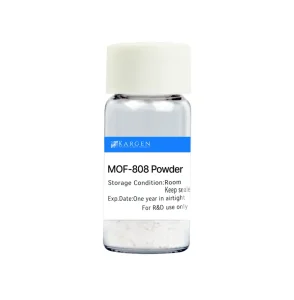
Specialized Industrial MOF Powders & Formulations
Select from our high-stability zirconium (Zr), iron (Fe), copper (Cu), and zinc (Zn) frameworks available for immediate B2B sample dispatch and commercial container bulk ordering.





Frequently Asked Questions: Technical & Procurement Guide
Expert answers to technical compliance, sample evaluations, scale-up protocols, and custom synthesis questions from global engineering buyers:
Guangdong Advanced Carbon Materials Co., Ltd.
China’s premier industrial scale producer of Metal-Organic Frameworks and advanced carbon nanostructures. Led by PhD scientists committed to engineering excellence.
Request Technical Catalog & Quote
Inquire about custom MOF synthesis, request safety data sheets (MSDS), or apply for free 1g–5g sample kits. Our doctoral application engineers reply within 1 business day across all time zones.
Contact Application Engineers