
🔬 High-Demand Nanomaterial Products for Kuwait Industrial Deployment
Engineered framework materials validated for gas sweetening, CO₂ capture, and water recovery in high-ambient temperature regions.




🏛️ Executive Whitepaper: The Advanced Materials Revolution in Kuwait
Strategic aligned insights supporting the State of Kuwait’s Vision 2035 ("New Kuwait") through sustainable chemical processing, gas separation, and low-energy industrial sorption.
⚙️ Kuwait's Industrial Realities & Sorbent Requirements
The State of Kuwait represents one of the world's most demanding operational environments for industrial porous materials and solid sorbents. With summer ambient temperatures routinely surpassing 50°C (122°F) and heavy reliance on energy-intensive hydrocarbon processing, crude oil refining (KNPC / KOC facilities), and seawater desalination, the regional demand for highly resilient advanced materials has grown exponentially.
Traditional separation technologies—such as liquid amine scrubbing for sour gas sweetening or cryogenic distillation for hydrocarbon fractionation—incur substantial parasitic energy loads. Metal-Organic Frameworks (MOFs) and porous coordination polymers offer a paradigm shift. Featuring unprecedented surface areas exceeding 6,000 m²/g, customizable pore geometries, and tunable chemical selectivity, MOF powders provide a low-energy solution tailored for Kuwait’s upstream and downstream industrial operators.
🌐 Exporter Expertise & Quality Standards
As a global pioneer in ton-scale MOF manufacturing, our facility bridges the gap between academic innovation and scalable industrial supply. Serving industrial buyers across Kuwait City, Shuaiba Industrial Area, Mina Al-Ahmadi, and Mina Abdulla, we maintain strict adherence to international quality management systems (ISO 9001:2015, REACH, and RoHS compliance).
Every batch delivered to the Kuwait market undergoes rigorous characterization, including powder X-ray diffraction (PXRD) phase verification, nitrogen gas sorption BET surface area measurements, thermogravimetric analysis (TGA) for thermal stability limits, and hydrothermal cycling tests. Our export logistics network ensures seamless freight customs clearing through Kuwait’s major sea portals (Shuwaikh Port and Shuaiba Port) with full climate-controlled containerized shipping.
📈 Global & Regional Market Performance Dynamics
Quantifiable operational benchmarks achieved through engineered metal-organic framework deployments in Middle Eastern climate conditions.
Addressing Kuwait's Micro-Climate & Gas Separation Challenges
The global market for advanced solid adsorbents is shifting rapidly from conventional Zeolites and Activated Carbons toward custom-synthesized crystalline frameworks. In the Middle East—and Kuwait specifically—this transition is driven by three key macroeconomic imperatives:
- Desalination & Water Security: Atmospheric Water Harvesting (AWH) using ultra-hydrophilic frameworks (such as MOF-303 and Al-FUM) enables localized potable water generation from air even at ambient relative humidity under 30%.
- De-carbonization of Oil & Gas Operations: Selective CO₂ capture sorbents (such as MOF-74(Mg) and KAUST-7) remove carbon dioxide directly from natural gas stream heads and refinery flue gas with minimal heat regeneration requirements.
- HVAC Latent Load Reduction: Coating heat exchanger fins with thermally robust MOF sorbents lowers moisture content prior to chillers, cutting commercial building cooling power consumption across Kuwait City by up to 40%.
🚀 Technology Roadmap: Advanced Sorbents for Kuwait Vision 2035
A strategic technological outlook mapping material synthesis capabilities to industrial de-carbonization milestones.
1️⃣ Phase I: Mechanochemical Scale-Up
Transitioning from solvent-heavy solvothermal synthesis to eco-friendly, continuous mechanochemical ball-milling. This drastically reduces unit costs for high-volume frameworks like ZIF-8 and ZIF-67, rendering mass adoption feasible for Kuwait's heavy industries.
2️⃣ Phase II: Direct Structured Pellets
Formulating raw MOF powders into robust micro-extruded pellets, honeycombs, and metallic substrate coatings without sacrificing intrinsic microporosity or crushing strength—vital for high-flow gas beds in refineries.
3️⃣ Phase III: Hybrid DAC & AWH Units
Deploying dual-function Sorptive Carbon Capture and Water Harvesting systems powered by solar-thermal energy, creating zero-carbon water and carbon-neutral fuels in desert installations across the Mina Al-Ahmadi hub.
🛠️ Macro-Industry Engineering Solutions for Kuwait Sectors
Tailored material deployments addressing specific operational bottlenecks in refining, water management, and energy production.
🛢️ Upstream & Downstream Hydrocarbon Refining
Kuwait's oil refineries process sour crude streams rich in volatile sulfur compounds (H₂S, mercaptans) and light hydrocarbons. Frameworks like TYUT-12 and KAUST-7 exhibit molecular sieving action that separates olefins (ethylene, propylene) from paraffin streams with extreme precision. Furthermore, their high chemical resistance enables continuous sweetening without rapid framework collapse under corrosive hydrogen sulfide exposure.
💧 Desalination Plant Off-Gas & Water Recovery
While Kuwait relies heavily on Multi-Stage Flash (MSF) and Reverse Osmosis (RO) desalination, waste heat rejection remains a major thermal loss. Integrating water-stable aluminum-based frameworks (MIL-100(Al), MOF-303) into adsorption-desorption heat exchangers utilizes low-grade waste heat (60–75°C) to generate supplemental fresh water and ambient air cooling simultaneously.
📊 Technical Selection & Material Properties Matrix
Direct comparison of technical parameters engineered to assist procurement and chemical engineering teams in material selection.
| MOF Grade | Metal Node / Linker | BET Surface Area (m²/g) | Thermal Stability (°C) | Key Operational Feature | Primary Kuwait Application |
|---|---|---|---|---|---|
| ZIF-67 | Cobalt / 2-Methylimidazole | 1,500 – 1,800 | 400°C | High Hydrophobic Stability | Gas Sweetening & Catalytic Supports |
| MOF-5 | Zinc / Terephthalate (BDC) | 2,800 – 3,500 | 300°C | Ultra-High Gas Capacity | Bulk Methane & Natural Gas Storage |
| MOF-74(Mg) | Magnesium / DOBDC | 1,300 – 1,500 | 380°C | Open Metal Site CO₂ Affinity | Flue Gas & Reformer CO₂ Capture |
| MIL-100(Al) | Aluminum / Trimesate (BTC) | 1,800 – 2,200 | 350°C | Hydrothermal Water Adsorption | Atmospheric Water Harvesting & Desiccants |
| KAUST-7 | Niobium / Fluorinated Linker | 400 – 600 | 250°C | Molecular Sieving Pore Size | CO₂/CH₄ & Olefin-Paraffin Separation |
| UiO-66 | Zirconium / Terephthalate | 1,100 – 1,400 | 500°C | Extreme Acid & Thermal Resistance | Harsh Chemical & Waste Stream Filtration |
📦 Complete Hot Products Portfolio Serving Kuwait Exporters & Industrial Procurement
Explore our comprehensive selection of certified Metal-Organic Framework powders available for ton-scale export shipping.







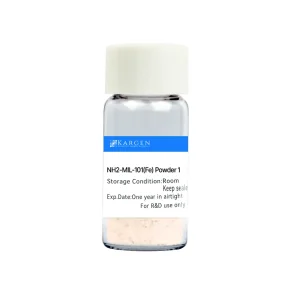
❓ Frequently Asked Questions: Technical & Logistics for Kuwait Buyers
Expert answers addressing quality assurance, thermal stability, custom synthesis, and international shipping to Kuwait ports.
Q1 How do KARGEN MOFs maintain structural integrity in Kuwait's high-temperature climate (50°C+)?
Our framework structures are specifically screened for high thermal and hydrothermal decomposition thresholds. Grades like UiO-66 and ZIF-8 feature rigid metal-ligand coordination bonds that maintain crystal lattice stability up to 400°C–500°C in dry air and remain intact through thousands of ambient temperature moisture absorption-desorption cycles without framework degradation.
Q2 What compliance documentation is provided for Kuwait Customs and Industrial Procurement?
Every shipment exported to Kuwait includes a comprehensive Certificate of Analysis (CoA), Safety Data Sheet (SDS) prepared in accordance with GHS standards, Powder X-ray Diffraction (PXRD) patterns, BET surface area validation reports, and a Certificate of Origin (CO). We work directly with Kuwaiti import clearing agents for hassle-free delivery to Shuwaikh and Shuaiba ports.
Q3 Can KARGEN supply custom-shaped MOFs (pellets, extrudates, honeycombs) for refinery gas beds?
Yes. While standard grades are manufactured as fine crystalline powders, our engineering division offers custom extrusion and binderless shaping services. We convert raw powders into 1–3 mm spherical granules, cylindrical extrudates, or wash-coated ceramic honeycombs engineered for low pressure drops in commercial fixed-bed sorbents.
Q4 What is the lead time for evaluation samples vs. ton-scale order delivery to Kuwait?
Free evaluation samples (1–5 grams) for qualified industrial R&D teams are dispatched via express air courier (DHL/FedEx) within 48 hours of verification. Commercial bulk orders (kilogram to ton-scale) are typically delivered to Kuwait within 2 to 4 weeks depending on batch volume and specific packaging requirements.
Q5 Which MOF material is recommended for direct atmospheric water harvesting in arid Gulf regions?
For low relative humidity environments (RH 15–40% typical of desert summers in Kuwait), we strongly recommend MOF-303 or MIL-100(Al). These frameworks exhibit a steep S-shaped water sorption isotherm, enabling complete water release under low-grade solar heat (65°C–75°C).
Partner with a World-Class MOF Exporter Serving Kuwait
Unlock superior separation efficiency, lower carbon footprints, and resilient advanced material performance for your enterprise today.