
Flagship MOF Powders for Kuala Lumpur Enterprises
Engineered for extreme hydrothermal stability, carbon capture efficiency, and industrial gas purification across Malaysia's tropical commercial hubs.

Best ZIF-67 Powder Metal Organic Frameworks (MOFs) - Optimized for KL Petrochemical Catalysis
View ZIF-67 Specs
High-Quality China MOF-5 Powder - High-Performance Framework for Gas Storage & Pollution Control
View MOF-5 Specs
Best High-Quality MOF-74(Mg) Powder - High CO₂ Capacity Sorbent for Klang Valley Clean Energy
View MOF-74(Mg) Specs
High-Quality MIL-100(Al) Powder MOFs - Ultra-Stable Dehumidification Sorbent for Tropical HVAC
View MIL-100(Al) Specs1. Kuala Lumpur's Industrial Transition & Advanced Nanotechnology Demand
As the economic epicenter of Malaysia, the Greater Kuala Lumpur area (encompassing the Federal Territory of Kuala Lumpur and the industrial heartlands of Selangor, Shah Alam, and Cyberjaya) is undergoing a rapid transition toward high-value manufacturing, zero-carbon infrastructure, and semiconductor modernization. Driven by Malaysia’s National Energy Transition Roadmap (NETR) and the New Industrial Master Plan 2030 (NIMP 2030), industrial enterprises across Klang Valley are seeking next-generation porous materials to solve critical environmental and energy bottlenecks.
Metal-Organic Frameworks (MOFs)—crystalline porous materials composed of metal nodes linked by organic ligands—represent a paradigm shift for Kuala Lumpur's industrial sectors. Possessing record-breaking Brunauer-Emmett-Teller (BET) surface areas (exceeding 2,000–6,000 m²/g), customizable pore geometries, and tailored chemical affinities, MOFs outperform traditional zeolites and activated carbons across four primary local sectors:
Semiconductor & Electronics Packaging
High-purity specialty gas purification (trapping sub-ppm moisture, oxygen, and silanes) for advanced OSAT facilities in Selangor and adjacent electronics clusters.
Petrochemical & Refinery Processing
Selective olefin/paraffin separation (C₂H₄/C₂H₆ and C₃H₆/C₃H₈) and low-energy hydrogen storage for refinery corridors linked to Port Klang supply chains.
Tropical HVAC & Green Data Centers
Advanced desiccant wheel coatings enabling low-temperature (60–80°C) thermal regeneration in ambient relative humidity (80–90% RH) across KL’s mega-data centers.
Strategic Advantage for Malaysian Importers & Procurement Officers
Importing advanced nanostructured powders directly from KARGEN (Guangdong Advanced Carbon Materials Co., Ltd.) eliminates intermediary markups while guaranteeing batch-to-batch consistency verified by Powder X-ray Diffraction (PXRD) and Nitrogen physisorption isotherms. With direct sea freight routes from Zhuhai/Shenzhen ports to Northport/Westport in Port Klang (taking under 5–7 days transit), Kuala Lumpur manufacturers enjoy an unbeatable combination of technical precision and supply chain speed.
2. Nanotechnology Technical Roadmap & Future Outlook (2026–2030)
The global transition toward decarbonization requires functional materials capable of performing molecular surgery on industrial gas streams. Over the next five years, the operational deployment of MOFs in Southeast Asia will follow three key technological vectors:
Phase 1: Green Solvent Mechanochemical Synthesis Scale-Up
Traditional solvothermal MOF synthesis relied on high volumes of toxic solvents like N,N-dimethylformamide (DMF). KARGEN's proprietary mechanochemical continuous extrusion tech eliminates solvent usage by over 90%, drastically lowering production costs while yielding uniform sub-micron crystals. This permits ton-scale commercial availability for frameworks such as ZIF-8 and Al-FUM at price points compatible with large-scale industrial tenders in Malaysia.
Phase 2: Hybrid Matrix Membranes (MMMs) for Post-Combustion Carbon Capture
Incorporating MOF nanofillers (such as MOF-74 and KAUST-7) into polymeric membranes overcomes the Robeson upper bound, providing both high CO₂ permeability and ultra-high CO₂/N₂ selectivities (>50). For power generation plants and gas refineries around the Klang Valley, this opens up compact, energy-efficient post-combustion carbon capture without the solvent degradation issues associated with liquid amine scrubbing.
Phase 3: Solid-State Battery Electrolytes & Thermal Management
As Malaysia builds out its regional EV ecosystem, MOF-modified separator coatings (using ZIF-8 and UiO-66 derivatives) immobilize anions, promote uniform Li-ion flux, and suppress dendrite formation in high-energy lithium metal batteries. Concurrently, hydrothermally stable MOFs are being integrated into thermal energy storage systems to capture low-grade ambient heat.
KARGEN Industrial Metric Milestones
Quantifiable engineering performance delivered to overseas industrial clients.
3. Macro-Industry Solutions Tailored for Kuala Lumpur & Klang Valley
To assist procurement engineers and plant managers in selecting optimal nanomaterial grades, our scientific engineering team has mapped specific commercial challenges in Malaysia to tailored framework solutions:
| Target Application Sector | Dominant Industry Challenge | Recommended MOF Product | Engineering Performance Mechanism |
|---|---|---|---|
| Flue Gas CO₂ Capture | High humidity & low CO₂ partial pressure in exhaust streams. | MOF-74(Mg) / KAUST-7 | Open metal sites yield high CO₂ uptake (>5 mmol/g at 0.15 bar) with high CO₂/N₂ selectivity. |
| Skyscraper & Data Center HVAC | High ambient humidity (80-90% RH) causing massive latent cooling loads. | Al-FUM / MIL-100(Al) | Steep S-shaped water sorption isotherm; desorbs water efficiently at low heat (<70°C). |
| Olefin/Paraffin Separation | Cryogenic distillation requires massive capital & energy expenditure. | TYUT-12 / MOF-303 | Size-exclusion pore windows achieve high-purity C₃H₆/C₃H₈ separation at ambient temperature. |
| Lithium Battery Separators | Dendrite short-circuits and thermal runoff at elevated ambient temperatures. | ZIF-8 / UiO-66 Powder | Uniform sub-nanometer pores regulate ionic concentration profiles and trap electrolyte impurities. |
| Specialty Gas Purification | Trace H₂S, NH₃, and VOC contamination in electronic grade gases. | MIL-100(Fe) / NH2-MIL-101 | Active Lewis acid/base siteschemisorb polar contaminants down to single-digit ppb levels. |
Case Study Focus: Atmospheric Water Generation in Tropical Microclimates
In humid equatorial regions like Kuala Lumpur, atmospheric water harvesting (AWH) provides decentralized potable water. Standard silica gels and zeolites require regeneration temperatures above 150°C, rendering solar-thermal integration inefficient. Utilizing Aluminium Fumarate (Al-FUM) or MIL-53(Al), system integrators achieve rapid adsorption-desorption cycling powered directly by waste heat or flat-plate solar collectors, yielding up to 3.5 liters of pure water per kilogram of sorbent per day.
Supply Chain Resilience, Scale & Cost Superiority
Historically, Metal-Organic Frameworks were restricted to university research labs due to gram-scale synthesis costs exceeding $50–$100 per gram. KARGEN has transformed this paradigm as China's premier ton-scale MOF industrial manufacturer.
- Ton-Scale Continuous Production: Automated reactor arrays capable of delivering metric-ton annual outputs for major industrial tenders.
- 90%+ Upstream Raw Material Vertical Integration: Direct sourcing of metal salts (Zn, Al, Fe, Cu, Mg) and organic linkers within Guangdong's chemical cluster.
- Logistical Proximity to Port Klang: Fast ocean shipping out of Greater Bay Area ports (Zhuhai, Nansha, Shenzhen) ensures minimal freight turnaround times.
Direct Export Logistics to Kuala Lumpur
We manage complete export documentation and hazardous/non-hazardous chemical compliance for smooth clearance through Customs Malaysia:
4. Localization Support & Regulatory Compliance for Malaysia
Enterprise procurement in Malaysia requires strict adherence to local industrial safety regulations and environmental guidelines. KARGEN provides complete compliance backing for all material shipments entering Kuala Lumpur and Selangor:
DOSH / JKKP CLASS Regulation Compliance
All nanomaterial shipments include Safety Data Sheets (SDS) fully compliant with Malaysia's Occupational Safety and Health (Classification, Labelling and Safety Data Sheet of Hazardous Chemicals) Regulations 2013 (CLASS Regulations), formatted in both English and Bahasa Malaysia upon request.
ESG & SIRIM Green Standard Support
Our eco-friendly mechanochemical manufacturing aligns with corporate ESG goals, supporting local clients seeking SIRIM Eco-Labeling or green industrial certification under Malaysia's Net Zero 2050 framework.
5. Global Corporate Procurement Standard & Quality Assurance
To eliminate risks for overseas procurement directors and quality assurance managers, KARGEN enforces a 4-tier digital quality control system for every batch shipped to ASEAN markets:
PXRD Phase Verification
Confirms 100% crystalline framework purity with zero amorphous impurity phases.
BET Surface Area Analysis
N₂ physisorption testing guarantees specified porosity and surface area metrics.
TGA Thermal Limits
Thermogravimetric Analysis verifies thermal stability profiles under process gas atmospheres.
PSD & SEM Profiling
Laser particle size distribution ensures seamless dispersion in host matrices.
Comprehensive MOF & Porous Materials Catalog
Explore our full line of industrial-scale powders and engineered adsorbents available for direct export to Kuala Lumpur.

Best China MIL-100(Fe) Powder MOFs - Eco-Friendly Iron Framework for Wastewater Treatment
View MIL-100(Fe) Specs
Best TYUT-12 MOF - High-Performance Adsorbent for Hydrocarbon & Propane Separation
View TYUT-12 Specs

High-Quality Customized Metal Organic Frameworks (MOFs) - Tailored Synthesis Solutions
Custom MOF Inquiry


MIL-53(Al) Powder MOFs - Breathing Structural Adsorbent for Gas Sensing & Storage
View MIL-53(Al) Specs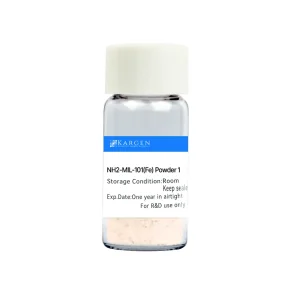
Best NH2-MIL-101(Fe) Powder MOFs - Functionalized Framework for Advanced Catalysis
View NH2-MIL-101 SpecsFrequently Asked Questions for Kuala Lumpur Importers
Direct answers regarding sample dispatch, shipping lead times to Port Klang, custom ligand synthesis, and technical support.
What is the typical shipping lead time from your factory to Kuala Lumpur?
For standard in-stock MOF powders (such as ZIF-8, HKUST-1, Al-FUM), sample orders ship via air express (DHL/FedEx/UPS) within 24–48 hours, arriving in Kuala Lumpur in 2–4 business days. Bulk commercial shipments dispatched via sea freight from Zhuhai or Shenzhen to Port Klang typically take 5 to 7 days transit time.
Can KARGEN provide evaluation sample lots for Malaysian R&D centers?
Yes. We support corporate R&D teams and university laboratories in Malaysia by offering qualified 1g to 5g evaluation samples. Please contact our engineering department via email with your project parameters to apply for complimentary sample evaluation lots.
How do your MOFs perform under Kuala Lumpur's high ambient humidity?
Hydrothermal stability is a key benchmark of our product design. Grades such as Al-FUM, UiO-66, and MIL-53(Al) demonstrate complete framework integrity even after continuous exposure to boiling water or high relative humidity (80-90% RH). Our technical team provides moisture-stability isotherm data for each grade.
Do you offer custom MOF synthesis under OEM/ODM terms?
Yes. Our team of PhD scientists specializes in custom linker functionalization (e.g., -NH₂, -OMe, -SO₃H derivatives), controlled particle sizing (from 50nm up to several microns), and formulating ready-to-use liquid dispersions or binder-free shaped extrudates.
What quality documentation accompanies bulk shipments?
Every commercial batch is delivered with a comprehensive Certificate of Analysis (COA), Powder X-Ray Diffraction (PXRD) pattern, N₂ adsorption-desorption BET surface area test report, Thermogravimetric Analysis (TGA) curve, and a GHS-compliant Safety Data Sheet (SDS).
Connect with Our Nanotechnology Engineers Today
Whether you require evaluation samples for a pilot facility in Selangor or ton-scale contract manufacturing for an industrial project in Kuala Lumpur, our technical team is ready to assist.