Best China Suppliers: High-Quality MOF-5 Powder Metal Organic Frameworks from Factory for Gas Storage and Pollutant Removal Service, Exporters
Product Description
| Product Name | MOF-5 |
|---|---|
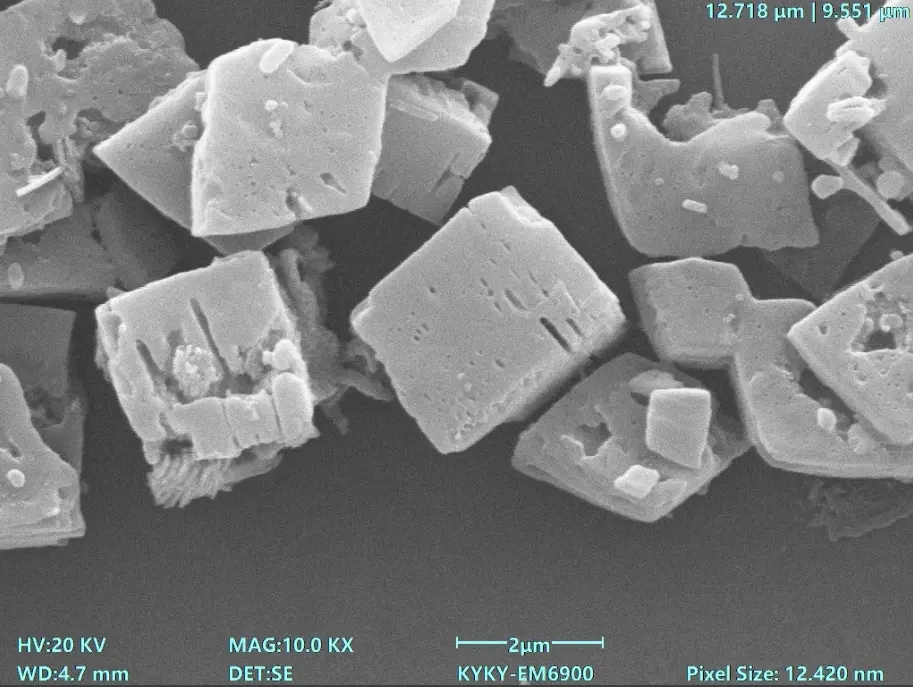
| Particle size | 1-3 um |
| Specific surface area | > 2000㎡/g |
| Pore size | 1.2nm |
MOF-5 is recognized for its high porosity, making it suitable for gas storage, especially hydrogen and carbon dioxide. The binding energy for hydrogen adsorption is approximately 26-27 meV, indicating effective physisorption (Gurung & Adhikari, 2023). A semi-empirical molecular dynamics study demonstrated that CO2 can form a liquid-like structure within MOF-5, showcasing its capacity for gas storage under varying conditions (Listyarini et al., 2023).
Recent studies highlight the effectiveness of functionalized MOF-5 in removing phenolic pollutants, with fluorine-modified variants showing superior adsorption capabilities due to enhanced van der Waals and π–π interactions (Razavi et al., 2024).
To address moisture susceptibility, a hydrophobic porous shell was developed around MOF-5, maintaining its structural integrity while enabling CO2/N2 separation under humid conditions (Li et al., 2023). While MOF-5 shows promise in various applications, its stability and performance can be influenced by environmental factors and structural modifications, necessitating further research to optimize its use in practical scenarios.