
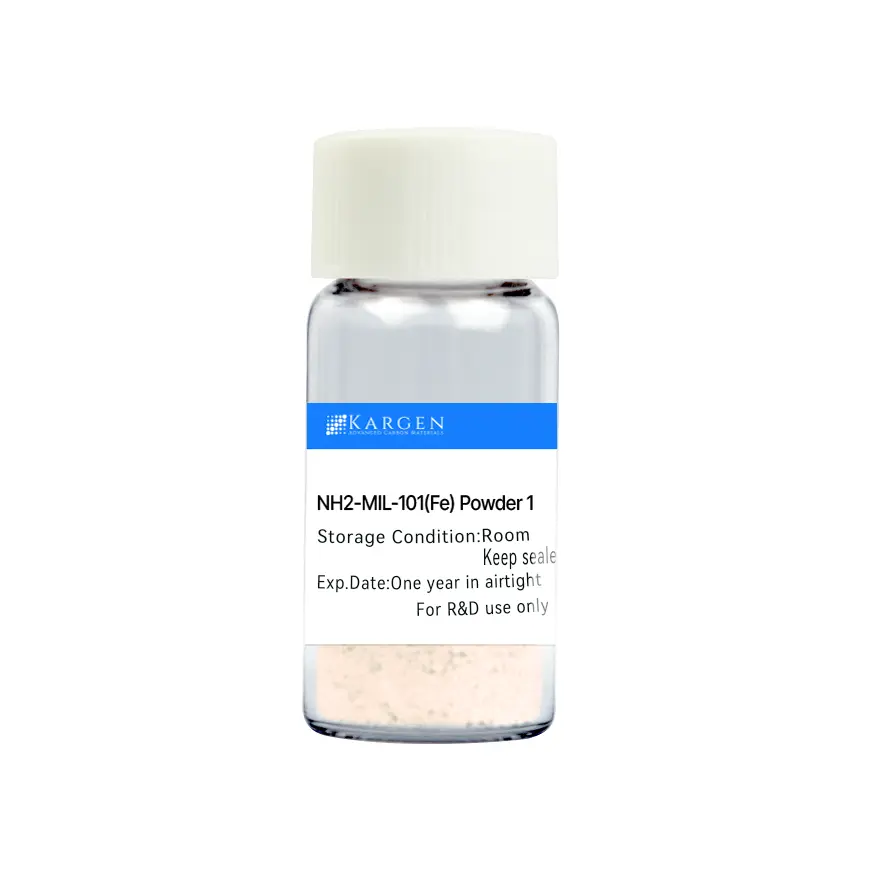
Best NH2-MIL-101(Fe) Powder - Top China Suppliers & Factory for Metal Organic Frameworks (MOFs) in Catalysis and Sensing Suppliers, Exporters
Product Description
| Product Name | NH2-MIL-101(Fe) |
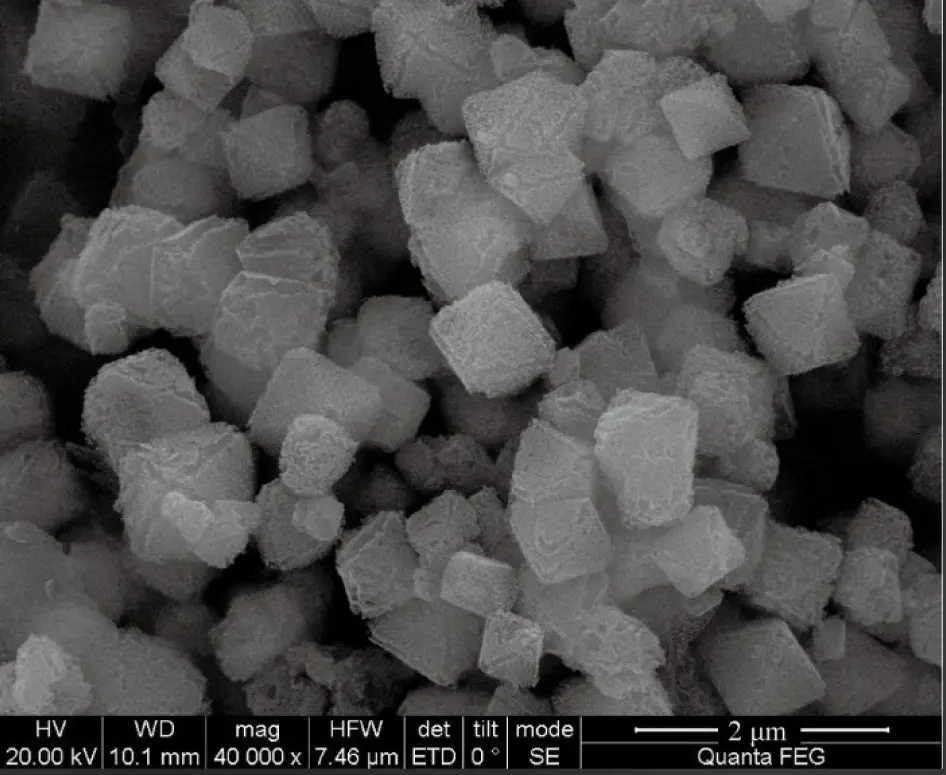
| Particle size | 0.8~1.0 μm |
| Specific surface area | ≥260㎡/g |
| Pore size | ≈2.1nm |
Catalytic Applications
NH2-MIL-101(Fe) serves as a support for Au-Cu nanoalloys, enhancing nitrogen fixation efficiency by improving N2 adsorption and reducing the energy barrier for N2 bond cleavage, achieving a notable NH3 yield of 161.07 μg h−1 mg-1cat. and a Faradaic efficiency of 58.86%.
The framework facilitates multi-site catalysis, activating both N2 and H2 under mild conditions, which is crucial for sustainable ammonia production.
Sensing Applications
NH2-MIL-101(Fe) nanoparticles have been integrated into sensors for simultaneous detection of caffeic acid and acetaminophen, demonstrating high sensitivity with detection limits of 29 nM and 24 nm, respectively.
Functionalized NH2-MIL-101(Fe) has been developed as a fluorescent biosensor for lead ions, achieving a detection limit of 9.51 ppb, showcasing its potential in environmental monitoring.
Frequently Asked Questions
NH2-MIL-101(Fe) features a particle size of 0.8~1.0 μm, a specific surface area of ≥260㎡/g, and a pore size of approximately 2.1nm.
It acts as a support for Au-Cu nanoalloys, which enhances nitrogen fixation efficiency by improving N2 adsorption and lowering the energy barrier for N2 bond cleavage.
It achieves a Faradaic efficiency of 58.86% alongside an NH3 yield of 161.07 μg h−1 mg-1cat.
Yes, functionalized NH2-MIL-101(Fe) can be utilized as a fluorescent biosensor for detecting lead ions with a detection limit of 9.51 ppb.
It is integrated into sensors for the simultaneous detection of caffeic acid and acetaminophen, offering detection limits of 29 nM and 24 nm, respectively.
The main challenges involve optimizing its performance for large-scale applications and ensuring its long-term stability under diverse operational conditions.









