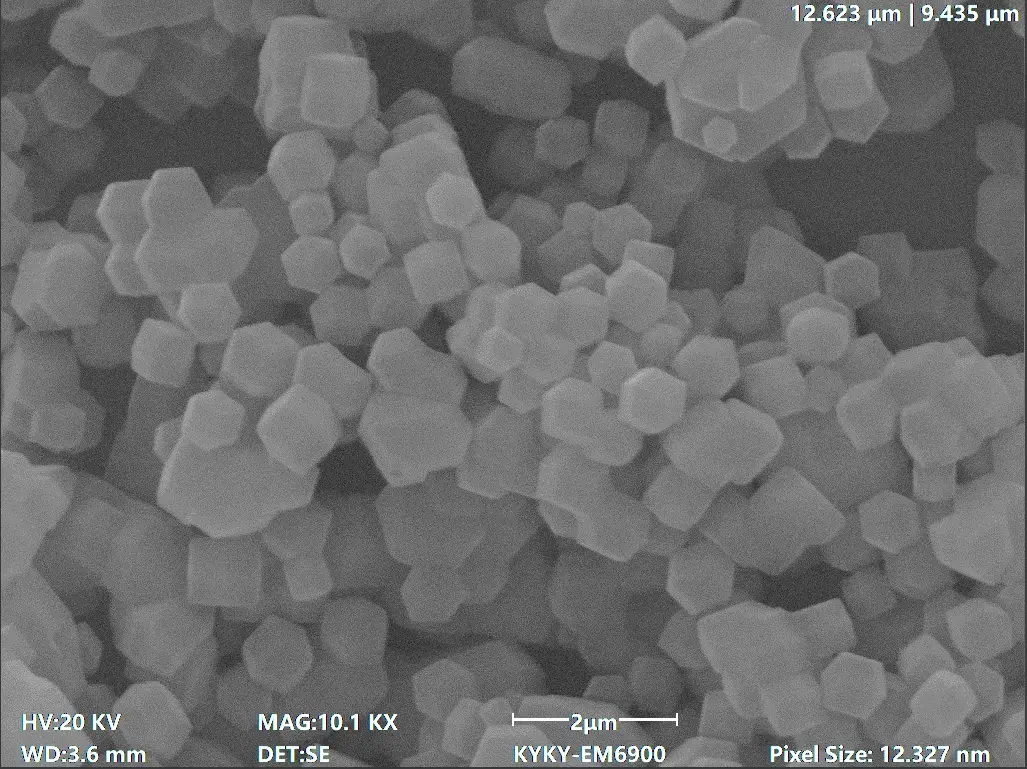
ZIFs have advantages over zeolites such that the hybrid framework structures are expected to have more flexibility in surface modification. Among a large variety of ZIFs, ZIF-8 is the most representative one first synthesized by Chen’s group, and then systematically named by the Yaghi’s group. It can be fabricated by zinc and mIm with a sodalite structure consisting of a four- and a six-membered ring ZnN4 cluster, which has good thermal and chemical stability, especially large specific surface area, adjustable porosity and abundant active sites.
As we all know, ZIF-8 has shown up distinguished advantages and advances in adsorption, gas separation, drug delivery, catalysis and biosensor. ZIF-8 possesses the typical cubic sodalite topology with 11.6 Å large β-cages, which are connected by 6-membered ring windows (~3.4 Å). ZIF-8 and its membranes perform significant sieving advantages over ultramicroporous zeolites in selective separation of gas mixture contributing to the narrow six-membered ring pores (~3.4 Å) and hydrophobic behavior.
Frequently Asked Questions (FAQ)
What are the primary physical specifications of ZIF-8?
ZIF-8 features a particle size of approximately 600 nm, a high specific surface area of ≥1500 ㎡/g, and a pore size ranging between 0.8 and 1.8 nm.
How is ZIF-8 structured?
ZIF-8 is fabricated by zinc and 2-methylimidazole (mIm) with a sodalite structure. It consists of a four- and a six-membered ring ZnN4 cluster, showing a typical cubic sodalite topology with 11.6 Å large β-cages connected by 6-membered ring windows (~3.4 Å).
What advantages does ZIF-8 hold over traditional zeolites?
ZIF-8 offers a hybrid framework structure that provides greater flexibility in surface modification. Additionally, it exhibits excellent thermal and chemical stability, large specific surface area, adjustable porosity, and hydrophobic behavior.
What are the main application fields for ZIF-8?
Due to its abundant active sites and adjustable porosity, ZIF-8 is widely utilized in adsorption processes, gas separation, drug delivery systems, catalysis, and biosensors.
Why is ZIF-8 highly effective for selective gas separation?
ZIF-8 and its membranes provide significant molecular sieving advantages for gas mixture separation. This performance is driven by its narrow six-membered ring pores (~3.4 Å) and hydrophobic properties, allowing precise selective filtration compared to ultramicroporous zeolites.
What level of stability does ZIF-8 display under operational conditions?
ZIF-8 exhibits excellent thermal and chemical stability owing to its robust ZnN4 cluster sodalite framework, making it suitable for demanding industrial and chemical applications.