
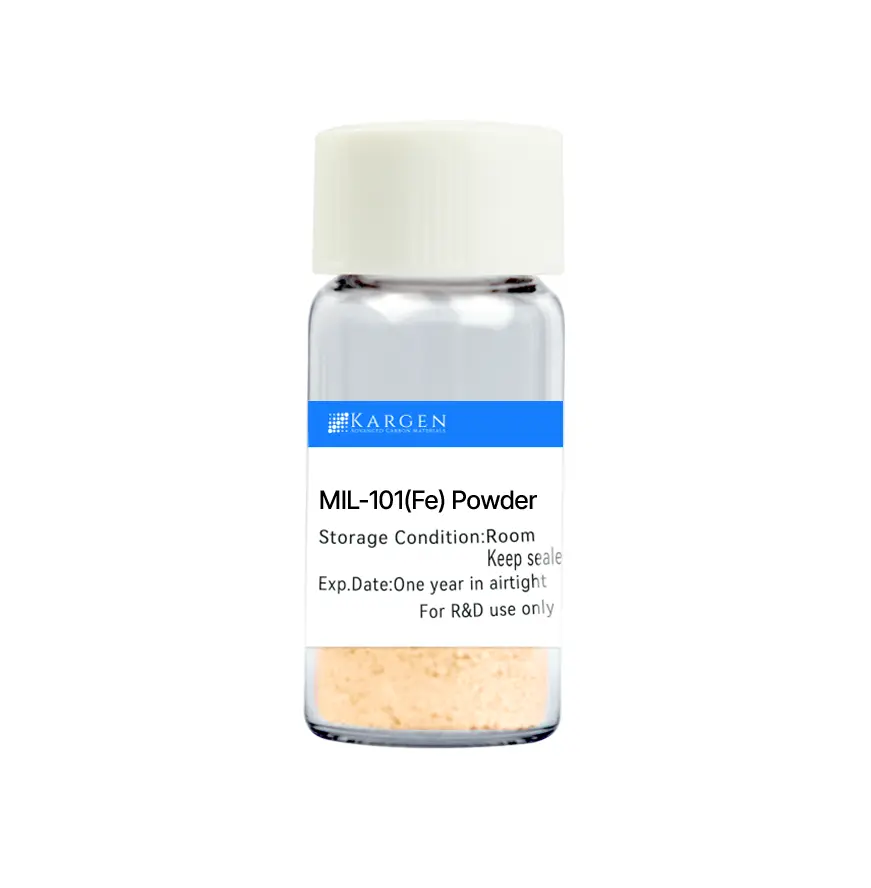
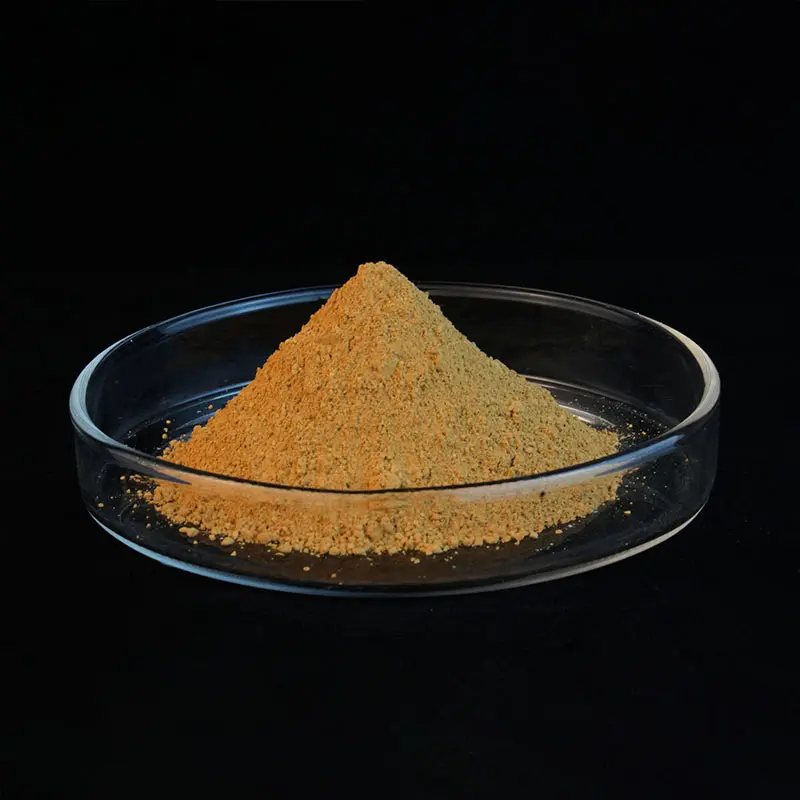
High-Quality China MIL-101(Fe) Powder Metal Organic Frameworks (MOFs) - Top Suppliers & Factory Available Service, Supplier

MIL-101(Fe) is a highly acclaimed metal-organic framework (MOF) with the molecular formula Fe3O(H2O)2OH(BTC)2). Known for its remarkable versatility, this innovative material finds extensive applications in various fields such as adsorption, catalysis, and drug delivery. As a leading supplier in China, our factory specializes in the production of high-quality MIL-101(Fe), ensuring exceptional performance and reliability for your industrial and research needs. Choose our trusted China suppliers for your MOF requirements and experience the benefits of this cutting-edge technology

Product Description

MIL-101(Fe) is a metal-organic framework (MOF) primarily composed of iron (Fe) ions coordinated with organic ligands, specifically 1,4-benzenedicarboxylic acid (BDC). This structure provides high porosity and surface area, making it suitable for various applications, including pollutant remediation and energy storage.

Product Specifications
Product Name MIL-101(Fe)
Particle size 1-3 μm
Specific surface area ≥1000㎡/g
Pore size 0.3~2.0 nm
Key Structural Composition

The framework is based on iron ions (Fe3+) which are pivotal for its structural integrity and functionality (Chen et al., 2024). The BDC ligands form a robust coordination network with the iron ions, contributing to the stability and porosity of the MOF (Liu et al., 2024).
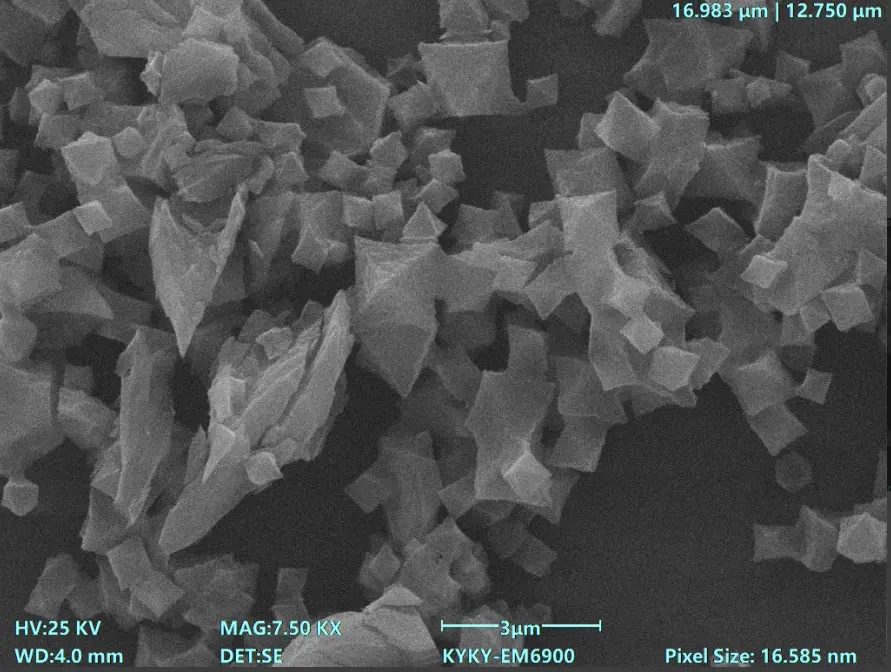
KAR-F49 MIL-101(Fe)
Applications & Performance

MIL-101(Fe) has been effectively utilized for the simultaneous removal of heavy metals like Pb²⁺, Cd²⁺, and Cu²⁺ from contaminated water and soil, achieving low residual concentrations (Wang et al., 2025). It also serves as a photocatalyst for degrading crude oil in wastewater, demonstrating a remarkable 94.73% removal efficiency under optimized conditions (Wang et al., 2024).

The framework has been modified to create efficient electrocatalysts for rechargeable Zn-air batteries, showcasing high performance in oxygen evolution and reduction reactions (Hao et al., 2024). Additionally, MIL-101(Fe) composites with iron nanoparticles have been developed for supercapacitor applications, achieving a capacitance of 1305 F g⁻¹ (Mahajan et al., 2024).

Current Challenges

While MIL-101(Fe) shows promise in these applications, challenges such as scalability and long-term stability in practical environments remain areas for further research.


Frequently Asked Questions (FAQ)
Q What is the composition and structure of MIL-101(Fe)?
MIL-101(Fe) is a metal-organic framework (MOF) consisting of iron (Fe³⁺) ions coordinated with 1,4-benzenedicarboxylic acid (BDC) organic ligands. This coordination creates a highly porous structure with a large surface area.
Q What are the key physical properties of MIL-101(Fe)?
It features a particle size of 1-3 μm, a specific surface area of ≥1000㎡/g, and a pore size distribution ranging from 0.3 to 2.0 nm.
Q How is MIL-101(Fe) used in environmental remediation?
It is used to simultaneously remove heavy metals (such as Pb²⁺, Cd²⁺, and Cu²⁺) from contaminated water and soil. Additionally, it acts as a photocatalyst that can degrade crude oil in wastewater with a 94.73% efficiency rate.
Q Can MIL-101(Fe) be applied to energy storage systems?
Yes. Modified MIL-101(Fe) serves as an electrocatalyst for rechargeable Zn-air batteries to facilitate oxygen evolution and reduction. It is also used in iron nanoparticle composites for supercapacitors, achieving a capacitance of 1305 F g⁻¹.
Q What limitations currently affect the practical use of MIL-101(Fe)?
The primary challenges preventing widespread practical application are scalability in production and maintaining long-term stability in real-world environments.

Related Products







