
High-Quality China Suppliers of KAUST-7 Powder Metal Organic Frameworks (MOFs) | High CO2 Adsorption Factory Service, Exporter

KAUST-7, also referred to as NbOFFIVE-1-Ni, is a remarkable material for various applications. This innovative compound features elongated Nb–O and Nb–F bonds, measuring 1.899 Å and 1.681 Å, respectively, which contributes to the formation of larger anionic octahedra that effectively pillaring the square grid. As a result, KAUST-7 exhibits a reduced pore size, enhancing its structural properties. Renowned for its exceptional chemical and thermal stability, KAUST-7 is highly resistant to water and H2S, making it a preferred choice among industrial applications. Additionally, it demonstrates a high selectivity for CO2 adsorption over H2 and CH4, making it essential for gas separation processes. As a leading product from China, KAUST-7 is available through trusted suppliers and factories, ensuring quality and reliability

Product Description

Product Name KAUST-7
Particle size 0.6~1.1μm
Specific surface area ≥200㎡/g
Pore size 0.3~0.5 nm

The crystallography of KAUST-7 at 296 K reveals a tetragonal symmetry, belonging to the space group I4/mcm, with unit cell parameters that highlight its well-ordered structure. The unit cell dimensions, with 'a' and 'b' equaling 9.942(4) Å and 'c' measuring 15.764(6) Å, contribute to the material's distinctive pore architecture. This fine-tuning of the pore dimensions is pivotal for enhancing CO2 interaction, particularly in terms of the enthalpy of absorption, a critical factor for selective gas adsorption processes.

KAUST-7 has garnered significant attention in the scientific community due to a multitude of desirable properties. Its high chemical and thermal stability, coupled with exceptional water and H2S tolerance, positions it as a robust candidate for applications in harsh environments. Moreover, the material's high CO2 adsorption selectivity over H2 and CH4 makes it an attractive option for carbon capture and storage initiatives, which are essential for mitigating the impact of greenhouse gas emissions.
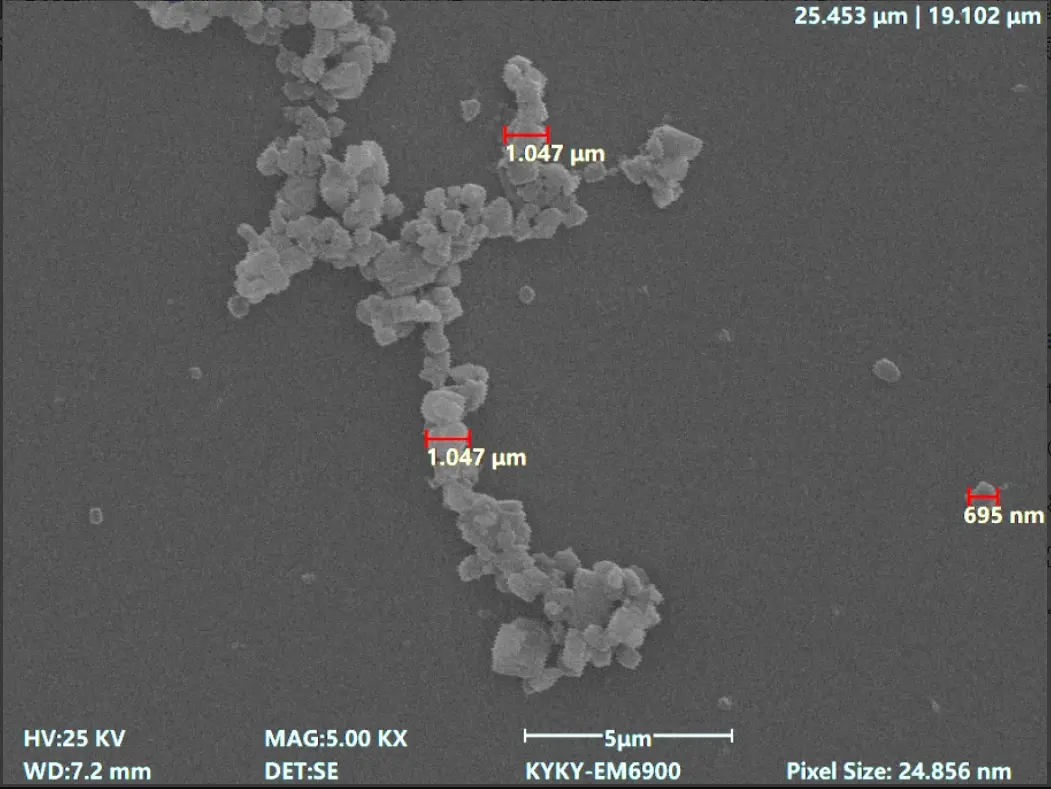
KAR-F32 KAUST-7

In terms of physical attributes, KAUST-7 is available in a particle size range of 1000-5000 nm, offering a substantial specific surface area of at least 170 ㎡/g. The pore size of 0.3-0.5 nm is finely tuned for molecular sieving, enabling the selective adsorption of gases, which is vital for various separation processes in industrial applications.

The development of KAUST-7 underscores the ongoing advancements in the field of MOFs, highlighting the potential for designing materials with tailored properties to address specific challenges in gas storage, separation, and environmental management. As research progresses, the unique characteristics of KAUST-7 are expected to play a significant role in the development of sustainable technologies that can contribute to a cleaner and more efficient future.


Frequently Asked Questions

What is the crystal structure and symmetry of KAUST-7?
At 296 K, KAUST-7 exhibits a tetragonal symmetry belonging to the space group I4/mcm. Its unit cell dimensions are 'a' and 'b' equaling 9.942(4) Å, and 'c' measuring 15.764(6) Å, which defines its distinctive pore architecture.
What are the stability properties of KAUST-7 in harsh environments?
KAUST-7 possesses high chemical and thermal stability, along with exceptional tolerance to water and H2S, making it a highly robust candidate for applications in demanding environments.
Why is KAUST-7 suitable for carbon capture and storage?
KAUST-7 features a high CO2 adsorption selectivity over H2 and CH4. This selective gas adsorption capability makes it an ideal option for carbon capture initiatives aimed at mitigating greenhouse gas emissions.
What are the physical specifications (particle size and surface area) of KAUST-7?
KAUST-7 is available in a particle size range of 1000-5000 nm (with specification options at 0.6~1.1μm) and provides a specific surface area of at least 170 ㎡/g (up to ≥200㎡/g).
How does the pore size of KAUST-7 assist in gas separation?
With a finely tuned pore size of 0.3-0.5 nm, KAUST-7 acts as a molecular sieve. This precise sizing enables the selective adsorption of gases, which is vital for various industrial separation processes.
What role does KAUST-7 play in the development of future technologies?
As an advanced Metal-Organic Framework (MOF), KAUST-7 highlights the potential of designing materials with tailored properties to solve challenges in gas storage, separation, and environmental management for sustainable, cleaner technologies.

Related Products







