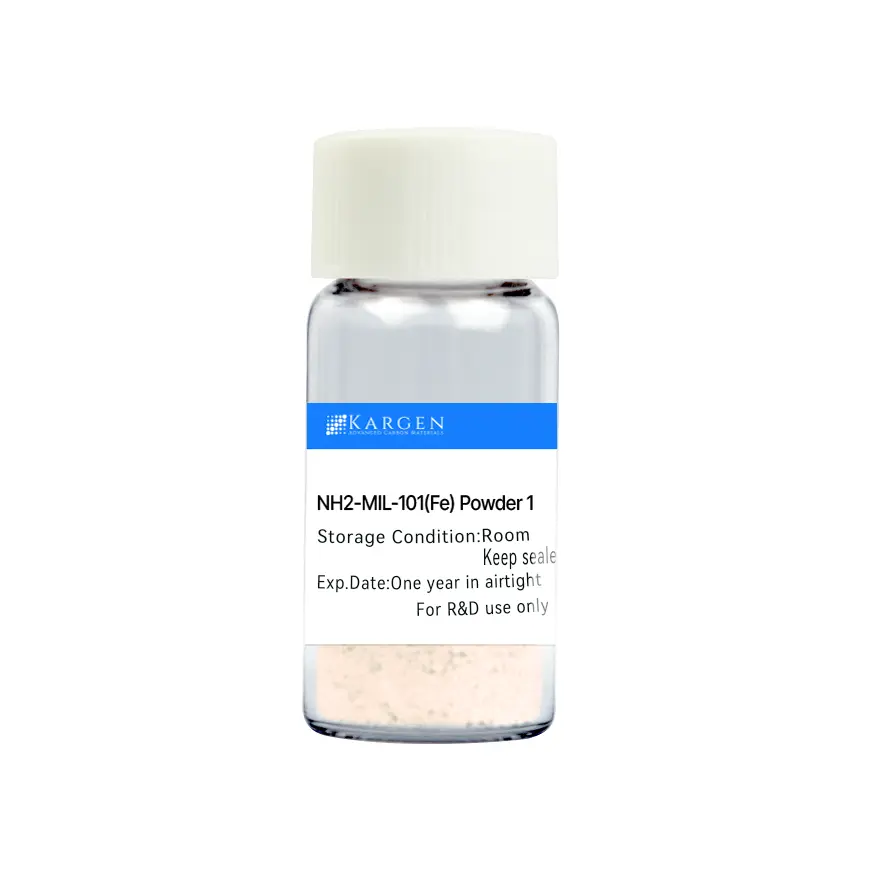
High-Quality NH2-MIL-101(Fe) Powder MOFs from China Suppliers - High-Quality Factory Production for Catalysis and Sensing Applications Suppliers, Exporter
NH2-MIL-101(Fe) is a cutting-edge material composed of 2-amino benzene dicarboxylic acid (H2BDC-NH2) and ferrous ions, renowned for its significant applications in catalysis and sensing. This innovative compound is produced by top China suppliers and factories, ensuring high-quality and reliable performance. Its exceptional conductivity, stability, and catalytic efficiency position it as a promising candidate for a wide range of technological advancements. Discover the potential of NH2-MIL-101(Fe) for your next project with leading materials from China.
NH2-MIL-101(Fe) serves as a support for Au-Cu nanoalloys, enhancing nitrogen fixation efficiency by improving N2 adsorption and reducing the energy barrier for N2 bond cleavage, achieving a notable NH3 yield of 161.07 μg h−1 mg-1cat. and a Faradaic efficiency of 58.86%.
Ammonia Synthesis
The framework facilitates multi-site catalysis, activating both N2 and H2 under mild conditions, which is crucial for sustainable ammonia production.
Sensing Applications
Electrochemical Detection
NH2-MIL-101(Fe) nanoparticles have been integrated into sensors for simultaneous detection of caffeic acid and acetaminophen, demonstrating high sensitivity with detection limits of 29 nM and 24 nm, respectively.
Lead Ion Detection
Functionalized NH2-MIL-101(Fe) has been developed as a fluorescent biosensor for lead ions, achieving a detection limit of 9.51 ppb, showcasing its potential in environmental monitoring.
Application Notice: While NH2-MIL-101(Fe) exhibits remarkable capabilities, challenges remain in optimizing its performance for large-scale applications and ensuring stability under various operational conditions.
Frequently Asked Questions (FAQ)
What are the primary structural parameters of NH2-MIL-101(Fe)?
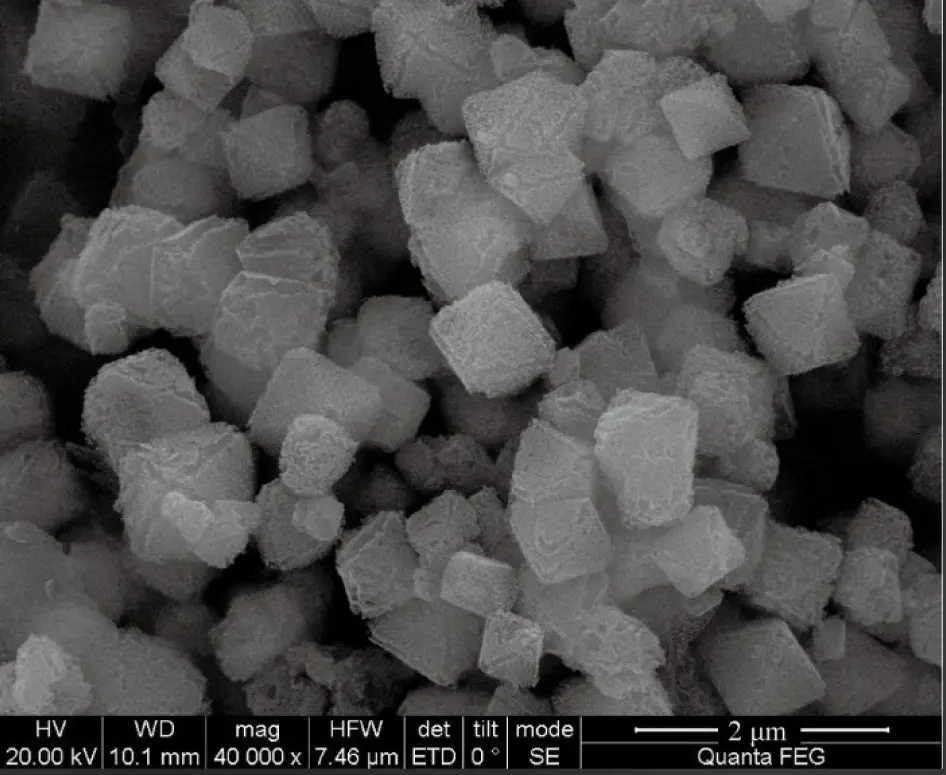
NH2-MIL-101(Fe) features a particle size of 0.8~1.0 μm, a specific surface area of ≥260㎡/g, and an average pore diameter of approximately 2.1 nm.
How does NH2-MIL-101(Fe) contribute to electrocatalytic nitrogen fixation?
It functions as a catalyst support for Au-Cu nanoalloys, effectively lowering the energy barrier for N2 bond cleavage and enhancing adsorption, reaching an NH3 yield of 161.07 μg h−1 mg-1cat. with a Faradaic efficiency of 58.86%.
Can NH2-MIL-101(Fe) facilitate ammonia synthesis under mild conditions?
Yes, its porous coordination framework enables multi-site catalysis capable of activating both N2 and H2 under mild operational conditions.
What compounds can be detected using NH2-MIL-101(Fe) electrochemical sensors?
It has been successfully integrated into electrochemical sensors for the simultaneous detection of caffeic acid and acetaminophen, achieving detection limits of 29 nM and 24 nm, respectively.
Is NH2-MIL-101(Fe) suitable for heavy metal detection?
Yes, functionalized NH2-MIL-101(Fe) serves as an effective fluorescent biosensor for lead ions (Pb2+) with an ultra-sensitive detection limit of 9.51 ppb.
What are the primary operational challenges for this material?
The main development challenges include scaling up performance for industrial-scale deployment and securing long-term structural stability across varying operational environments.