
Featured CO2 Capture & Separation Adsorbents
Explore our premium-grade MOF materials engineered for high-selectivity carbon dioxide adsorption, gas purification, and industrial scale-up.






Macro Industry Solutions for Carbon Dioxide Capture & Gas Purification
Addressing global decarbonization mandates through advanced material engineering, ultra-high surface area metal-organic frameworks, and energy-efficient regeneration cycles.
Point-Source Flue Gas CO2 Capture
Post-combustion capture from coal-fired power units, cement kilns, and steel manufacturing plants requires adsorbents capable of processing large volumes of low-pressure CO2 (10-15% partial pressure) in humid conditions. Advanced MOFs like ZIF-8 and MIL-100(Fe) feature hydrothermal stability and high CO2/N2 selectivity, slashing thermal regeneration penalties compared to traditional aqueous amine (MEA/MDEA) scrubbing systems by over 40%.
Direct Air Capture (DAC) Materials
Capturing ultra-dilute atmospheric CO2 (~420 ppm) demands engineered sorbents with extraordinary kinetic adsorption rates and tight pore size windows. Chemically modified MOFs, such as amine-functionalized UiO-66 and MOF-303, offer tailored open metal sites that selectively bind CO2 even under sub-ambient partial pressures, facilitating scalable, low-temperature Vacuum Temperature Swing Adsorption (VTSA) cycles.
Biogas Upgrading & Natural Gas Purification
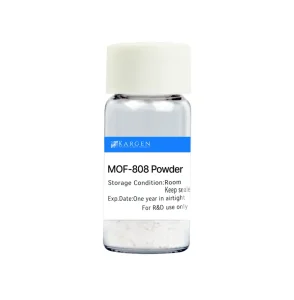
Biomethane production requires efficient removal of CO2, H2S, and residual moisture from raw landfill gas or agricultural digestate. Utilizing tailored frameworks like HKUST-1 and MOF-808 allows for sharp molecular sieving of CO2 from CH4, achieving fuel-grade biomethane purity (>98%) while minimizing methane slip loss to below 0.1%.
Global Commercial & Industrial Landscape
Analyzing global carbon markets, net-zero regulatory frameworks, and the economic shift toward solid-state MOF sorbents.
The Net-Zero 2050 Economic Imperative
With stringent global carbon pricing systems—such as the European Union Emissions Trading System (EU ETS) surpassing €80–€100 per ton of CO2—heavy industries are under immense pressure to deploy cost-effective Carbon Capture, Utilization, and Storage (CCUS) solutions. Conventional liquid amine absorption systems suffer from high energy consumption during solvent boiling (often requiring 3.5 to 4.5 GJ per ton of captured CO2), severe pipe corrosion, and thermal degradation into toxic nitrosamines. Global industrial original equipment manufacturers (OEMs) are aggressively transitioning to solid-state adsorbent beds. MOFs offer a quantum leap in energy efficiency, operating with desorption energy thresholds below 2.0 GJ/ton CO2, representing a 50% reduction in OPEX for major emitters.
Supply Chain Bottlenecks & Mass Production Breakthroughs
Historically, metal-organic frameworks were restricted to milligram-scale university research due to complex solvothermal synthesis, high organic solvent costs (e.g., DMF), and low reaction yields. KARGEN has broken this commercial bottleneck. Operating from a 10,000 m² advanced material manufacturing campus in Zhuhai, China, KARGEN leverages continuous green mechanochemical synthesis and solvent-free reaction technology to produce ton-scale MOF powders with consistent pore volume, uniform crystalline structures, and competitive industrial pricing. As leading exporters, we ensure robust supply chain stability for multi-ton industrial projects across Europe, North America, the Middle East, and Asia-Pacific.
| Technology / Adsorbent Class | CO2 Capacity (mmol/g) | Regeneration Energy (GJ/t CO2) | Hydrothermal & Chemical Stability | Industrial Scalability & Cost Factor |
|---|---|---|---|---|
| KARGEN ZIF-8 / MOF Powder | 3.5 - 5.2 | 1.8 - 2.2 | High chemical stability, water repellent, non-corrosive | Commercial Ton-Scale Supply; Lowest Lifetime OPEX |
| Aqueous Liquid Amines (MEA/MDEA) | 1.2 - 2.0 | 3.6 - 4.5 | High corrosion, chemical degradation, toxic sludge | High CAPEX & ongoing solvent replenishment |
| Synthetic Zeolites (Zeolite 13X) | 2.1 - 3.0 | 2.8 - 3.4 | Deactivates under moisture (competing H2O absorption) | Low material cost, high energy regeneration penalty |
| Activated Carbon Media | 1.0 - 1.8 | 2.4 - 3.0 | Poor CO2/N2 selectivity at low partial pressures | Low cost, inefficient for flue gas or DAC applications |
Technical Framework & Material Selection Matrix
Selecting the optimal Metal-Organic Framework for targeted carbon dioxide separation, moisture harvesting, and industrial gas catalysis.
ZIF-8 (Zinc Imidazolate Framework)
Metal Center: Zinc (Zn) | Linker: 2-Methylimidazole
Pore Window: 3.4 Å | BET Area: >1600 m²/g
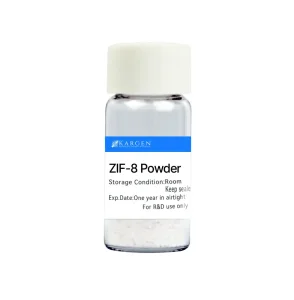
Core Advantage: Remarkable hydrophobic properties preventing water vapor poisoning. Ideal for post-combustion CO2 capture, hydrocarbon separation, and battery separator coatings.
HKUST-1 / Cu-BTC Framework
Metal Center: Copper (Cu) | Linker: Trimesic Acid (BTC)
Pore Diameter: 9 Å & 13.5 Å | BET Area: >1800 m²/g
Core Advantage: High density of open copper metal coordination sites yielding extraordinary gas binding affinities for high-pressure CO2 storage and specialty gas purification.
UiO-66 & Functionalized Derivatives
Metal Center: Zirconium (Zr) | Linker: Terephthalic Acid
Thermal Limit: Up to 500°C | BET Area: >1200 m²/g
Core Advantage: Exceptional chemical stability across harsh acidic and basic media. Amino-functionalized (NH2-UiO-66) variants show supreme chemical adsorption for dilute CO2 streams.
MOF-303 & MOF-801 Series
Metal Center: Aluminum (Al) / Zirconium (Zr) | Linker: Pyrazole/Fumarate
Adsorption Isotherm: Steep S-shaped curve at low humidity
Core Advantage: Optimized for combined atmospheric water harvesting and climate-controlled desiccant dehumidification in zero-emission industrial HVAC systems.
MIL-100(Cr) / MIL-100(Fe) Series
Metal Center: Chromium (Cr) / Iron (Fe) | Linker: BTC
Mesoporous Cages: 25 Å to 29 Å | BET Area: >2000 m²/g
Core Advantage: Large pore size allows high-volumetric loading, liquid-phase dye removal, organic pollutant degradation, and large-molecule gas catalysis.
TYUT-12 Hydrocarbon Adsorbent
Specialty Grade: Olefin / Paraffin Sieving
Pore Architecture: Custom Tuned Microporous Lattice
Core Advantage: Tailored for crack-gas separation (ethylene/ethane, propylene/propane), outperforming traditional cryo-distillation energy budgets.
Localization Support, Compliance & Global Export Security
Ensuring seamless integration with regional chemical safety regulations, international shipping standards, and corporate ESG audits.
Regulatory Frameworks & International Certifications
Navigating global compliance is vital when procuring advanced nanomaterials. KARGEN operates strictly within ISO 9001:2015 Quality Management Systems, ISO 14001 Environmental Management Systems, and ISO 45001 Occupational Health and Safety standards. All exported CO2 adsorbents, MOF powders, and dispersions are supplied with comprehensive EU REACH compliance documentation, standard GHS Safety Data Sheets (SDS in 20+ languages), certified Certificate of Analysis (CoA) per batch, and full compliance under TSCA (USA) and ECHA (Europe) chemical inventories.
Global Logistics & Custom Packaging Solutions
As premier exporters of solid-state carbon dioxide capture media, KARGEN delivers tailormade packaging solutions engineered for long-distance ocean, air, and multimodal transport. Products are sealed in climate-controlled, moisture-barrier aluminium foil vacuum bags, nitrogen-purged drums, or bulk flexible intermediate bulk containers (FIBCs). With fast-track customs clearance capabilities and bonded warehouse partners across Asia, North America, and Europe, we guarantee hassle-free DDP, CIF, or FOB delivery with zero atmospheric contamination during transit.
Localized Application Scenarios in Heavy Industry
Real-world integration blueprints detailing how KARGEN MOFs transform emissions into valuable circular resources.
Steel & Iron Metallurgy
Blast furnace gases contain high concentrations of CO, CO2, and N2. Integrating KARGEN ZIF-8 swing beds selectively separates CO2 from flue gas streams, enabling clean carbon monoxide recycling back into furnace combustion loops while providing concentrated CO2 for downstream methanol synthesis.
Cement Kiln Decarbonization
Cement manufacturing produces raw limestone calcination emissions with up to 25% CO2 concentration. Utilizing thermally stable MIL-53(Al) or UiO-66 adsorbents captures high-temperature CO2 directly from pre-calciner exhausts without requiring extensive precooling stages.
Synthetic E-Fuels & Methanol Synthesis
Capturing CO2 is the vital first step for green e-fuel production. KARGEN provides high-purity MOF adsorbents that deliver refined, water-free CO2 feedstock direct to catalytic reactors for combining with green hydrogen to synthesize carbon-neutral aviation fuels (SAF).
Technical Roadmap & Next-Generation Outlook
Innovating the frontier of computational chemistry, automated MOF synthesis, and hybrid carbon membrane contactors.
AI-Guided High-Throughput Screening
KARGEN’s R&D team, composed of returning PhD scientists from global institutions, utilizes machine learning algorithms and density functional theory (DFT) calculations to simulate millions of virtual MOF structures. By predicting adsorption energy ($Q_{st}$) and diffusion rates prior to lab synthesis, we rapidly accelerate the discovery of custom frameworks for targeted industrial gases.
Mixed-Matrix Membranes (MMMs)
The future of continuous carbon capture lies in integrating nanostructured MOF crystals into polymer membranes. KARGEN’s MOF dispersions (e.g., nano-ZIF-8 suspended in organic matrix) allow membrane fabricators to produce hollow-fiber Mixed-Matrix Membranes that break the classic Robeson upper-bound limit, combining high gas permeability with supreme CO2 selectivity.
Executive Procurement & Engineering FAQ
Authoritative technical responses to common questions raised by chemical engineers, procurement heads, and OEM integrators.
Complete Industrial MOF Powder & Material Portfolio
Explore our comprehensive catalog of metal-organic frameworks for advanced environmental, gas separation, and energy storage applications.






Partner with China’s Leading MOF Supplier & Exporter
Whether you require evaluation samples, custom ligand functionalization, or industrial ton-scale supply for carbon dioxide capture projects, our senior technical team is available 24/7.