
Featured Metal Organic Framework Materials (Part 1)
Explore high-purity crystalline powders engineered for carbon capture, environmental remediation, and specialty gas storage.







Executive Summary: The Industrial Evolution of Metal-Organic Frameworks
Transitioning from academic curiosities to bulk industrial sorbents: How MOFs are redefining chemical separation, clean energy storage, and climate tech.
Metal-Organic Frameworks (MOFs)—a unique class of porous crystalline materials synthesized via the self-assembly of inorganic metal nodes (metal ions or clusters) and organic linkers (dicarboxylic acids, azoles, or phosphonates)—represent one of the most transformative advances in material science over the last quarter-century. Characterized by unprecedented internal Brunauer-Emmett-Teller (BET) surface areas (frequently exceeding 2,000 to 7,000 m²/g), ultra-high pore volume, and atomically tailorable pore apertures, MOFs have outpaced traditional porous solids such as activated carbons, silica gels, and synthetic zeolites across high-value industrial operations.
Global Commercial & Industrial Status of MOF Materials
Understanding supply dynamics, commercial readiness levels (CRL), and industrial adoption vectors across North America, Europe, and Asia-Pacific.
Carbon Management & DAC
Global decarbonization mandates have accelerated the adoption of MOFs in Point-Source Carbon Capture and Direct Air Capture (DAC). MOFs such as CALF-20 and Zr-based frameworks demonstrate low energy penalties during thermal swing adsorption (TSA), operating efficiently in moist flue gas streams.
Semiconductor Gas Purity
Electronics OEMs utilize sub-nanometer MOF pores to safely store and deliver highly toxic dopant gases (e.g., $AsH_3$, $PH_3$) at low pressure. Sub-ppm purification of noble gases ($Ne$, $Kr$, $Xe$) eliminates costly cryo-distillation setups.
Atmospheric Water Harvesting
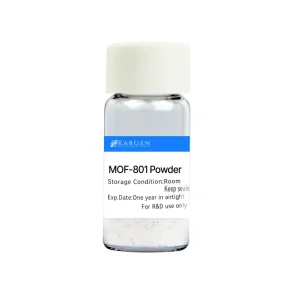
Under hyper-arid environmental conditions (RH < 20%), MOFs like MOF-801 and MOF-303 harvest potable water using low-grade solar heat ($\le 65^\circ\text{C}$), unlocking decentralized water generation without electrical grid dependency.
Historically, commercialization was constrained by the high cost of organic linkers (such as trimesic acid, 2-methylimidazole, or terephthalic acid derivatives) and solvent-intensive solvothermal synthesis pathways reliant on toxic Dimethylformamide (DMF). Today, the market has reached a tipping point. Scale-up innovations engineered by leading suppliers have shifted synthesis to mechanochemical extrusion, aqueous-phase continuous flow, and green solvent recovery systems—slashing unit costs by up to 85% over the past decade.
Next-Gen Metal-Organic Framework Examples & Technical Trends
A deep dive into benchmark structural architectures, crystallographic stability, and their primary industrial roles.
ZIF-8 (Zeolitic Imidazolate Framework-8)
Chemistry: $Zn(2\text{-methylimidazole})_2$ | Topology: SOD (Sodalite)
Renowned for exceptional hydrothermal and chemical stability in alkaline media. ZIF-8 features a pore window of $3.4\ \mathring{A}$ and cavity of $11.6\ \mathring{A}$, making it ideal for kinetic separation of propylene/propane mixtures, membrane coatings for Li-ion battery separators, and biocatalytic encapsulation.
UiO-66 & UiO-66-NH2 (Zr-Based MOFs)
Chemistry: $Zr_6O_4(OH)_4(1,4\text{-BDC})_6$ | Topology: fcu
The standard benchmark for ultra-high chemical, thermal ($> 500^\circ\text{C}$), and mechanical resilience. Highly tolerant to moisture and acidic gases. Universally applied in organic pollutant removal, catalytic destruction of chemical warfare agents, and aqueous heavy-metal adsorption.
HKUST-1 / MOF-199 (Cu-BTC)
Chemistry: $Cu_3(BTC)_2$ | Topology: tbo
Possesses a high concentration of unsaturated open copper metal sites (Lewis acid sites). Provides unmatched volumetric storage capacity for methane ($CH_4$), carbon dioxide ($CO_2$), and selective removal of polar sulfur compounds from natural gas streams.
MIL-101(Cr) & MIL-100(Al)
Chemistry: $Cr_3O(F/OH)(BDC)_3$ | Topology: mtn
Mesoporous framework boasting giant cage diameters ($29\ \mathring{A}$ and $34\ \mathring{A}$) and BET surface areas exceeding $3,500\ \text{m}^2/\text{g}$. Exceptional performance in industrial wastewater purification, dye adsorption, VOC removal, and heavy drug-delivery matrix carrier systems.
MOF-801 & MOF-303 (Water Sorbents)
Chemistry: $Zr_6O_4(OH)_4(\text{Fumarate})_6$ & $Al(\text{PZDC})$
Demonstrates steep S-shaped water sorption isotherms with inflection points below 20% RH. Operates with minimal desorption energy, enabling efficient atmospheric water generators and low-load desiccant dehumidification systems.
MOF-74(Mg) / CBO-27
Chemistry: $Mg_2(DOBDC)$ | Topology: etb
Features 1D hexagonal channels packed with ultra-dense magnesium open metal sites. Displays exceptionally high low-pressure $CO_2$ binding affinity, optimized for post-combustion coal/gas flue gas carbon capture.
Global Enterprise Procurement: Intent Analysis & Sourcing Framework
How technical directors, lead chemists, and supply chain executives qualify commercial MOF manufacturers.
When enterprise buyers submit inquiries for bulk MOF materials (ranging from kilogram sample lots to multi-ton contract manufacturing), intent shifts from academic metrics to strict industrial operational parameters. Procurement evaluation centers on four critical pillars:
1. Batch-to-Batch Purity & Phase Homogeneity
Variations in crystallinity or unreacted organic ligand residues severely alter pore accessibility. Buyers demand rigorous Powder X-ray Diffraction (PXRD) pattern matching, Thermogravimetric Analysis (TGA) activation profiles, and BET single-point surface area verification for every lot.
2. Particle Size Engineering & Shaping
Raw crystalline MOF powders cause massive pressure drops when packed into industrial adsorption columns. Exporters must offer custom particle sizing—including micro-spheres, extrudates, monoliths, coated honeycombs, and stable liquid dispersions (e.g., ZIF-8 in NMP/water for battery slurries).
3. Unit Economics & Scalable Pricing
To replace commercial activated carbon or zeolites, MOF pricing must align with lifetime operational ROI. Efficient industrial suppliers leverage high-yield, low-solvent synthesis routes to achieve target price points below $50-$100/kg at ton scale.
China Industry 4.0: Supply Chain Resilience & Manufacturing Superiority
How modern Chinese chemical production hubs leverage automated continuous synthesis and complete raw material integration to secure global supply chains.
China's strategic industrial transformation—under the Industry 4.0 manufacturing framework—has established the country as the premier international hub for mass-market Metal-Organic Framework production and exportation. Overseas buyers from North America, Japan, South Korea, and the EU increasingly rely on Chinese manufacturing partners to de-risk their material supply chains for three fundamental reasons:
Upstream Chemical Integration
China produces over 70% of the world's core organic linkers—including Benzene-1,4-dicarboxylic acid (BDC), Trimesic acid (BTC), and Imidazole derivatives—alongside high-purity transition metal salts ($ZrCl_4$, $Cu(NO_3)_2$, $Zn(CH_3COO)_2$). Direct vertical integration eliminates international raw material freight markups and lead-time delays.
Mechanochemical & Continuous Flow Synthesis
Modern Chinese factory facilities have shifted away from batch autoclaves to continuous twin-screw mechanochemical extruders and microchannel fluidic reactors. This mechanochemical technology reduces solvent consumption by up to 90%, boosts spacetime yield (STY), and guarantees high crystal reproducibility.
Digitized Quality Control Systems
Factory operations feature fully automated distributed control systems (DCS) linked to real-time inline monitoring. Inline PXRD, Nitrogen sorption porosimetry, ICP-OES metal analysis, and TGA decomposition testing are integrated directly into ISO 9001 quality workflows.
Localized Application Scenarios & Engineering Field Integration
Real-world implementation metrics illustrating how engineered MOFs solve technical roadblocks across modern industrial installations.
Case 1: Lithium-Ion Battery Separator Coatings
Material Used: ZIF-8 Sub-micron Dispersion
Engineering Integration: ZIF-8 particles coated onto polyethylene (PE) battery separators create uniform nanoporous channels. These channels regulate Li-ion flux, suppress lithium dendrite formation, and trap dissolved transition metal ions ($Mn^{2+}, Fe^{2+}$), increasing pouch-cell cycle life by 35% under fast-charging conditions.
Case 2: Industrial Flue-Gas Carbon Capture
Material Used: MOF-74(Mg) / Extruded Pellets
Engineering Integration: Installed within a dual-bed Vacuum Pressure Swing Adsorption (VPSA) unit at a petrochemical plant. The open metal sites selectively capture $CO_2$ from post-combustion streams ($15\%\ CO_2, 85\%\ N_2$) with a purity $> 95\%$, requiring regeneration temperatures under $100^\circ\text{C}$.
Case 3: Commercial HVAC Desiccant Dehumidification
Material Used: Al-FUM (Aluminium Fumarate)
Engineering Integration: Coated onto rotary honeycomb heat-exchanger wheels in energy-efficient HVAC systems. Al-FUM adsorbs water vapor with a low energy penalty and regenerates using waste heat at $65^\circ\text{C}$, cutting commercial air-conditioning energy consumption by 40%.
Comprehensive MOF Benchmark Comparison Matrix
Direct technical property baseline to guide lab screening, pilot development, and commercial sourcing decisions.
| MOF Grade | Metal Center | Organic Linker | BET Area ($m^2/g$) | Pore Window ($\mathring{A}$) | Thermal Limits | Primary Industrial Vector |
|---|---|---|---|---|---|---|
| MOF-5 | $Zn_4O$ cluster | 1,4-BDC | 2,500 - 3,200 | 13.8 | $400^\circ\text{C}$ | Hydrogen Storage, Gas Sensing |
| UiO-66 | $Zr_6O_4(OH)_4$ | 1,4-BDC | 1,100 - 1,500 | 6.0 | $500^\circ\text{C}$ | Catalysis, Acid-Gas Removal |
| MOF-801 | $Zr_6O_4(OH)_4$ | Fumaric Acid | 800 - 1,000 | 5.6 / 7.4 | $350^\circ\text{C}$ | Water Harvesting, Desiccants |
| MOF-74(Mg) | $Mg^{2+}$ | 2,5-DOBDC | 1,400 - 1,800 | 11.0 | $400^\circ\text{C}$ | Low-Pressure CO2 Capture |
| MIL-101(Cr) | $Cr^{3+}$ octahedra | 1,4-BDC | 3,000 - 4,000 | 12.0 / 16.0 | $350^\circ\text{C}$ | Wastewater Treatment, VOC Capture |
| TYUT-12 | Engineered Node | Custom Ligand | 1,600 - 2,200 | Tailored | $300^\circ\text{C}$ | Selective Hydrocarbon Separation |
| ZIF-8 | $Zn^{2+}$ | 2-Methylimidazole | 1,300 - 1,800 | 3.4 | $420^\circ\text{C}$ | C3H6/C3H8 Separation, Li-Battery Coating |
| MOF-303 | $Al^{3+}$ | PZDC | 1,100 - 1,400 | 6.0 | $300^\circ\text{C}$ | Arid-Zone Water Generation |
| MIL-100(Al) | $Al^{3+}$ | BTC (Trimesate) | 1,800 - 2,300 | 5.5 / 8.6 | $350^\circ\text{C}$ | Eco-Friendly Adsorption Heat Pumps |
| HKUST-1 | $Cu^{2+}$ dimer | BTC (Trimesate) | 1,500 - 2,100 | 9.0 | $250^\circ\text{C}$ | Specialty Gas Storage & Purification |
Featured Metal Organic Framework Materials (Part 2)
Explore additional high-grade MOF powders and customized formulations engineered for global export.




Frequently Asked Questions (Technical & Procurement Guidance)
In-depth technical answers addressing common evaluation, scale-up, and export logistics queries from global industrial buyers.