
High-Quality MOF-303 Powder Metal Organic Frameworks (MOFs) Service, Exporter
Product Description
| Product Name | MOF-303 |
| Particle size | ≈0.2 μm |
| Specific surface area | ≥1100 ㎡/g |
| Pore size | 0.3~0.5 nm |
Modified versions of MOF-303, such as the mixed-linker variant, have shown enhanced separation performance for water and ethanol, achieving improved mass flux and stability compared to the unmodified form. The mixed-linker MOF-303(50/50) exhibited a water/ethanol separation factor of 8500, indicating its effectiveness in this application.
MOF-303 serves as an effective adsorbent for capturing sulfur dioxide (SO₂), demonstrating high selectivity over methane (CH₄) and carbon dioxide (CO₂), which is crucial for mitigating catalyst poisoning in energy applications.
A functionalized magnetic probe based on MOF-303 has been developed for the efficient analysis of N-linked glycopeptides, showcasing its utility in clinical diagnostics and glycoproteomics.
Overall, MOF-303's versatility across these domains highlights its importance in advancing both industrial and biomedical applications.
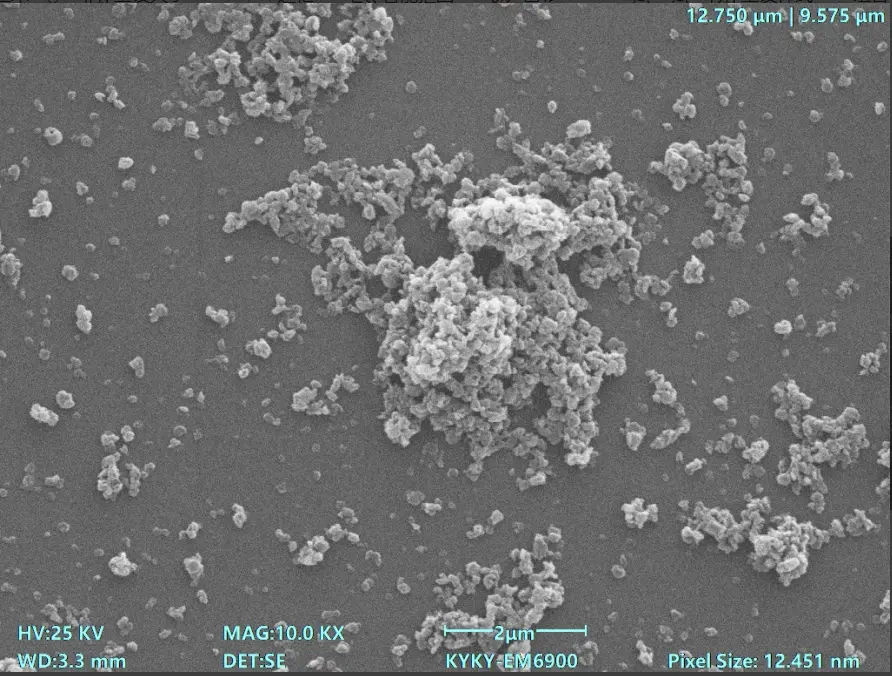
MOF-303 features a particle size of approximately 0.2 μm, a high specific surface area of ≥1100 ㎡/g, and a controlled pore size ranging from 0.3 to 0.5 nm.
Modified versions such as the mixed-linker MOF-303(50/50) demonstrate exceptional pervaporation performance with a water/ethanol separation factor of up to 8500, delivering higher mass flux and structural stability.
MOF-303 exhibits high adsorption selectivity for sulfur dioxide (SO₂) over methane (CH₄) and carbon dioxide (CO₂), making it highly effective for preventing catalyst poisoning in energy applications.
MOF-303 can be functionalized into a magnetic probe for the efficient analysis of N-linked glycopeptides, rendering it valuable in glycoproteomics and clinical diagnostic workflows.
Yes, MOF-303 can be modified (e.g., creating mixed-linker variants or functionalized magnetic probes) to optimize performance for specific industrial separations or scientific diagnostics.









