
Best MOF Gas Sensor Suppliers & Industrial OEM Solution Directory
Comprehensive Technical Roadmap, Information-Gain Analysis, and High-Surface-Area Metal-Organic Framework Material Procurement for Sub-ppm Chemical Sensing & Environmental Monitoring
Explore our primary catalog of high-purity, scalable Metal-Organic Frameworks optimized for selective gas detection, air purification, and energy harvesting.
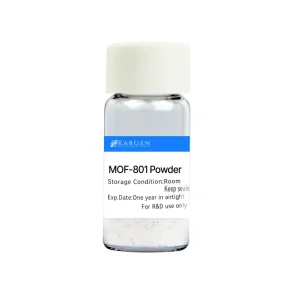





Metal-Organic Frameworks (MOFs) represent a paradigm shift in chemical sensing architectures. By combining crystalline inorganic nodes with functional organic linkers, MOFs offer unprecedented surface areas (up to 7,000 m²/g), atomic-level pore tunability, and tailorable chemical affinity. For procurement directors and sensor integration engineers, sourcing from qualified MOF gas sensor suppliers ensures access to ultra-selective, sub-ppm detection layers for hazardous, explosive, and volatile organic compounds (VOCs).
Through pre-concentration mechanisms engineered into frameworks such as MOF-303 and ZIF-8, gas molecules are physically entrapped within uniform micropores, amplifying local chemical signals for Quartz Crystal Microbalance (QCM), Surface Acoustic Wave (SAW), and Chemiresistive transducers.
Functionalization with amine groups (e.g., NH2-MIL-101(Fe)) or open metal sites (e.g., HKUST-1, MOF-74(Mg)) enables targeted coordination bonds with polar gases like NH3, H2S, and CO2, achieving selectivity ratios exceeding 100:1 against ambient N2, O2, and moisture.
Elimination of thermal micro-heaters allows MOF-integrated micro-electro-mechanical systems (MEMS) to operate seamlessly within battery-powered IoT environmental monitors, wearable industrial safety badges, and remote pipeline leak detectors.
The transition of Metal-Organic Frameworks from laboratory academic synthesis to industrial scale-up represents one of the fastest advancements in advanced materials science. Our R&D vision aligns with global semiconductor and environmental monitoring trends.
Integration of MOF powders (MIL-100, MOF-177) into micro-GC gas chromatography channels to concentrate trace pollutants prior to optical or thermal detection.
Direct liquid-phase epitaxial growth of highly oriented surface-mounted MOF thin films onto interdigitated electrodes for ultra-fast response times (<2 seconds).
Engineering intrinsic electrical conductivity into 2D conjugated MOF nanosheets, facilitating direct chemiresistive sensing without requiring host polymer matrices.
Multi-array "electronic noses" combining 4–8 distinct MOF coatings (e.g., ZIF-8, TYUT-12, MOF-801) parsed by edge-AI pattern recognition algorithms for complex gas mixture deconvolution.
Different market segments demand distinct chemical stability profiles, pore aperture geometries, and functional ligand arrays. Below is an engineering matrix detailing optimized MOF selection for major industrial verticals.
| Industry Vertical | Target Analyte / Gas | Optimal MOF Framework | Sensing Mechanism | Key Operational Advantage |
|---|---|---|---|---|
| Semiconductor Fabs | Trace Moisture & Toxic Silanes | MOF-303 / MOF-801 | Gravimetric (QCM) | Hydrophilic micropores capture sub-ppm moisture without fouling cleanroom gases. |
| Automotive & HVAC | Cabin CO2 & VOCs (Formaldehyde) | ZIF-8 / MOF-74(Mg) | Optical / Luminescent | High thermal stability up to 400°C; robust in fluctuating relative humidity. |
| Petrochemical & Energy | C1-C4 Hydrocarbons & H2S | TYUT-12 / MIL-101(Fe) | Chemiresistive | Precise pore aperture enables thermodynamic separation and real-time detection. |
| Medical & Breath Care | Exhaled Acetone & Ammonia | NH2-MIL-101(Fe) / MIL-100(Cr) | Surface Acoustic Wave | Amine functionalization offers strong hydrogen-bonding affinity for bio-markers. |
| Green Hydrogen Safety | Trace H2 Leaks (<4% LFL) | MOF-177 / Custom Pd-MOF | Kelvin Probe / Capacitive | Catalytic stability prevents false alarms caused by atmospheric hydrocarbon background. |
Historically, widespread commercial adoption of Metal-Organic Frameworks was constrained by high precursor solvent costs and low batch-yield solvothermal synthesis. Our state-of-the-art manufacturing infrastructure in China overcomes these bottlenecks through green mechanochemical continuous processing.
Equipped with continuous twin-screw extruders and industrial fluid-bed jet mills, our production lines yield multi-ton commercial quantities of ZIF-8, MOF-303, and MIL-series powders annually with uncompromised crystallinity and Brunauer-Emmett-Teller (BET) surface area ratings.
Every single batch undergoes rigorous analytical quality control, including Powder X-Ray Diffraction (PXRD), Thermogravimetric Analysis (TGA), and Nitrogen Sorption Isotherm verification to guarantee zero drift in sensitivity during mass device integration.
By shifting to solvent-free mechanochemical grinding and aqueous-phase synthesis, we reduce hazardous liquid waste by 92%, satisfying international ESG standards and securing EU REACH / US TSCA regulatory compliance for tier-1 global enterprise buyers.
When selecting a reliable MOF supplier for commercial sensor manufacturing or OEM contract engineering, procurement teams must evaluate key technical metrics beyond unit pricing. Below is an essential vendor qualification framework.
For thin-film deposition (spin coating, spray coating, inkjet printing), sub-micron or nanometer particle sizes (100 nm – 500 nm) are mandatory to prevent nozzle clogging and ensure homogeneous film thickness. Request particle sizing data (D10, D50, D90) prior to bulk orders.
Gas sensors deployed in real-world ambient conditions encounter humidity fluctuations. Frameworks based on high-valence metal ions such as Zr4+ (UiO-66), Fe3+ (MIL-101), or Al3+ (MIL-53) offer superior structural stability compared to legacy zinc or copper frameworks when exposed to water vapor.
If standard commercial powders do not meet target analyte sensitivity targets, partner with suppliers capable of custom organic synthesis (e.g., nitro, amino, hydroxyl, or halogenated linker modifications) and pre-dispersed ink formulations.
Seamless international delivery is critical for continuous industrial production lines. We maintain comprehensive global shipping protocols, regulatory documentation, and technical support frameworks.
All MOF shipments include bilingual Safety Data Sheets (SDS), COA certificates, and compliance documentation for air and sea freight according to IATA and IMDG regulations.
To streamline early-stage prototype screening, qualified corporate R&D units can obtain 1g to 5g evaluation samples dispatched within 48 hours, backed by direct Ph.D. scientific consultation.
We respect proprietary OEM device designs. All custom synthesis requests and joint development agreements (JDA) are protected under legally binding non-disclosure agreements.
Browse the remaining selection of high-surface-area metal organic frameworks, functionalized powders, and specialized adsorbents available for factory-direct dispatch.



Engineering and sourcing queries answered by our senior materials research team to support your vendor audit and technical qualification.