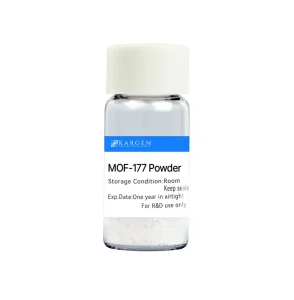
Featured Metal-Organic Framework Powders
Explore our benchmark industrial-grade MOF powders engineered for ultra-high surface area, crystal purity, and thermal resilience across global industrial scale deployments.





Mechanochemical Synthesis
Environmentally conscious solvent-free or solvent-minimal continuous production ensuring lot-to-lot crystallographic consistency and reduced production overhead.
Custom Linker & Node Engineering
Full-spectrum custom synthesis: tailored pore apertures, unsaturated open metal sites, functionalized organic ligands (e.g., -NH2, -COOH, -SO3H), and shaped extrudates.
Tier-1 Quality Assurance
Every shipment comes verified by Powder X-Ray Diffraction (PXRD), N2 Physisorption (BET surface area), and Thermogravimetric Analysis (TGA) characterization data.
Comprehensive Technical Breakdown: Metal-Organic Frameworks (MOFs)
Metal-Organic Frameworks (MOFs) represent a transformative class of crystalline porous materials composed of metal ions or clusters coordinated to organic linkers. Characterized by unparalleled permanent porosity, ultra-high specific surface areas (frequently exceeding 2,000 to 7,000 m²/g), and molecularly tunable pore geometries, MOFs are fast superseding legacy adsorbents such as activated carbon, zeolites, and silica gels across modern chemical processing.
As industrial processes transition toward decarbonization, high-purity gas purification, and low-energy separations, selecting the best MOF powder service and exporter becomes a critical strategic imperative. Global EPC firms, energy conglomerates, semiconductor manufacturers, and battery developers require not merely bench-scale chemistry, but dependable ton-scale manufacturing, precise morphological control, chemical robustness, and comprehensive localized support.
Deep Dive: Core MOF Topologies & Industrial Applications
1. ZIF-8 (Zinc Imidazolate Framework)
ZIF-8 (comprising Zn²⁺ metal nodes bridged by 2-methylimidazole) is celebrated for its extraordinary thermal stability (up to 500°C in inert atmospheres) and exceptional chemical stability in boiling water and alkaline solutions. Featuring a sodalite (SOD) topology with 3.4 Å pore windows opening into a 11.6 Å cavity, ZIF-8 is the industry standard for:
- Lithium-Ion Battery Separator Coatings: Modulating lithium-ion transport dynamics, mitigating dendrite formation, and enhancing ionic conductivity.
- Kinetic Olefin/Paraffin Separation: Rapidly separating propylene from propane based on sub-nanometer molecular sieving.
- Heterogeneous Catalysis: Serving as a robust catalyst support for organic transformations.
2. HKUST-1 (Cu-BTC Framework)
Formed by copper metal nodes linked via 1,3,5-benzenetricarboxylate (BTC), HKUST-1 features a 3D intersecting pore network with open coordination copper sites. It exhibits exceptionally high volumetric storage density for light gases. Prime use cases include:
- Specialty Gas Storage & Delivery: Safe storage of toxic electronic gases (phosphine, arsine, silane) for semiconductor fabs.
- Natural Gas (Methane) Storage: Adsorbed Natural Gas (ANG) technology for clean transport.
- Trace Moisture Adsorption: Deep desiccant drying for non-aqueous streams.
3. MOF-74 Series (Mg, Fe, Ni, Co)
MOF-74 features a 1D hexagonal channel structure densely packed with open metal cation sites. MOF-74(Mg) demonstrates unmatched CO₂ adsorption capacities at low partial pressures, making it indispensable for flue gas carbon capture (CCUS) and Direct Air Capture (DAC) systems.
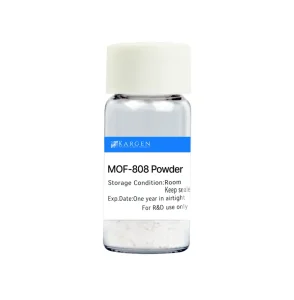
4. KAUST-7 & MOF-808 (Zr-Based Frameworks)
Zirconium-based MOFs like MOF-808 and fluorinated frameworks like KAUST-7 offer ultra-high chemical stability in acidic, humid, and corrosive media. KAUST-7 exhibits molecular exclusion mechanisms tailored specifically for selective CO₂ capture from gas mixtures containing moisture and sulfur compounds, eliminating expensive pre-drying steps.
5. MIL Series (MIL-100(Fe), MIL-101(Fe), MIL-88A(Fe))
Materials of Institute Lavoisier (MIL) frameworks utilize non-toxic, earth-abundant Iron (Fe) nodes. MIL-100(Fe) and MIL-101(Fe) feature mesoporous cages (up to 34 Å) permitting the encapsulation of bulky bio-molecules, active pharmaceutical ingredients (APIs), and heavy metal contaminants for wastewater remediation.
Quantitative MOF Performance Matrix
| MOF Topology | Metal Node / Linker | BET Surface Area (m²/g) | Pore Aperture (Å) | Primary Industrial Application |
|---|---|---|---|---|
| ZIF-8 | Zn / 2-Methylimidazole | 1,300 – 1,800 | 3.4 / 11.6 | Battery Separator Coatings, C3H6/C3H8 Separation |
| HKUST-1 | Cu / Trimesic Acid (BTC) | 1,500 – 2,100 | 9.0 x 9.0 | Semiconductor Gas Purification, ANG Storage |
| MOF-74(Mg) | Mg / 2,5-Dihydroxyterephthalate | 1,200 – 1,500 | 11.0 | Low-Pressure CO₂ Capture, Flue Gas Decarbonization |
| MOF-808 | Zr / Trimesic Acid | 1,600 – 2,200 | 18.4 | Acidic Water Remediation, Heavy Metal Trapping |
| MIL-101(Fe) | Fe / Terephthalic Acid | 2,000 – 3,500 | 29.0 / 34.0 | Drug Delivery Systems, Wastewater Decontamination |
| KAUST-7 | Nb-Al / Pyrazine-Fluoride | 600 – 900 | 3.0 – 4.0 | Direct Moisture-Tolerant CO₂ Capture |
China's Manufacturing & Supply Chain Advantages in MOF Production
Historically, MOF commercialization was stymied by prohibitive production costs, high solvent consumption (e.g., DMF, DEF), and batch-to-batch inconsistency. China has emerged as the global epicenter for industrial-scale MOF manufacturing, overcoming these hurdles through several key structural advantages:
- Upstream Chemical Integration: China controls over 70% of global basic chemical precursor capacity, including organic linkers (terephthalic acid, trimesic acid, imidazoles) and high-purity metal salts (zirconium oxychloride, copper nitrate, zinc acetate). This raw material proximity translates directly into low bill-of-materials costs.
- Mechanochemical & Continuous Flow Innovations: Leading Chinese manufacturers have pioneered green mechanochemical synthesis (twin-screw extrusion without liquid solvent) and continuous-flow hydrothermal reactors. This dramatically reduces volatile organic compound (VOC) emissions while lowering energy input by up to 60%.
- Scalable Infrastructure & Ecosystem: With 10,000+ m² automated facilities dedicated to nanomaterial synthesis, Chinese MOF exporters can seamlessly transition customer orders from 10-gram evaluation samples to multi-ton commercial contracts within compressed timelines.
Custom OEM/ODM Synthesis: Tailoring MOFs to Exact Process Needs
Off-the-shelf MOF powders do not always fit every proprietary industrial module. Global enterprise procurement teams frequently require customized modifications:
Post-Synthetic Modification (PSM)
Chemical modification of organic linkers post-crystallization (e.g., amine grafting) to boost affinity for specific gas species like amine-functionalized MOFs for ultra-selective CO₂ binding.
Formulation & Shaping Engineering
Raw MOF powders can cause pressure drop issues in packed-bed reactors. We provide customized pelletization, extrusion into cylindrical granules, spherical bead formation, and wash-coating onto ceramic/metallic honeycombs.
Global Regulatory Compliance, Quality Assurance & Logistics
Exporting advanced nano-materials globally requires strict adherence to international regulatory frameworks. Reliable MOF service providers ensure absolute compliance:
- Regulatory Certifications: Compliance with EU REACH (Registration, Evaluation, Authorisation and Restriction of Chemicals), US TSCA (Toxic Substances Control Act), and RoHS/REACH SVHC declarations.
- Packaging Integrity: MOF powders possess intense moisture and gas affinity. Standard export packaging utilizes double-layer vacuum-sealed aluminum foil bags enclosed within moisture-proof UN-certified steel drums or high-density fiber drums filled with inert argon gas blanket.
- Localized Technical Support: Regional technical teams in North America, Europe, and Asia-Pacific provide assistance with on-site integration, dispersion optimization, safety data sheet (SDS) translation, and customs clearance paperwork.
Future Outlook & Regional Market Trends (2025–2035)
The global MOF market is projected to expand at a CAGR exceeding 28.5% over the next decade. Key regional drivers include:
- North America: Massive federal funding for CCUS, Direct Air Capture hubs, and clean hydrogen infrastructure driving demand for MOF-74 and Zr-based MOFs.
- Europe: Strict ESG mandates and energy transition policies driving adoption of MOF-coated heat exchangers for low-energy HVAC and sorption cooling.
- Asia-Pacific: Rapid growth in EV battery manufacturing, where ZIF-8 slurries and coatings improve safety and ion kinetics in solid-state and advanced lithium-ion chemistries.
Expert Answers for MOF Procurement & R&D Teams
Technical and logistics guidance directly from our senior material scientists and global trade team.
Customized & Specialty MOF Formulations
Discover tailored metal-organic frameworks designed for specialized drug delivery, precise gas storage, and custom chemical industrial processing.