
Core Nanomaterial & Advanced HVAC Sorbent Supply (Part I)
Precision Metal-Organic Frameworks (MOFs) driving solid-state desiccant cooling and ultra-low energy air conditioning performance worldwide.






Executive Summary: The Global Energy-Efficient AC Imperative
Navigating carbon regulations, grid constraints, and advanced material innovations in modern enterprise HVAC infrastructure.
Grid Strain & Decarbonization Mandates
Commercial HVAC systems account for over 40% of total electrical energy consumption in modern enterprise facilities and data centers. With regulatory frameworks like the EU Energy Efficiency Directive, US Inflation Reduction Act (IRA) tax credits, and global ESG disclosure requirements tightening worldwide, industrial buyers can no longer rely on incremental efficiency gains from standard vapor-compression chillers.
The Latent Heat Load Bottleneck
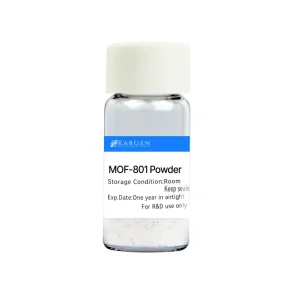
Traditional air conditioning systems overcool air below its dew point solely to remove moisture (latent load), before reheating it for thermal comfort (sensible load). This thermodynamic inefficiency wastes up to 50% of operating power. Advanced nanostructured sorbents—such as MOF-801 and Al-FUM—decouple sensible cooling from latent dehumidification, unlocking dramatic efficiency thresholds.
Material-Driven HVAC Transformation
By engineering high-surface-area Metal-Organic Frameworks into heat exchanger coatings and desiccant wheels, equipment manufacturers (OEMs) and commercial service suppliers achieve low-temperature waste heat regeneration (under 70°C). This allows industrial facilities to run high-efficiency AC networks off low-grade industrial exhaust steam or solar thermal energy.
Quantitative Performance Benchmarks
Field-validated operational impact of next-generation high-efficiency AC installations across industrial campuses.
Enterprise AC Procurement & Lifecycle TCO Framework
A strategic guide for VP of Infrastructure, Procurement Directors, and Industrial Facility Managers evaluating tier-1 HVAC suppliers.
Total Cost of Ownership (TCO) Shift
Capital Expenditure (Capex) represents only 12% to 15% of an industrial chiller’s 15-year lifecycle cost. The remaining 85% is consumed by ongoing electrical power, water treatment for cooling towers, and maintenance services. Procuring high-efficiency AC equipment backed by low-maintenance sorbents yields exponentially lower lifetime OpEx.
Supplier Verification & SLA Compliance
Global enterprises must vet AC suppliers based on ISO 5001 energy management compliance, AHRI 550/590 performance ratings, and 24/7 Service Level Agreements (SLAs). Top suppliers provide remote IoT telemetry for predictive maintenance, guaranteeing 99.99% uptime for mission-critical industrial facilities.
Refrigerant Transition (GWP & PFAS Compliance)
As global regulations phase out high-Global Warming Potential (GWP) hydrofluorocarbons (HFCs) under the Kigali Amendment, premier suppliers are transitioning to ultra-low GWP refrigerants (such as R-1234yf, R-290, and R-32) combined with solid-state moisture capture beds.
Technological Architecture Comparison
Evaluating conventional HVAC technologies against MOF-enhanced solid-state energy efficient AC systems.
| Performance Dimension | Standard DX Vapor Compression | Chilled Water System (VFD) | MOF-Coated SDC + Hybrid Chiller |
|---|---|---|---|
| Sensible & Latent Handling | Coupled (Requires overcooling) | Coupled (High pump loss) | Fully Decoupled (Zero overcooling) |
| Average Seasonal COP / EER | 2.8 – 3.5 COP | 4.2 – 5.1 COP | 6.8 – 8.5 COP Equivalent |
| Regeneration Energy Source | 100% High-Grade Electricity | 100% High-Grade Electricity | Low-Grade Waste Heat (<65°C) / Solar |
| Refrigerant Charge Volume | 100% Full Chemical Charge | Moderate (Primary Loop) | Reduced by 40-60% |
| Dehumidification Efficiency | Low (Energy Intensive) | Moderate | Ultra-High (Isothermal Sorption) |
| Enterprise ESG / Carbon Footprint | Baseline High Impact | 25% Reduction Potential | Up to 60% Lifetime Reduction |
Global Enterprise Application Sectors
Tailored high-efficiency cooling architectures deployed across demanding industrial and commercial environments.
Hyperscale Data Centers & AI Compute Clusters
High-density rack arrays generate immense sensible thermal loads requiring continuous cooling. Integrated liquid-to-air cooling coupled with MOF desiccant air prep units eliminates condensation risks while maintaining targeted relative humidity (40-55% RH) without energy-intensive reheating cycles.
Pharmaceutical & Cleanroom Manufacturing
Precision manufacturing spaces demand strict environmental controls (±0.5°C temperature tolerance and ±2% RH control). Utilizing chemical sorbents such as MIL-101(Al) and KAUST-7 ensures ultra-pure air filtration, moisture capture, and volatile organic compound (VOC) removal in a single pass.
Commercial Real Estate & Mixed-Use Complexes
Large commercial towers benefit from centralized variable refrigerant flow (VRF) and enthalpy recovery systems. Integrating low-regeneration desiccant wheels cuts central chiller plant size requirement by 35%, drastically reducing initial installation capex and electrical transformer footprint.
Frequently Asked Questions (FAQ)
Expert insights regarding energy efficient AC service selection, sorbent integration, maintenance, and enterprise deployment.
Core Nanomaterial & Advanced HVAC Sorbent Supply (Part II)
Explore our complete industrial portfolio of synthetic framework powders tailored for gas separation, liquid purification, and cooling efficiency.





