
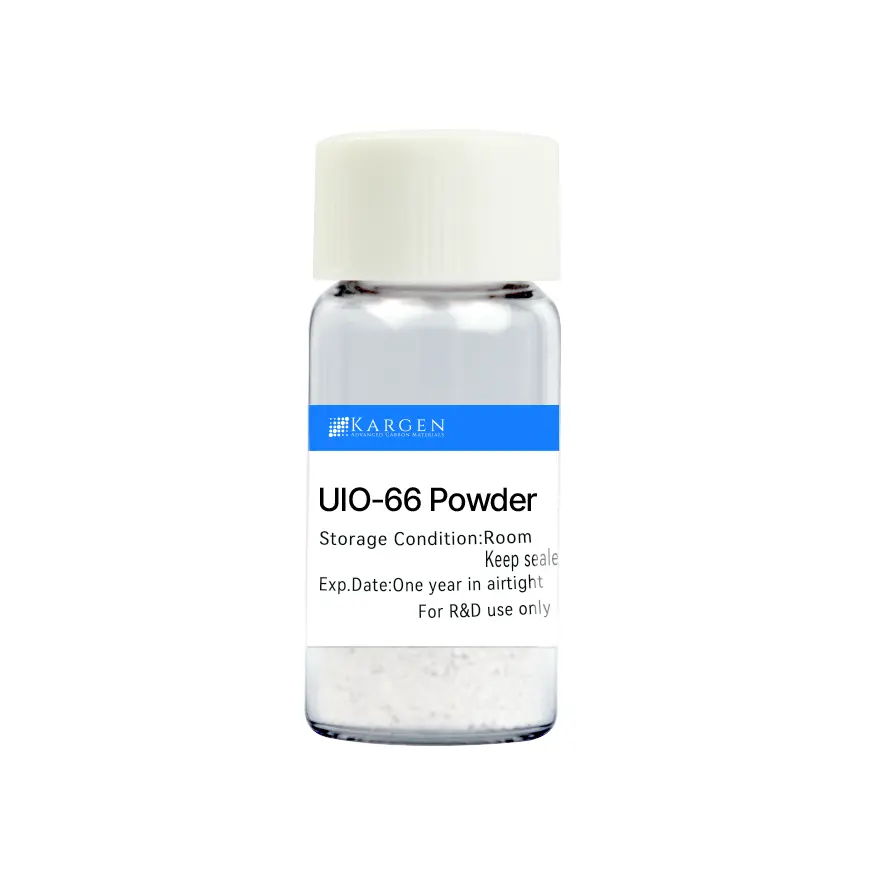
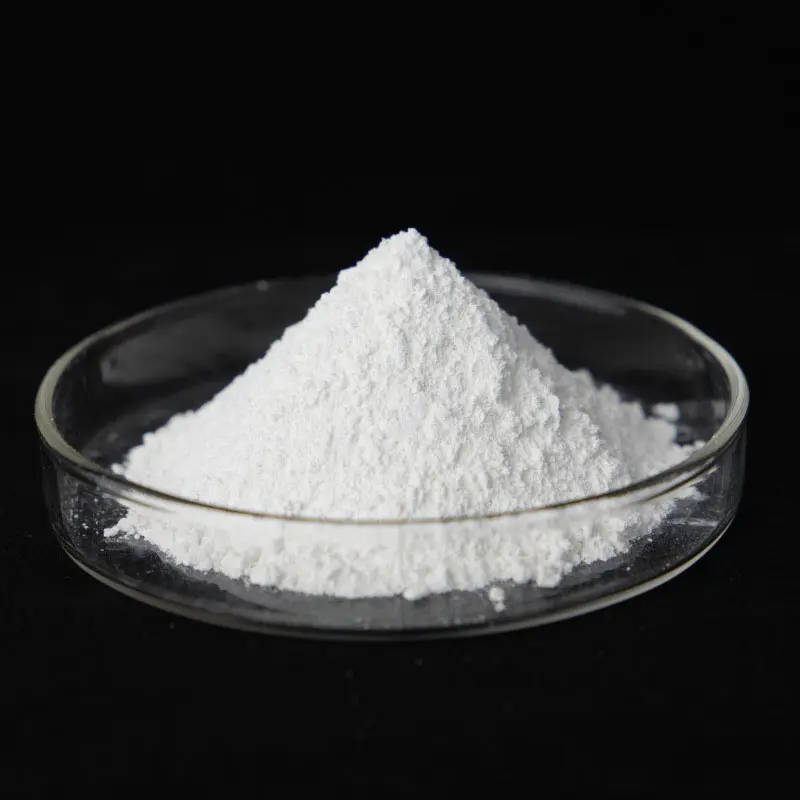
High-Quality UIO-66 Powder Metal Organic Frameworks (MOFs) Suppliers, Exporters

UiO-66 is a crystal containing metal nodes composed of a zirconium oxide complex bridged by terepthalic acid ligands. UiO-66 is reported by Lillerud’s group a decade ago, it was first synthesized in the University of Oslo, so it is named after the university. UiO-66 can be applied in areas such as catalysis, photocatalysis, adsorption separation, sensors, and even in biomedicine. 

Product Description

Product Name UiO-66
Particle Size 100~200 nm
Specific Surface Area ≥1000 ㎡/g
Pore Size 0.35~1.5 nm

This crystal is a face-centered-cubic structure containing an fm-3m symmetry with a lattice parameter of 20.7 Å. It contains two separate cages, a tetrahedron cage of 7.5 Å, another an octahedron cage of 12 Å, and a pore aperture of 6 Å. The theoretical pore volume of UiO-66 is 0.77 cm³/g, and the surface area is 1160 m²/g. UiO-66 is of the fcu topology. The use of this system for MOFs includes defining the inorganic node as a secondary building unit (SBU) and classifying the zirconium oxide node in UiO-66 as cuboctahedral, allowing up to 12 points of extension for BDC struts to coordinate.

Half of the eight oxygen atoms in the hydroxylated version of this SBU are bound to three zirconium atoms as individual atoms, and the remaining oxygen atoms are bound to three zirconium atoms in hydroxide form. UiO-66 is known for its high stability and coordination.

The highly tunable nature of this exceedingly stable MOF allows strategies such as doping and postsynthetic modifications to add functionalities for their specific applications. It is anticipated that this research will continue to advance into many different fields as there have been many exciting prospects for the application of UiO-66 in areas such as catalysis, photocatalysis, adsorption separation, sensors, and even in biomedicine.
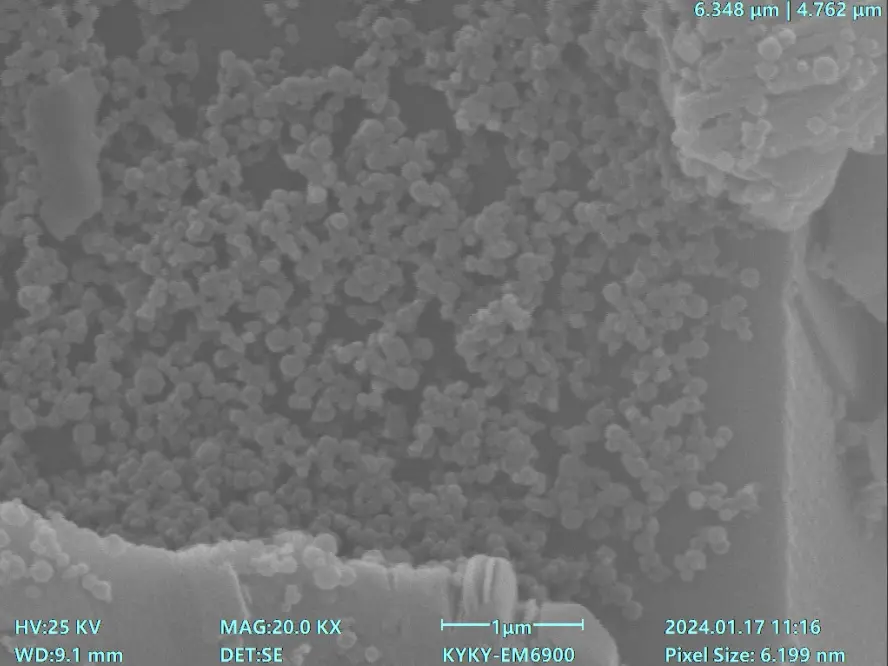

KAR-F30 UiO-66
Frequently Asked Questions
What is the particle size and surface area of UiO-66?
UiO-66 features a particle size ranging from 100 to 200 nm, a specific surface area of ≥1000 ㎡/g, and a theoretical surface area of 1160 m²/g.
What is the pore structure and cage sizes of UiO-66?
UiO-66 has a pore size of 0.35 to 1.5 nm with a pore aperture of 6 Å. It consists of two separate cages: a 7.5 Å tetrahedron cage and a 12 Å octahedron cage, yielding a theoretical pore volume of 0.77 cm³/g.
What crystal symmetry does UiO-66 possess?
UiO-66 has a face-centered-cubic structure with fm-3m symmetry, featuring a lattice parameter of 20.7 Å and an fcu topology.
Why is UiO-66 known for high chemical stability and tunability?
UiO-66 incorporates cuboctahedral zirconium oxide nodes (allowing up to 12 points of extension for BDC struts), giving it outstanding stability. Its structure permits modification via doping and postsynthetic techniques to tailor functionalities.
What are the main application fields for UiO-66?
UiO-66 is widely applied in catalysis, photocatalysis, adsorption separation, chemical sensors, and biomedicine.

Related Products








