Precision-Engineered Metal-Organic Frameworks
Direct factory supply of high-purity MOF powders, featuring verified Brunauer-Emmett-Teller (BET) surface areas, tailored crystallite size distributions, and scalable manufacturing consistency.





1. Comprehensive Technical Definition of Metal-Organic Frameworks (MOFs)
Metal-Organic Frameworks (MOFs) represent a revolutionary class of ultra-porous, crystalline hybrid materials constructed from metal ions or metal-oxo clusters (termed Secondary Building Units, or SBUs) coordinated with polyfunctional organic linkers (such as carboxylates, azoles, or phosphonates). Through the principles of Reticular Chemistry, these inorganic and organic building blocks self-assemble into extended one-, two-, or three-dimensional periodic coordination networks possessing unprecedented pore volumes, tuneable pore geometries, and record-breaking internal surface areas reaching up to 7,000 m²/g.
Unlike traditional inorganic sorbents such as zeolites or amorphous activated carbons, MOFs possess a deterministic atomic architecture. By altering the chemical identity of the metal node (e.g., $Zr^{4+}$, $Al^{3+}$, $Fe^{3+}$, $Zn^{2+}$, $Cu^{2+}$) or modifying the length, functionalization, and geometry of the organic ligand (e.g., terephthalic acid, fumaric acid, trimesic acid, 2-methylimidazole), materials scientists can tune pore apertures with sub-angstrom precision. This sub-nanometer tailorability enables targeted guest-host molecular recognition, optimal thermodynamic heats of adsorption ($Q_{st}$), and extraordinary kinetic separation selectivities.
The primary advantage of engineered MOFs lies in their dual-sorption mechanism: physical confinement within uniform micropores combined with chemical chemisorption via unsaturated coordinatively open metal sites (OMS) or hydrogen-bonding ligand backbones. This dual action facilitates high volumetric uptake at low partial pressures, a requisite for Direct Air Capture (DAC) and gas purification.
Benchmark Physical-Chemical Comparison Matrix
To understand the industrial competitive advantage of Metal-Organic Frameworks, a rigorous comparative analysis against conventional industrial adsorbents is outlined below:
| Adsorbent Metric / Parameter | Metal-Organic Frameworks (MOFs) | Synthetic Zeolites (e.g., 13X, 5A) | Activated Carbon | Mesoporous Silica (e.g., SBA-15) |
|---|---|---|---|---|
| BET Surface Area (m²/g) | 1,000 – 7,000+ | 400 – 900 | 800 – 1,800 | 600 – 1,000 |
| Pore Structure & Distribution | Crystalline, strictly uniform (0.3 – 5.0 nm) | Crystalline, rigid uniform (0.3 – 1.0 nm) | Amorphous, broad micro/mesoporous | Ordered mesoporous (2.0 – 30.0 nm) |
| Chemical Tailorability | Infinite (Nodes & Linkers modification) | Limited (Si/Al ratio adjustment) | Very Low (Surface functional groups) | Moderate (Post-synthetic silanization) |
| Regeneration Energy Penalty | Low to Moderate (30–70 kJ/mol) | High (80–120 kJ/mol) | Moderate (40–80 kJ/mol) | Moderate (40–70 kJ/mol) |
| Water Harvesting Isotherm Type | Stepwise S-Shape (Tunable RH threshold) | Type I (High uptake only at low RH) | Type V (Low affinity for water) | Type V (Irregular hysteresis) |
| Volumetric Gas Density | Exceptional (Approaching liquid storage) | Moderate | Low to Moderate | Low |
2. Global Industry Trends & Reticular Materials Evolution
The global market for advanced solid-state adsorbents is undergoing a paradigm shift. Historically confined to academic research laboratories due to high linker costs and low-yield batch solvothermal synthesis, MOFs are now fully entering the commercial industrialization era. Key technology trends driving this market acceleration include:
- Transition from Solvothermal to Green Mechanochemical & Continuous Flow Synthesis: Modern manufacturing has evolved away from energy-intensive, dimethylformamide (DMF)-dominated solvothermal reactors. Today's top exporters employ solvent-free mechanochemical extrusion, aqueous phase reaction circuits, and continuous-flow microfluidic synthesis, lowering manufacturing carbon footprints while driving bulk material costs down towards industrial feasibility.
- Development of MOF Matrix Mixed Membranes (MMMs): Incorporating MOF nanoparticles into polymeric matrices (such as polyimides, polysulfones, or PVDF) resolves trade-offs between membrane permeability and selectivity (the Upper Bound limit), creating high-flux battery separators and gas-separation membranes.
- Shaped Formulations (Pellets, Monoliths, Extrudates & Coatings): Raw MOF synthesis yields sub-micron powders, which can cause severe pressure drops in industrial packed-bed contactors. Advanced exporters provide specialized MOF shaping services—transforming powders into attrition-resistant extrudates, honeycombed monoliths, or wash-coated metal exchangers without blocking crystalline pore entrances.
- Machine Learning & AI-Driven Reticular Discovery: Computational screening using DFT (Density Functional Theory) and GCMC (Grand Canonical Monte Carlo) simulations accelerates the identification of optimal linker-node combinations for target gas molecules prior to physical synthesis.
3. Global Industrial Procurement Demand Drivers
Global procurement teams across North America, Europe, East Asia, and the Middle East are integrating Metal-Organic Frameworks into critical supply chains to address urgent regulatory, environmental, and technological bottlenecks:
Direct Air Capture & CO₂ Capture
High thermal stability MOFs such as KAUST-7 and ZIF-8 offer selective carbon dioxide adsorption from flue gases and ambient air, requiring up to 40% less thermal regeneration energy than liquid amine scrubbing.
Atmospheric Water Harvesting (AWH)
Hydrothermally robust frameworks like MOF-801, Al-FUM, and MOF-303 extract potable water directly from desert air (10-30% relative humidity) using ambient solar thermal heat for desorption.
Lithium Battery Coatings & Storage
ZIF-8 and MIL-series coatings on battery separators mitigate lithium dendrite growth, optimize ion-solvation sheaths, enhance electrolyte wettability, and drastically improve thermal runaway safety.
Furthermore, semiconductor fabricators utilize open-metal site MOFs (e.g., HKUST-1) for ultra-pure toxic gas storage and sub-ppb removal of hazardous impurities like arsine ($AsH_3$), phosphine ($PH_3$), and ammonia ($NH_3$). In the petrochemical sector, engineered MOFs achieve olefin/paraffin separations (e.g., ethylene/ethane, propylene/propane) at room temperature, potentially replacing energy-intensive cryogenic distillation columns.
4. China Industry 4.0: Supply Chain Resilience & Efficiency Advantages
China has emerged as the global powerhouse for mass-producing high-grade reticular materials. Leveraging complete upstream chemical integration, world-class modern facilities, and advanced process automation, Chinese manufacturers offer distinct strategic benefits for international B2B buyers:
1. Complete Vertical Integration of Organic Linkers & Metal Salts
The manufacturing cost of MOFs is heavily dependent on organic linker availability. China's mature domestic synthesis capacity for precursor linkers—such as terephthalic acid, imidazole derivatives, fumaric acid, and trimesic acid—eliminates import dependencies, insulating global buyers from supply chain shocks.
2. Advanced Automated Ton-Scale Production Infrastructure
Transitioning from gram-scale research to metric-ton commercial supply requires rigorous heat transfer management and crystal growth control. Modern Chinese Industry 4.0 plants feature digital batch records, automated crystallization reactors, closed-loop solvent recycling units, and continuous spray dryers. This guarantees batch-to-batch chemical purity ($>99\%$) and identical Powder X-Ray Diffraction (PXRD) fingerprints across metric-ton deliveries.
3. Unrivaled Cost-to-Performance Ratio
Through process intensification, green synthesis routes, and scale economies, Chinese exporters have systematically lowered the industrial cost barrier of MOF powders from multi-thousand-dollar academic pricing down to commercially viable levels required for large-scale engineering deployment.
5. Detailed Taxonomy of Benchmark Export MOF Families
Understanding the specific structural characteristics of major commercial MOF product families is vital for correct engineering selection:
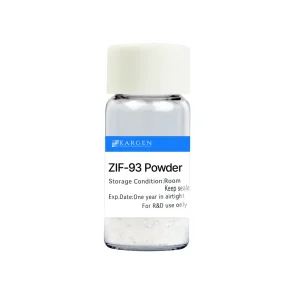
- Zeolitic Imidazolate Frameworks (ZIFs, e.g., ZIF-8, ZIF-67, ZIF-93): Constructed from zinc or cobalt nodes linked by imidazolate ligands. ZIFs feature sodalite topologies with extraordinary chemical and thermal stability in basic media and water, making them ideal for carbon capture, lithium battery separators, and membrane coatings.
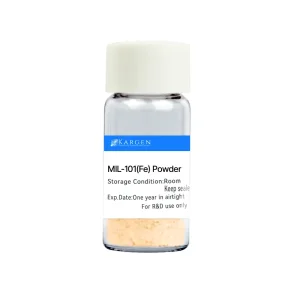
- Materials of Institut Lavoisier (MIL Series, e.g., MIL-100(Fe), MIL-101(Fe), MIL-53(Al), MIL-100(Cr)): Built from trivalent metal centers ($Fe^{3+}, Al^{3+}, Cr^{3+}$) and dicarboxylate/tricarboxylate linkers. MILs offer massive mesoporous cages (up to 34 Å), large pore volumes, low toxicity (especially Fe-based grades), and strong catalytic or environmental water treatment capabilities.
- Copper Carboxylates (e.g., HKUST-1 / Cu-BTC): A face-centered cubic framework containing open $Cu^{2+}$ dimer sites. Highly prized for gas storage (methane/hydrogen), gas purification, and selective Lewis-acid catalytic reactions.
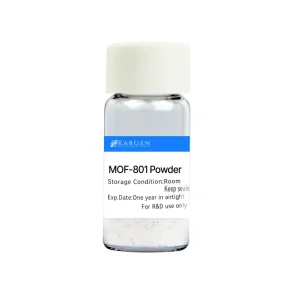
- Zirconium-Based Frameworks (UiO Series & MOF-801/MOF-303): Zirconium-oxo clusters connected by carboxylates yield some of the highest hydrothermally and acid-stable frameworks known. MOF-801 and MOF-303 exhibit steep water sorption isotherms perfect for arid-climate water generation.
- Specialty Separation Frameworks (e.g., KAUST-7, TYUT-12, Al-FUM): Purpose-engineered for tight molecular sieving, thermodynamic gas separation, and energy-efficient desiccant dehumidification systems.
6. Industrial Application Integration & Engineering Implementation
Integrating raw MOF powders into real-world operational units requires careful engineering choices depending on the end-use process design:
Fixed-Bed Gas Adsorbers: When placing MOF materials inside thermal swing adsorption (TSA) or pressure swing adsorption (PSA) vessels, engineered pellets (1.5mm – 3.0mm extrudates binder-formulated with clay or silica) are recommended to ensure structural integrity and prevent fluidization or bed pressure spikes.
Coated Exchangers & Dehumidification Wheels: For HVAC, energy-recovery, or water-harvesting equipment, fine MOF powders (0.5 – 2.0 micron particle size) are suspended in aqueous polymeric binders and dip-coated or slurry-sprayed directly onto aluminum heat-exchanger fins or corrugated ceramic rotor substrates.
Battery Separator Dip-Coating: Ultra-fine, monodisperse ZIF dispersions are applied to polyolefin separators via slot-die or doctor-blade processes, creating uniform nanometer-thick protective layers that stabilize ion transport.
Frequently Asked Questions for MOF Procurement & Engineering
Direct technical answers addressing stability, customization, batch consistency, and export logistics.
What is the typical shelf life and storage protocol for bulk MOF powders?
How do MOFs withstand long-term hydrothermal cycling in atmospheric water harvesting?
Can custom organic linkers or metal nodes be requested via OEM/ODM services?
What activation/degassing procedures are required prior to industrial deployment?
What quality assurance documentation accompanies export shipments?
Specialized Functional Frameworks & Industrial Powders
Explore our complete export series designed for gas separation, catalytic substrates, and high-performance material additives.