
Industrial-Grade MOF Materials (Batch 01)
Select from our standardized and specialized MOF formulations engineered for high thermal stability, controlled pore networks, and electrochemical compatibility.






The Electrochemical Imperative: MOF Innovations in Lithium-Ion Energy Storage
As global decarbonization accelerates, the demands placed on energy density, fast-charging safety, and thermal stability in lithium-ion batteries (LIBs) have reached unprecedented thresholds. Traditional polyolefin separators (such as PE and PP) and conventional liquid organic electrolytes face significant physical limitations. Under high-voltage operational regimes (≥4.5V) or extreme fast-charging conditions, lithium dendrite growth, transition metal ion dissolution from cathode materials, and runaway thermal cascades pose paramount safety and lifespan risks.
Metal-Organic Frameworks (MOFs)—crystalline porous materials composed of metal nodes coordinated with organic linkers—have emerged as transformative additives and structural modifiers across key lithium-ion battery sub-systems. Featuring ultra-high specific surface areas (up to 7,000 m²/g), tuneable pore diameters (0.3 to 3.0 nm), and customized open metal sites (OMS), MOFs fundamentally resolve the critical electrochemical bottlenecks limiting next-generation battery performance.
Dendrite Suppression & Single-Ion Transport
MOF pores functionalized with negative charges or specific spatial constraints immobilize bulky organic anions (e.g., $PF_6^-$). This boosts the lithium-ion transference number ($\text{t}_{\text{Li}^+}$) from typical values of ~0.3 to >0.8, eliminating concentration polarization and preventing uneven Li nucleation during fast charge cycles.
Thermal Resilience & Shrinkage Mitigation
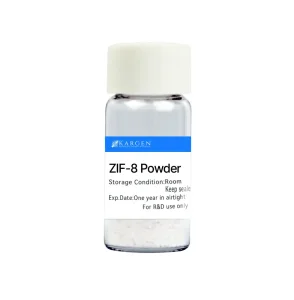
Coating polyolefin separators with hydrothermally stable MOF powders (such as ZIF-8 or UiO-66) raises thermal breakdown thresholds beyond 200°C with near-zero zero-dimensional thermal shrinkage, halting thermal runaway propagation during internal short circuits.
Transition Metal & Moisture Scavenging
Unsaturated open metal sites inside frameworks like HKUST-1 or MIL-101 chemically scavenge trace water ($H_2O$) and fluoride species ($HF$) from liquid electrolytes, preventing cathode leaching (e.g., $Mn^{2+}$ migration) and preserving the Solid Electrolyte Interphase (SEI).
Global Industrial Landscape & Ton-Scale Feasibility
Historically, the deployment of MOFs in energy storage was constrained by high synthesis costs, reliance on toxic organic solvents (DMF, DEF), and batch-to-batch inconsistency. Today, leading Chinese manufacturers, such as Guangdong Advanced Carbon Materials Co., Ltd. (KARGEN), have overhauled this paradigm via green mechanochemical synthesis and solvent-free continuous hydrothermal processing.
| Synthesis Route | Yield Efficiency | Environmental Footprint | Industrial Suitability for LIB Separators |
|---|---|---|---|
| Solvothermal (Legacy) | Low (~60-70%) | High organic solvent waste (DMF/DEF) | Unsuitable for high-volume automotive tier-1 supply |
| Mechanochemical (KARGEN standard) | Very High (>92%) | Solvent-free or low-solvent grinding | Ideal for bulk separator slurry & dispersion blending |
| Hydrothermal Continuous Flow | High (>88%) | Aqueous base, high energy efficiency | Optimized for water-stable frameworks (Al-FUM, MIL-53) |
Localized Application Scenarios in Modern Lithium Cell Manufacturing
Translating MOF powder functionality into functional battery components requires tailored processing strategies. Below are key deployment pathways adopted by tier-1 cell integrators and material supply chains:
1. Ceramic-MOF Hybrid Separator Coatings
By blending 5-10 wt% ZIF-8 or UiO-66 powders into standard $Al_2O_3$ or $SiO_2$ aqueous slurries, coating mills produce ultra-thin, highly porous functional layers on polyolefin substrates. The resulting separator exhibits superior electrolyte wettability, reducing cell filling times while dramatically enhancing electrolyte retention over thousands of deep discharge cycles.
2. Solid-State Polymer Composite Electrolytes
In solid-state lithium-metal architectures, incorporating sub-micron MOF fillers into Polyethylene Oxide (PEO) or PVDF matrices forms MOF-CPEs (Composite Polymer Electrolytes). The porous MOF networks cross-link polymer chains, suppressing crystallization at room temperature and accelerating $Li^+$ transfer along internal channel walls.
3. High-Voltage Cathode Interfacial Buffers
Applying thin layers of MIL-101(Al) onto high-nickel cathode surfaces (NMC811 / NMC90505) stabilizes the cathode-electrolyte interphase (CEI). Open metal sites absorb oxygen radicals released at high voltages, arresting gas generation (swelling) and capacity fade in pouch-cell EV modules.
Technology Roadmap: MOF Engineering in Next-Gen Electrochemical Systems
The trajectory of commercial MOF integration spans immediate commercialization steps to forward-looking smart energy storage designs:
Phase 1 (2025–2027): Mass Commercialization of MOF-Coated Separators
Focus on low-cost, mass-produced frameworks (ZIF-8, Al-FUM). Scale integration into commercial EV and ESS battery lines to extend fast-charging safety windows and meet stringent EU battery passport thermal containment metrics.
Phase 2 (2027–2030): All-Solid-State Battery Integration
Transition toward single-ion conducting MOF structural scaffolds. Replacing liquid electrolytes completely with MOF-infilled inorganic-polymer membranes to achieve energy densities exceeding 500 Wh/kg with absolute safety.
Phase 3 (2030–2035): Intelligent Self-Healing & Sensing Frameworks
Development of responsive MOF structures capable of releasing active passivating agents upon thermal stress or sensing early lithium dendrite stress spikes via impedance shifts, enabling real-time internal battery health diagnostics.
Enterprise Expertise & Global Quality Assurance
Guangdong Advanced Carbon Materials Co., Ltd. (KARGEN) was founded by returning scholars from prestigious institutions in the United States, Germany, and Sweden. Operating from Zhuhai, China, KARGEN bridges foundational material innovation with industrial volume requirements.
R&D & Intellectual Property Strength
- Over 60% of company staff are dedicated R&D scientists; >80% hold Master's or Ph.D. degrees.
- Collaborative partnerships with 70+ top-tier universities and global battery R&D centers.
- Portfolio of 20 granted invention patents and 100+ high-impact research publications.
- First manufacturer in China to realize verified ton-scale MOF industrial supply lines.
Global Regulatory & Supply Compliance
- Full REACH & RoHS compliance documentation available for export to the EU and North America.
- Strict digital quality inspection for every lot (BET surface area, PXRD phase purity, PSD analysis).
- Custom OEM/ODM capability: pore sizing, particle tuning (200nm to 5µm), and custom liquid dispersions.
- Guaranteed 1-business-day response time for all global technical and purchasing requests.
Frequently Asked Questions: MOF Procurement & Battery Engineering
Detailed engineering answers for battery chemists, separator coating engineers, and procurement teams evaluating MOF integration.
Industrial-Grade MOF Materials (Batch 02)
Explore targeted metal-organic framework grades engineered for specific pore geometries, catalytic supports, and chemical separation processes.




Advance Your Electrochemical Formulations Today
Partner with China's pioneer in ton-scale Metal-Organic Framework production. Request sample quantities, custom dispersion specs, or full technical dossiers from our PhD engineering team.