High-Purity MOF Powders & Industrial Adsorbents
Explore our core commercial metal-organic framework grades engineered for high specific surface areas, tailored pore dimensions, and exceptional hydrothermal resilience.







Macro-Industry Landscape: The Shift Toward Reticular Organic-Metal Frameworks
The global transition toward net-zero carbon emissions, zero-emission industrial gas processing, and advanced energy storage has exposed the thermodynamic limits of conventional sorbents. Traditional materials such as activated carbons, zeolites, and silica gels often suffer from poor selectivity, high regeneration energy penalties, and rigid pore architectures that cannot be chemically tuned. As an authoritative leader in advanced carbon and porous nanomaterials, Guangdong Advanced Carbon Materials Co., Ltd. (KARGEN) stands at the forefront of the chemical revolution, offering high-efficiency Organic Metal Frameworks (MOFs) designed to solve critical global separation, catalysis, and energy management challenges.
Metal-Organic Frameworks represent a unique class of hybrid crystalline materials comprising metal ions or clusters (Secondary Building Units - SBUs) coordinated with organic linkers (multitopic carboxylates, azoles, or phosphonates). This reticular design principle yields unprecedented physical properties: specific surface areas exceeding 7,000 m²/g, ultra-high void volumes up to 90%, precise atomic-scale pore diameter control (from 0.3 nm to 3.0 nm), and custom chemical reactivity inside the pore cavities.
Ultra-High Surface Area
Internal surface areas ranging from 1,000 to over 6,000 m²/g allow massive volumetric and gravimetric gas adsorption densities compared to legacy silicas.
Custom Pore Geometry
Atomic-level structural control allows tailored aperture sizes matching the kinetic diameters of target molecules like CO₂, H₂, CH₄, and C₂H₄.
Low Regeneration Energy
Steep adsorption/desorption isotherms allow complete material regeneration under mild temperature or pressure swings, slashing operational expenditure.
Technical Information Gain Notice: Unlike lab-scale vendors offering micro-gram evaluation lots, KARGEN operates a fully integrated 10,000 m² campus in Zhuhai, Guangdong, combining 1,800 m² of advanced R&D laboratories, a 1,000 m² engineering scale-up center, and ton-scale continuous production reactors to meet global industrial export demands.
Synthesis Chemistry & Scalable Manufacturing Routes
Transitioning organic metal frameworks from university benchtop synthesis to industrial-grade bulk production requires solving immense process engineering bottlenecks: solvent recycling, heat transfer control during crystallization, yield optimization, and particle size distribution standardisation.
1. Green Solvent-Free & Low-Solvent Mechanochemical Synthesis
Traditional MOF synthesis relies heavily on high-boiling polar organic solvents such as N,N-dimethylformamide (DMF), which introduce significant environmental burden and high purification costs. KARGEN has pioneered commercial-scale mechanochemical extrusion and twin-screw reactive grinding for key product lines like ZIF-8 and Al-FUM. This solvent-less process operates under continuous ambient or mild temperature conditions, cutting VOC emissions by up to 85% while drastically reducing unit costs.
2. Hydrothermal & Continuous Flow Crystallization
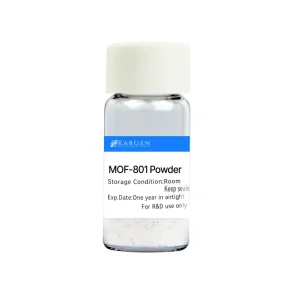
For carboxylate-based frameworks such as MIL-53(Al), MIL-101(Cr), and MOF-801, KARGEN utilizes continuous plug-flow hydrothermal reactors. By precisely modulating temperature profiles, residence times, and liquid hourly space velocity (LHSV), our manufacturing lines produce sub-micron crystals with narrow grain size distributions, preserving batch-to-batch crystallinity (PXRD verified) and high nitrogen/argon adsorption capacities.
3. Post-Synthetic Modification (PSM) & Functionalization
To enhance selectivity under moist flue gas or chemically aggressive conditions, KARGEN employs post-synthetic linker exchanges and amine-functionalization strategies (e.g., NH2-MIL-101(Fe)). Introducing basic amine motifs (-NH₂) into the organic backbone increases quadrupole interactions with target CO₂ molecules, enhancing low-pressure capture efficiency and moisture tolerance.
Commercial MOF Specifications & Material Selection Guide
Compare physical-chemical metrics across our standard exporter product catalog to identify the optimal framework for your process operational window.
| MOF Designation | Metal Node / Organic Linker | BET Surface Area (m²/g) | Pore Volume (cm³/g) | Thermal Stability (°C) | Key Performance Attribute |
|---|---|---|---|---|---|
| ZIF-8 | Zn²⁺ / 2-Methylimidazole | 1,600 – 1,900 | 0.65 – 0.75 | Up to 400 °C | Exceptional hydrophobic behavior & alkaline stability; ideal for battery separators & gas storage. |
| HKUST-1 (Cu-BTC) | Cu²⁺ / 1,3,5-Benzenetricarboxylate | 1,500 – 2,000 | 0.70 – 0.85 | Up to 250 °C | High density of open metal sites; supreme volumetric CH₄, C₂H₂ and CO storage capacities. |
| Al-FUM | Al³⁺ / Fumaric Acid | 1,000 – 1,300 | 0.45 – 0.55 | Up to 350 °C | Hydrothermally robust with S-shaped water vapor uptake; optimal for atmospheric water harvesting. |
| MIL-53(Al) | Al³⁺ / 1,4-Benzenedicarboxylate | 1,100 – 1,500 | 0.50 – 0.65 | Up to 500 °C | Flexible "breathing" framework; high structural resilience for hydrocarbon separations. |
| MIL-101(Cr) | Cr³⁺ / 1,4-Benzenedicarboxylate | 3,000 – 3,800 | 1.30 – 1.65 | Up to 300 °C | Gigantic pore volume & mesoporous cages; ideal host for liquid catalytic species & hazardous dyes. |
| NH₂-MIL-101(Fe) | Fe³⁺ / 2-Aminoterephthalate | 800 – 1,200 | 0.40 – 0.55 | Up to 250 °C | Biocompatible, non-toxic node; targeted photocatalytic degradation and sensing applications. |
| MOF-801 | Zr⁴⁺ / Fumaric Acid | 800 – 1,000 | 0.40 – 0.48 | Up to 300 °C | Ultra-fast adsorption kinetics under low relative humidity (RH < 20%); advanced desiccant systems. |
| MOF-5 | Zn⁴O / 1,4-Benzenedicarboxylate | 2,500 – 3,200 | 1.00 – 1.25 | Up to 300 °C | Benchmark high-porosity framework for cryogenic hydrogen storage and bulk volatile capture. |
Macro-Industry Solutions & Localized Application Scenarios
KARGEN works closely with global engineering contractors, energy conglomerates, battery manufacturers, and HVAC system suppliers to integrate customized organic metal frameworks directly into high-value industrial systems.
Flue Gas CO₂ Capture & DAC
Deploying amine-functionalized MOFs (e.g., NH₂-MIL-101(Fe), KAUST-7) in post-combustion capture columns reduces desorption temperature demands from traditional amine scrubbing (120–140 °C) down to 70–80 °C, delivering dramatic thermal energy savings.
Atmospheric Water Harvesting (AWH)
Utilizing Al-FUM and MOF-801 in solar-driven water extraction systems operating in arid and desert climates. These frameworks harvest potable water directly from dry ambient air (RH as low as 15%) using natural sunlight as the sole thermal energy input.
Next-Gen Battery Coatings & Solid Electrolytes
Incorporating nano-scale ZIF-8 dispersions into polyolefin separators and solid polymer electrolytes traps migrating polysulfides, homogenizes lithium-ion flux, prevents dendrite growth, and extends battery cycle life in high-energy lithium batteries.
Specialty Gas Purification for Semiconductors
Custom copper-based frameworks like HKUST-1 efficiently remove trace moisture, carbon monoxide, and oxygen contaminants down to sub-ppb levels from hydride gases (Arsine, Phosphine, Silane) used in advanced microelectronics fabrication.
Energy-Efficient HVAC & Desiccant Wheels
Coating MOFs onto heat exchangers and desiccant wheel honeycombs decouples sensible and latent cooling loads in residential and commercial climate systems, lowering total HVAC power consumption by over 40%.
Hydrocarbon & Olefin/Paraffin Separation
Leveraging flexible pore systems in TYUT-12 and MIL-53(Al) to achieve single-step separation of ethylene/ethane and propylene/propane mixtures without energy-intensive cryogenic distillation.
Localization Support, Regulatory Compliance & Quality Control
As a global supplier and exporter servicing clients across North America, Europe, East Asia, and the Middle East, KARGEN places regulatory compliance and stringent quality management at the center of our operational methodology.
1. Regulatory Certifications & Safety Compliance
All MOF formulations exported by KARGEN comply fully with international chemical regulatory frameworks including EU REACH registration, US EPA TSCA inventory guidelines, and standard international maritime dangerous goods (IMDG) packing transport rules. Full Safety Data Sheets (SDS) in multi-language formats, REACH compliance declarations, and GHS-compliant labeling accompany every shipment.
2. Digital Quality Assurance & Batch Traceability
Our quality control facility is equipped with state-of-the-art analytical instrumentation: High-Resolution Powder X-Ray Diffractometers (PXRD), Automated N₂/Ar/CO₂ Physisorption Analyzers (BET surface area assessment), Thermogravimetric Analyzers (TGA), and Scanning Electron Microscopy (SEM). Each manufactured batch receives a comprehensive Certificate of Analysis (COA) documenting precise BET surface area, pore size distribution, residual solvent limits, and thermal degradation thresholds.
3. Global Logistics & Sample Evaluation Program
To reduce risk for client R&D and engineering qualification, KARGEN offers a streamlined 1–5 gram free evaluation sample program for qualified corporate B2B partners. Bulk commercial orders are packed under moisture-proof inert gas atmospheres in industrial fiber drums or vacuum-sealed aluminum totes to guarantee zero moisture degradation during ocean or air transit.
Technology Roadmap & Future Innovations in Reticular Chemistry
KARGEN’s R&D strategy, directed by returning scholars and senior scientists from top institutions in the United States, Germany, and Sweden, focuses on overcoming next-generation industrial material hurdles over the coming decade.
Machine Learning & AI Reticular Discovery
Integrating generative machine learning models and high-throughput crystal energy landscapes to screen billions of metal-linker combinations, accelerating target MOF synthesis cycles from years to weeks.
Mixed-Matrix Membranes (MMMs)
Engineering molecular-level interfacial compatibility between MOF nanoparticles and industrial polymers (Polysulfone, Polyimide) to eliminate interfacial micro-voids, creating ultra-selective gas separation membranes.
Monolithic & Shaped Extrudates
Developing binderless shaping processes to convert fine powders into high-density granules, extrudates, honeycombs, and monoliths with low bed pressure drop and high mechanical crush strength for industrial packed columns.
Deep Technical & Procurement Q&A
Expert answers provided by KARGEN’s application engineering team regarding MOF selection, chemical stability, scaling, and procurement processes.
Additional High-Grade Organic Metal Framework Products
Explore the remainder of our commercial factory products, available direct from China with full international shipping support.