
High-Performance MOF Materials & Sorption Cooling Powders
Engineered for high water-uptake kinetics, low regeneration heat, and ultra-high surface area applications in desiccant cooling and atmospheric HVAC systems.



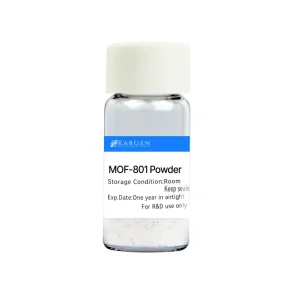


Re-Architecting Industrial Air Cooling: The Solid Sorption & MOF Nanomaterials Revolution
The global industrial cooling landscape is undergoing a systemic paradigm shift. As corporate sustainability mandates tighten, data center densities explode under artificial intelligence workloads, and international environmental frameworks like the Kigali Amendment phase out high-Global Warming Potential (GWP) fluorinated refrigerants, traditional vapor-compression air cooling systems are reaching their physical efficiency limits.
Conventional desiccants (silica gel, zeolites) require high regeneration temperatures (>120°C–150°C) and suffer from low equilibrium water uptake. Advanced MOF-based Air Cooling Services utilize crystalline porous coordination polymers engineered at the sub-nanometer scale. With surface areas exceeding 3,000–6,000 m²/g and S-shaped water vapor adsorption isotherms, MOFs desorb water vapor at low waste-heat temperatures (55°C–75°C), enabling thermal Coefficients of Performance (COP) up to 1.4–1.8 in adsorption cooling systems.
As a global premier Air Cooling Service & Supplier, Guangdong Advanced Carbon Materials Co., Ltd. (KARGEN) bridges the critical gap between academic breakthrough chemistry and industrial-scale deployment. Founded by returning scientists from premier research institutions in the United States, Germany, and Sweden, KARGEN operates China’s first dedicated ton-scale MOF manufacturing facility spanning 10,000 m² in Zhuhai, Guangdong. We empower global engineering firms, HVAC OEMs, data center operators, and gas treatment enterprises with tailored sorption cooling media, heat exchanger surface coatings, and application-specific thermal materials.
Global Commercial & Industrial State of Air Cooling
Global cooling demand is accelerating at an unprecedented pace. According to recent International Energy Agency (IEA) reports, space cooling and industrial thermal management account for over 20% of total global building electricity consumption. Meeting this demand requires shifting from pure power-driven chillers to thermally driven, waste-heat harvesting solid-adsorption cooling systems.
Data Center Power Usage Effectiveness (PUE) Crisis
Modern high-density AI compute nodes generate intense thermal loads exceeding 100 kW per rack. Traditional mechanical air cooling systems push data center PUE ratios above 1.5. MOF-assisted indirect evaporative and desiccant air cooling reduces compressor runtime, helping hyperscale operators achieve target PUE levels below 1.15.
Decarbonization & Low-GWP Regulations
Phase-down schedules for hydrofluorocarbons (HFCs) under European F-Gas regulations and North American AIM Act mandates are driving air cooling suppliers to adopt water (R718) as a natural refrigerant. MOF adsorbents paired with pure water vapor systems present zero Global Warming Potential and zero Ozone Depletion Potential.
Low-Grade Waste Heat Utilization
Manufacturing industries dump gigawatts of low-temperature waste heat (<80°C) into the atmosphere annually. KARGEN’s specialized MOF adsorbents (such as Al-FUM and MOF-303) convert this low-grade process waste heat into zero-electricity cooling power via thermally driven adsorption chillers.
Thermodynamic Superiority of MOF-Based Air Cooling Systems
Solid adsorption air cooling operates through cyclical water vapor adsorption and thermal desorption. The overall efficiency is governed by the structural design of the porous adsorbent material, specifically its pore diameter distribution, hydrothermal durability, and adsorption isotherm inflection point ($P/P_0$).
| Cooling Media / Technology | BET Surface Area (m²/g) | Water Uptake (g/g @ 30% RH) | Regeneration Temp (°C) | System COP Range | Hydrothermal Cycling Stability |
|---|---|---|---|---|---|
| KARGEN Al-FUM MOF | 1,100 – 1,300 | 0.45 – 0.52 | 60°C – 75°C | 1.35 – 1.65 | > 10,000 Cycles (No decay) |
| KARGEN MOF-303 | 1,350 – 1,550 | 0.48 – 0.56 | 55°C – 70°C | 1.40 – 1.80 | > 12,000 Cycles (No decay) |
| Conventional Silica Gel | 600 – 750 | 0.08 – 0.12 | 90°C – 120°C | 0.50 – 0.65 | Moderate (Degrades >80°C) |
| Zeolite 13X | 500 – 650 | 0.15 – 0.20 | 150°C – 200°C | 0.40 – 0.55 | High (High energy penalty) |
| Polymer Desiccants | N/A | 0.25 – 0.35 | 85°C – 110°C | 0.70 – 0.85 | Low (Structural hysteresis) |
Steep Step-Wise Isotherms
Unlike traditional materials with broad, gradual adsorption curves, KARGEN MOFs exhibit steep step-wise (S-shape) water uptake within narrow relative humidity windows ($P/P_0 = 0.1 - 0.3$). This enables complete charging and discharging of water vapor with ultra-small temperature swings, drastically lowering system energy input.
Direct Heat Exchanger Surface Coating
KARGEN has solved the thermal conductivity bottleneck of loose powder beds. Through our proprietary binder formulation and spray-coating technology, MOF nanoparticles are bound directly onto aluminum and copper heat exchanger fins with layer thicknesses from 50 to 300 μm, reducing interfacial thermal resistance by over 65%.
China Factory Efficiency & Scale: The KARGEN Advantage
While laboratory-scale MOF synthesis is widespread globally, securing scalable, high-purity, ton-scale commercial production has long been the primary barrier for international HVAC equipment manufacturers. KARGEN’s headquarters in Zhuhai, China, provides an unparalleled structural supply chain advantage.
Ton-Scale Continuous Synthesis
Utilizing mechanochemical synthesis and solvent-free continuous hydrothermal processing, KARGEN operates high-capacity reactors delivering metric tons of MOF powder per month with zero batch-to-batch structural variance.
Unrivaled Cost-to-Performance Ratio
Leveraging China’s complete chemical precursor supply chain and streamlined manufacturing ecosystems, KARGEN delivers advanced MOFs at a fraction of Western academic supplier costs, rendering solid sorption air cooling commercially viable for mass production.
Rigorous Digital Quality Control
Every production lot undergoes comprehensive Powder X-Ray Diffraction (PXRD), N2 adsorption BET surface area quantification, and thermogravimetric analysis (TGA) to ensure 100% compliance with international OEM specifications.
Custom OEM / ODM Formulation
Beyond standard powders, KARGEN offers tailored particle sizes, water-based suspensions, extruded honeycomb blocks, and pre-coated heat exchanger fins customized to your exact cooling module engineering specs.
Localized Industrial Application Scenarios
KARGEN’s advanced sorption materials and air cooling engineering services are deployed across demanding thermal management applications worldwide:
1. AI Data Center Hyperscale Air Cooling
Integrated into indirect evaporative cooling (IEC) units, MOF desiccant wheels remove latent humidity loads prior to sensible cooling stages. This prevents condensation on cold plates, enables higher chilled water supply temperatures, and reduces annual cooling energy consumption by over 40%.
2. Industrial Waste Heat Recovery Chillers
Chemical plants, textile mills, and glass manufacturing facilities utilize KARGEN MOF-303 sorption beds powered by low-grade process steam or condenser runoff (60°C–80°C) to generate 7°C chilled water for space air conditioning without added electrical draw.
3. Arid Region Atmospheric Water & Cooling
In desert climates with low relative humidity (15%–30% RH), standard evaporative cooling fails. KARGEN Al-FUM adsorbents extract potable atmospheric water at night and release cool moisture during peak day temperatures, providing combined air cooling and water production.
4. Semiconductor & Battery Cleanrooms
Microelectronics fabrication and lithium-ion battery dry rooms require ultralow dewpoint controls (RH < 1%). MOF-enhanced desiccant air cooling systems deliver continuous ultra-dry air streams with 35% lower thermal regeneration penalties than lithium chloride or silica gel wheels.
5. Commercial HVAC & Cold Chain Logistics
Custom MOF coatings applied directly to rooftop AC coils decouple sensible and latent heat management, preventing mold growth, suppressing VOC contaminants, and ensuring stable humidity control for perishable food and pharmaceutical transport.
Global Procurement Checklist for Air Cooling Media
When qualifying an Air Cooling Service & Supplier for large-scale enterprise deployments, procurement managers and senior engineering teams should evaluate four primary technical parameters:
1. Desorption Kinematics
Verify that the sorbent releases over 85% of adsorbed moisture within a 5-to-10-minute cycle window at available waste heat temperatures (<70°C).
2. Hydrothermal Durability
Ensure materials maintain framework integrity under continuous humidity condensation-desorption stress for over 10,000 full operational cycles.
3. Coating Adhesion Strength
For heat-exchanger-integrated systems, inspect binder formulation to guarantee zero delamination under mechanical vibration and thermal expansion.
4. Scalable Capacity & COA
Confirm supplier capability for multi-ton contract manufacturing backed by certified Certificate of Analysis (COA) testing for every batch shipment.
Frequently Asked Questions (FAQ)
In-depth answers from KARGEN’s PhD research scientists and HVAC application engineers.
How does a MOF-based air cooling system differ from standard compressor HVAC?
Which KARGEN MOF grades are recommended for air cooling applications?
What is KARGEN's production capacity for industrial supply contracts?
Can KARGEN provide custom MOF coatings on client-supplied heat exchangers?
How do I request evaluation samples for air cooling testing?
What is the expected operational lifespan of KARGEN MOF cooling adsorbents?
Advanced Frameworks for Industrial Separation & Thermal Control
Complete range of precision metal-organic structures manufactured in our Zhuhai facility for global export.






Accelerate Your Next-Gen Air Cooling & Thermal Systems
Partner with Guangdong Advanced Carbon Materials Co., Ltd. (KARGEN) to access ton-scale MOF supply, expert thermal engineering consultation, and custom desiccant coating developments.