
High-Performance MOF Powders & Frameworks
Direct factory supply for lab evaluations and ton-scale industrial deployment across green hydrogen, catalysis, and carbon management.




Solving the Volumetric Density Dilemma in Hydrogen Storage
Hydrogen ($H_2$) possesses the highest gravimetric energy density among chemical fuels (120 MJ/kg), yet its extremely low ambient volumetric density ($0.089 \text{ g/L}$) makes physical containment the central bottleneck of the global clean transition.
700 Bar Compression Bottlenecks
Traditional Type IV composite cylinders require massive mechanical work, consuming up to 15% of the hydrogen's total lower heating value (LHV) purely for compression. High pressures introduce safety risks, heavy wall thickness, and geometry constraints for vehicle design.
Cryogenic Liquefaction (20 K) Evaporative Loss
Liquid hydrogen ($LH_2$) achieves ~70 g/L density but requires extreme cryogenic cooling ($20.28 \text{ K}$), consuming nearly 30% of energy content. Boil-off gas (BOG) losses render stationary long-duration storage inefficient without active sub-cooling systems.
The MOF Solid-State Advantage
Metal-Organic Frameworks (MOFs) pack hydrogen molecules via physisorption within sub-nanometer crystalline pores at moderate pressures (30–100 bar) and cryo-adsorptive temperatures (77–160 K), exceeding liquid $H_2$ volumetric density locally while eliminating extreme mechanical stress.
By engineering MOFs with Brunauer-Emmett-Teller (BET) surface areas exceeding 5,000 m²/g and tailored pore apertures (0.6 – 1.2 nm), our materials allow hydrogen storage systems to meet the U.S. Department of Energy (DOE) target of 40–50 g/L system volumetric capacity at operating pressures under 100 bar, dramatically lowering systemic capital expenditure (CAPEX).
Engineering Open Metal Sites & Isosteric Heat of Adsorption
The physical interaction between $H_2$ and crystalline framework nodes determines total gas capacity and thermal management requirements during ultra-fast refueling cycles.
Open Metal Site (OMS) Activation
By vacuum-desolvating coordinatively unsaturated metal nodes—such as $Cu^{2+}$ in HKUST-1 or $Ni^{2+}$ in Ni-MOF-74—we induce localized charge polarization. This enhances the $H_2$ binding energy from typical physical adsorption levels (4–6 kJ/mol) up to 10–13 kJ/mol.
Compaction & Granulation Tech
Unprocessed MOF powders exhibit low bulk packing density (~0.15–0.30 g/cm³), penalizing vessel volume. Our proprietary binder-less monolithic synthesis and low-shear mechanical pelletization achieve packing densities up to 0.68 g/cm³ while retaining 92%+ of native micro-porosity.
Thermal Conductive Composites
Adsorption is exothermic. Without internal heat dissipation, bed temperatures spike, severely curtailing hydrogen uptake. We integrate expanded natural graphite (ENG) networks or 3D aluminum foam matrixes into MOF beds, increasing thermal conductivity from 0.1 W/m·K to >5.5 W/m·K.
Comparative Analysis of Hydrogen Storage MOFs
Empirical data based on standardized volumetric & gravimetric gas sorption characterization (77 K & 298 K, 1–100 bar).
| MOF Grade | Metal Node / Linker | BET Surface Area (m²/g) | Pore Volume (cm³/g) | Gravimetric H₂ (77K, 100 bar) | Volumetric H₂ (Bed Density) | Primary Industrial Use Case |
|---|---|---|---|---|---|---|
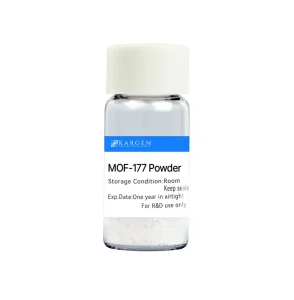
| MOF-177 | Zn₄O / BTB (Trimesic deriv.) | 4,500 – 5,300 | 1.89 | 7.5 wt% | 48 g/L | Bulk Cryo-Adsorptive Storage Tanks |
| HKUST-1 (Cu-BTC) | Cu₂ / BTC (Benzene-1,3,5-tricarb) | 1,800 – 2,200 | 0.85 | 5.2 wt% | 57 g/L | High Density Volumetric Vessels & Purifiers |
| MIL-101(Al) / (Cr) | Al or Cr / Terephthalic Acid | 3,200 – 4,100 | 1.55 | 6.8 wt% | 42 g/L | Hydro-Thermal Cyclic Clean Energy Beds |
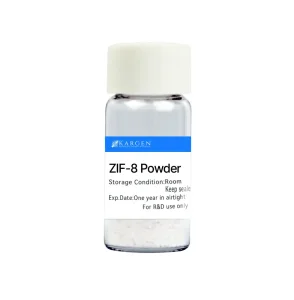
| ZIF-8 | Zn / 2-Methylimidazole | 1,600 – 1,900 | 0.66 | 3.1 wt% | 34 g/L | Chemical Proofing, Hybrid Separator Membranes |
| KAUST-7 (NbOFFIVE-1-Ni) | Ni / Pyrazine / (NbOFFIVE)²⁻ | Pure Microporous | 0.38 | Trace Target Selectivity | Molecular Trap | Specialty Hydrogen & CO₂ Molecular Sieves |
| ZIF-67 | Co / 2-Methylimidazole | 1,500 – 1,800 | 0.63 | 3.3 wt% | 35 g/L | Catalytic Substrate & Carrier Gas Purification |
* Tested in accordance with ISO 16111:2018 Transportable gas storage devices — Hydrogen absorbed in reversible metal hydride / porous media.
Where Solid-State MOF Storage Outperforms Legacy Systems
From heavy transport logistics to semiconductor zero-defect carrier gas networks, customized MOF architectures eliminate operational bottlenecks.
Heavy-Duty Fuel Cell Logistics
Long-haul Class 8 trucks and fuel cell locomotives require high range without sacrificing cargo weight limits. Cryo-adsorptive MOF vessels operating at 30–50 bar allow conformable tank shapes under truck chassis, delivering up to 30% longer driving range compared to standard 350-bar systems.
Off-Grid Green H₂ Microgrids
Solar and wind electrolyzer plants experience rapid output fluctuations. MOF-filled buffer tanks store high-purity hydrogen at low pressures directly from electrolyzer outlets without requiring costly multi-stage oil-free compressors, maximizing round-trip efficiency.
Semiconductor Clean Room H₂ Purifiers
Sub-nanometer MOF channels serve a dual function: high-capacity storage combined with trace contaminant scrubbing. Integrated MOF beds adsorb moisture, $CO$, $CO_2$, and hydrocarbons down to sub-ppb levels, supplying ultra-pure grade 9.0 (99.9999999%) hydrogen gas for EUV lithography.
Global Compliance & Industrial Certification
Every synthesis batch undergoes stringent digital quality control, proving zero structural degradation across thousands of pressure swing adsorption (PSA) cycles.
ISO 9001:2015 Quality Validation
Our 10,000 m² automated manufacturing complex operates under strict ISO 9001 governance. Each lot is issued a detailed Certificate of Analysis (CoA) containing PXRD patterns, nitrogen BET adsorption isotherms, TGA thermal stability curves, and particle size distribution (D10, D50, D90).
REACH, RoHS & Environmental Safety
Fully compliant with EU REACH regulation (EC No 1907/2006) and RoHS directives. We employ eco-friendly solvothermal and low-solvent mechanochemical green synthesis pathways to ensure zero toxic heavy metal runoff during manufacturing.
Pressure Vessel Standard Compliance
Our engineered MOF monoliths and pellets conform to safety mandates required for integration into ASME Section VIII, PED 2014/68/EU, and UN 3375 gas storage vessels, undergoing rigorous vibration, drop, and pressure shock testing.
Technology Roadmap: The Next Decade of MOF Hydrogen Innovation
Transitioning from cryo-adsorptive systems to ambient-temperature solid-state storage through molecular-level enthalpy manipulation.
Cryo-Adsorptive System Scale
Commercialization of compacted MOF-177 and HKUST-1 monoliths for heavy transport tanks operating at 77–160 K and 30–100 bar, attaining system volumetric densities of 45–50 g/L.
High Enthalpy Ambient MOFs
Integration of photo-responsive linkers and double-open metal sites to boost isosteric heat of adsorption ($Q_{st}$) to 15–20 kJ/mol. Enables room temperature ($298 \text{ K}$) high-density storage at under 50 bar.
Gigawatt-Scale Continuous Synthesis
Fully continuous continuous-flow microfluidic and mechanochemical manufacturing, driving MOF bulk production costs below $15/kg for global pipeline and maritime infrastructure.
Frequently Asked Questions (FAQ)
Direct technical answers for design engineers, material scientists, and procurement executives.
What makes MOFs superior to traditional metal hydrides for hydrogen storage?
Traditional interstitial metal hydrides (e.g., $LaNi_5$, $TiFe$) store hydrogen via chemical hydride formation, which requires high temperatures (200–300°C) and substantial thermal energy to release gas. Furthermore, metal hydrides are extremely heavy, yielding low gravimetric capacities (<2 wt%). MOFs operate via low-energy physisorption, releasing hydrogen rapidly with minimal thermal penalty, while providing up to 4x higher gravimetric energy density (up to 7.5+ wt%).
What operating temperature and pressure deliver peak hydrogen storage in MOF-177 and HKUST-1?
Maximum gravimetric and volumetric capacity is achieved under cryo-adsorptive conditions at 77 K (-196°C) and pressures between 30 and 100 bar. Under these parameters, MOF-177 achieves over 7.5 wt% excess adsorption, while HKUST-1 reaches up to 57 g/L volumetric density. At room temperature (298 K), capacity decreases unless high-enthalpy open metal site frameworks (e.g., Ni-MOF-74) are deployed under 100 bar pressure.
How does pelletization/compaction affect MOF gas uptake and flow rates?
Uncompressed MOF powders have poor spatial efficiency and cause high pressure drops across reactor beds. Using our specialized binder-less or low-binder compaction tech, we compress powders into 3mm–5mm cylindrical pellets or dense monolithic blocks. This elevates packing density by up to 250% while preserving >90% of the internal pore volume and maintaining high inter-particle gas diffusivity.
What thermal management strategies are recommended during rapid refueling cycles?
Hydrogen physisorption releases heat ($\Delta H_{ads} \approx 4-12 \text{ kJ/mol}$). During fast filling, the bed temperature can rise quickly, decreasing equilibrium uptake. We recommend integrating internal aluminum heat exchangers, micro-channel cooling tubes, or blending 5-10 wt% Expanded Natural Graphite (ENG) into the MOF matrix to increase effective thermal conductivity up to 5.5 W/m·K.
Can KARGEN supply free sample quantities for feasibility testing?
Yes. Qualified R&D teams, academic institutions, and OEM procurement units can request 1 g to 5 g evaluation samples of standard powders (ZIF-8, HKUST-1, Al-FUM, MOF-177). Custom synthesized or functionalized MOF variants are available under OEM/ODM collaborative development agreements.
What is your industrial manufacturing scalability and lead time for bulk orders?
KARGEN operates a 10,000 m² R&D and production complex with multi-ton annual capacity. Standard catalog materials ship within 3–5 business days. Commercial bulk orders (100 kg to multi-ton lots) are delivered within 2–4 weeks accompanied by complete batch-specific CoA and quality documentation.
Gas Separation & Specialty MOF Solutions
Optimized microporous materials engineered for extreme chemical stability, separation selectivity, and hydrogen storage.




Accelerate Your Hydrogen System Engineering
Partner directly with KARGEN’s PhD material scientists to customize pore sizes, scale up synthesis, or evaluate free 1–5g testing samples.