1 / 2
Best MIL-100(Fe) Powder Metal Organic Frameworks (MOFs) Service, Exporters
Product Description
Product Specifications
| Product Name | MIL-100(Fe) |
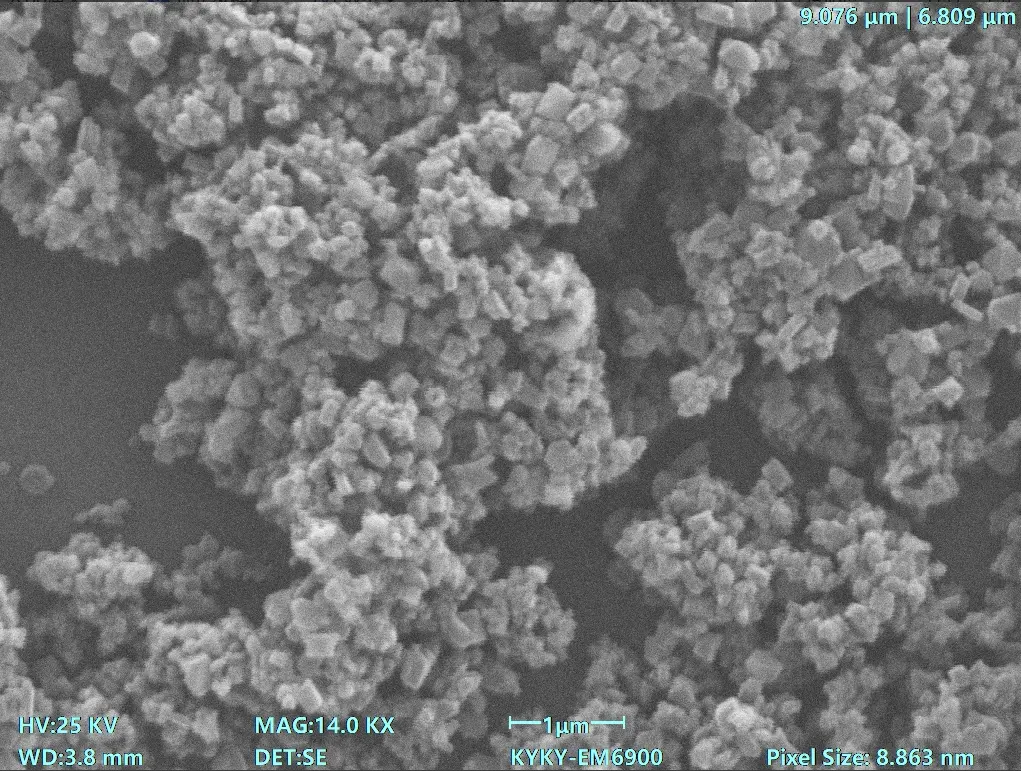
| Particle Size | 200 ~ 500 nm |
| Specific Surface Area | ≥ 1300 ㎡/g |
| Pore Size | 0.3 ~ 1 nm |
Eco-Friendly & Low Cost
Iron center makes MIL-100(Fe) non-toxic, inexpensive, and environmentally friendly compared to Co or Cr alternatives.
High Thermal Stability
Maintains structural integrity up to 280 °C in air and up to 340 °C in N2 atmosphere.
MIL-100(Fe) can maintain to be remarkably stable under a large scope of water vapor pressures or treatment with boiling water. On the one hand, iron, the metal center of MIL-100(Fe), is cheap, nontoxic, and environmentally friendly compared with other metals (i.e., Co, Cr, etc), which also makes MIL-100(Fe) welcome. On the other hand, MIL-100(Fe) as a supporting matrix possesses distinctive characteristics including high thermal stability (up to 280 °C in air and 340 °C in N2) and mesoporous structure enabling easy and rapid diffusion of reactant molecules.
MIL-100(Fe) was found to show a good performance in gas adsorption and separation. First, MIL-100(Fe) with mesoporous cages could be a potential water vapor adsorbent. According to its water sorption isotherm at 30 °C, MIL-100(Fe) showed outstanding water sorption uptakes up to 0.873 g H2O per g dry absorbent at partial pressures of over 0.5.
In contrast to the conventional porous materials which needed to be dehydrated at high temperature before use, the MIL-100(Fe) adsorbent required a dehydration temperature of 70 °C. The excellent performance in water vapor adsorption exhibited by MIL-100(Fe) suggested commercially viable application of energy-efficient desiccant dehumidification.
Frequently Asked Questions
What are the main physical properties of MIL-100(Fe)?
MIL-100(Fe) features a particle size of 200–500 nm, a high specific surface area of ≥1300 ㎡/g, and a pore size ranging between 0.3 and 1 nm.
What is the thermal stability limit for MIL-100(Fe)?
MIL-100(Fe) possesses high thermal stability, withstanding temperatures up to 280 °C in air and up to 340 °C in N2 atmosphere.
Why is iron used as the metal center in MIL-100(Fe)?
Iron is selected because it is low-cost, non-toxic, and environmentally friendly compared to alternative metal centers such as Cobalt (Co) or Chromium (Cr).
How does MIL-100(Fe) compare to commercial adsorbents like silica gel?
MIL-100(Fe) achieves a water sorption uptake of up to 0.873 g H2O/g dry adsorbent, which is substantially higher than NaX (0.336 g/g), SAPO-34 (0.330 g/g), and silica gel (0.327 g/g).
What is the required dehydration temperature for MIL-100(Fe)?
Unlike traditional porous materials requiring high-temperature activation, MIL-100(Fe) requires a mild dehydration temperature of only 70 °C, making it energy-efficient.