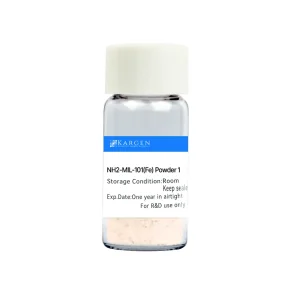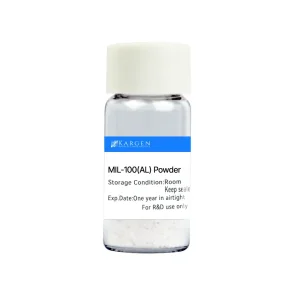
Benchmark MOF Frameworks — High-Purity Powders & Catalytic Adsorbents
Explore our primary portfolio of ultra-high surface area Metal-Organic Frameworks engineered for exceptional thermal, chemical, and hydrothermal stability.
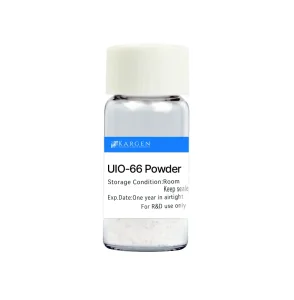
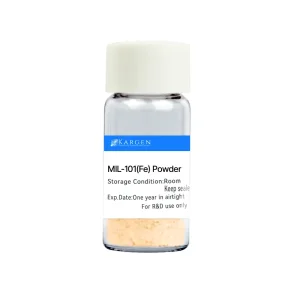
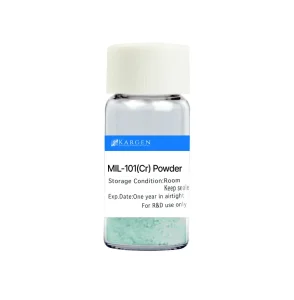
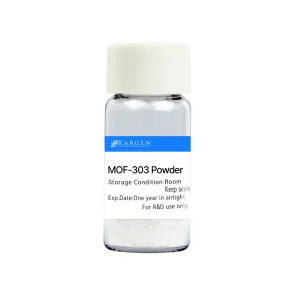
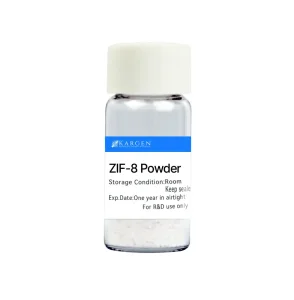
Executive Summary: The Industrial Shift to MOF Adsorbents
Metal-Organic Frameworks (MOFs) represent a paradigm shift in advanced separation science, offering ultra-high specific surface areas (up to 7,000 m²/g) and atomically precise pore structures that far surpass traditional adsorbents like activated carbons, zeolites, and silica gels.
Beyond Legacy Adsorbents
Conventional sorbents suffer from random pore size distribution, broad desorption energy requirements, and limited chemical customization. MOFs solve these bottlenecks through self-assembled organic linkers and inorganic metal nodes, allowing custom enthalpy tuning for target guest molecules.
This atomic-level tailoring reduces parasitic thermal energy penalties during desorption by 30% to 55% compared to liquid amine wash systems and classical zeolites.
Global Commercial Ecosystem
The global demand for MOF adsorbents is experiencing exponential growth driven by stringent net-zero carbon mandates, direct air capture (DAC) scaling, HVAC latent load management, and high-purity semiconductor specialty gas processing.
Leading chemical processors and clean-tech equipment manufacturers are transitioning from laboratory-scale testing to multi-ton contract procurement, demanding reliable industrial suppliers with guaranteed batch consistency.
Supply Risk & Qualification
The primary challenge for industrial buyers lies in bridging the gap between small-batch academic synthesis and continuous ton-scale supply. Scalable solvent recycling, green mechanochemical synthesis, and robust quality control under ISO standards are essential prerequisites.
As a leading supplier in China, our facilities guarantee single-digit lot-to-lot BET variations, ensuring predictable engineering performance in full-scale adsorption columns.
Synthesis Innovations & Micro-Pore Engineering Roadmap
Unlocking commercial feasibility requires continuous innovation in synthetic chemistry, binderless shaping, and low-cost organic linker synthesis.
1. Mechanochemical & Continuous Extrusion
Replacing traditional solvent-intensive solvothermal batch reactors, our factory utilizes twin-screw continuous extrusion and green mechanochemistry. This process eliminates up to 90% of toxic organic solvents (like DMF), drastically lowering production cost and carbon footprint while achieving kilogram-per-minute throughput.
2. Structural Stability Tuning
Hydrothermal breakdown in moist gas streams historically limited early MOFs. Through Zr-based clusters (UiO-66) and Al-based chains (Al-FUM, MIL-53), our structural engineering introduces high coordination numbers (up to 12-connected nodes), providing chemical resistance against acid vapors ($SO_x, NO_x$) and liquid water immersion up to 300°C.
3. Granulation & Binderless Shaping
Raw MOF powders cause significant pressure drops in fixed-bed reactors. Our advanced shaping technology transforms nano-crystals into 1–3 mm spherical granules, honeycomb monoliths, and extruded pellets with over 85% pore volume retention, ensuring low pressure drop and high mechanical crush strength (>50 N/bead).
Information Gain Technical Note: Pore Size Matching
Adsorption performance is not merely a function of surface area, but rather kinetic pore matching. For instance, MOF-303 presents a narrow 6 Å pore channel customized for water vapor capture at low relative humidity (<20% RH), whereas ZIF-8 features a 3.4 Å aperture opening ideal for molecular sieving of $CO_2$ (3.3 Å) from $N_2$ (3.64 Å). Choosing the right kinetic aperture prevents competitive adsorption poisoning.
Localized Application Scenarios & Industrial Case Studies
Real-world deployment across diverse climatic and industrial environments highlights the versatility and energy-saving capabilities of engineered MOF adsorbents.
Atmospheric Water Harvesting (AWH) in Arid Zones
In desert regions with relative humidity below 20%, silica gels and zeolites fail to capture moisture efficiently. Implementing MOF-303 and Al-FUM adsorbents allows continuous water extraction powered solely by ambient solar thermal energy (65–85°C regeneration temp).
Performance Metric: Delivers up to 1.3 liters of pure potable water per kilogram of MOF per day under 15% RH, requiring zero grid electricity for thermal desorption.
EV Lithium Battery Separator Coatings
Applying ultra-fine ZIF-8 dispersions onto polyethylene (PE) battery separators enhances electrolyte wettability and thermal stability up to 200°C without melting.
Performance Metric: The microporous ZIF-8 matrix selectively traps transition metal ions ($Fe^{2+}, Mn^{2+}$) dissolved from cathodes, reducing capacity degradation and increasing cell cycle life by over 35%.
Direct Air Capture (DAC) & Flue Gas Carbon Capture
Post-combustion carbon capture requires selective adsorption of $CO_2$ against background moisture and $N_2$. Hydrophobic amine-functionalized MOFs like UiO-66-NH2 exhibit high binary selectivity.
Performance Metric: Working capacity of >3.5 mmol/g under flue gas conditions (15% $CO_2$, 40°C), with a 40% reduction in regeneration enthalpy compared to monoethanolamine (MEA) liquid scrubbing.
Specialty Gas Purification & Olefin Separation
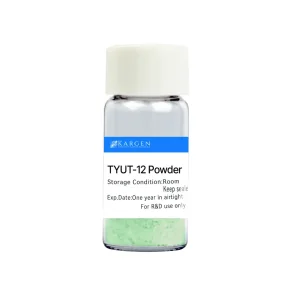
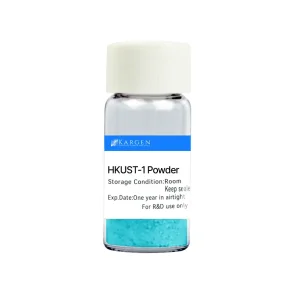
Ethylene/ethane ($C_2H_4/C_2H_6$) separation in petrochemical plants is extremely energy-intensive. TYUT-12 and HKUST-1 frameworks offer thermodynamic selectivity for ethane over ethylene.
Performance Metric: Produces polymer-grade ethylene (>99.95% purity) in a single breakthrough operation, replacing cryogenic distillation columns and cutting separation energy by 60%.
Desiccant Cooling Wheels & Heat Exchangers
Coating HVAC heat exchangers with MIL-100(Al) or Al-FUM handles the latent moisture load independently of sensible cooling, eliminating deep condensation cooling and reheat loops.
Performance Metric: Reduces overall chiller compressor power consumption by 45%, driven by low-grade waste heat regeneration at 55–70°C.
Toxic VOC Capture & Wastewater Treatment
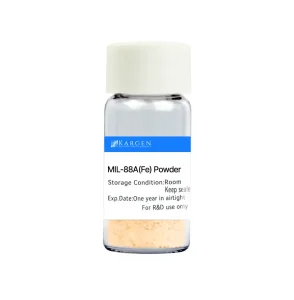
Iron-based MIL-88A(Fe) and MIL-101(Fe) serve dual roles as non-toxic adsorbents and Fenton-like catalysts for degrading persistent organic pollutants, micro-plastics, and heavy metal ions in industrial effluents.
Performance Metric: Achieves >98% removal efficiency for trace pharmaceuticals and volatile aromatics (benzene, toluene) from industrial gas streams.
China Factory Supply Chain Resilience & Efficiency Advantages
Leveraging world-class chemical infrastructure, direct backward integration, and automated quality management to deliver unmatched economic value and volume security.
Raw Material Integration
China controls the global production of foundational organic linkers, including terephthalic acid, fumaric acid, trimesic acid, and imidazole derivatives. Our direct factory partnership eliminates intermediate markups and insulates global buyers from raw material shortages.
Automated Quality Assurance
Every production batch undergoes automated characterization including Powder X-Ray Diffraction (PXRD) for crystal phase verification, Nitrogen Physisorption Isotherms for BET surface area determination, Thermogravimetric Analysis (TGA) for thermal stability, and ICP-MS for metal purity.
Seamless Global Logistics
Strategically based in Zhuhai within the Greater Bay Area (GBA), our factory enjoys immediate access to world-class deep-water sea ports and international air cargo hubs, offering flexible INCOTERMS (FOB, CIF, DDP) with hazardous chemical export compliance documentation pre-approved.
Technical Comparison: Benchmark MOF Adsorbents vs. Legacy Sorbents
Comprehensive physical property matrix engineered to assist technical directors and chemical engineering buyers in grade selection.
| Adsorbent Grade | Metal Node / Linker | BET Surface Area (m²/g) | Pore Volume (cm³/g) | Thermal Stability (°C) | Primary Target Application |
|---|---|---|---|---|---|
| UiO-66 | Zr / 1,4-BDC | 1,100 – 1,500 | 0.45 – 0.60 | Up to 500°C | Acid Gas Capture, Catalyst Support, Toxic VOC Removal |
| ZIF-8 | Zn / 2-Methylimidazole | 1,300 – 1,800 | 0.60 – 0.75 | Up to 400°C | CO₂/CH₄ Separation, Battery Separators, Hydrophobic Sensing |
| MIL-101(Cr) | Cr / 1,4-BDC | 2,800 – 3,500 | 1.30 – 1.65 | Up to 300°C | High-Capacity Gas Storage, Liquid Adsorption, Dye Remediation |
| HKUST-1 (Cu-BTC) | Cu / 1,3,5-BTC | 1,500 – 2,000 | 0.70 – 0.85 | Up to 250°C | Open Metal Site Gas Storage, Ammonia/Mercaptan Trapping |
| MOF-303 | Al / Pyrazole-3,5-dicarboxylic acid | 1,000 – 1,350 | 0.42 – 0.52 | Up to 300°C | Low-Humidity Atmospheric Water Harvesting, Dehumidification |
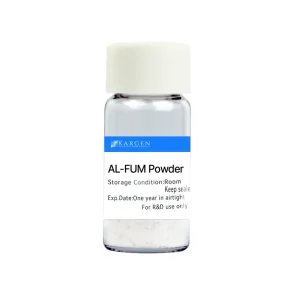
| Al-FUM | Al / Fumaric Acid | 1,000 – 1,250 | 0.45 – 0.55 | Up to 350°C | HVAC Adsorption Heat Pumps, Thermal Energy Storage |
| Legacy Zeolite 13X | Aluminosilicate | 400 – 700 | 0.25 – 0.35 | Up to 700°C | Generic Air Drying (High Desorption Energy Penalty) |
| Commercial Activated Carbon | Amorphous Carbon | 800 – 1,200 | 0.30 – 0.50 | Up to 200°C (in Air) | Non-Selective Water/Air Filtration (Uncontrolled Pores) |
Custom OEM/ODM Engineering & Regulatory Compliance
From lab-scale custom linker functionalization to rapid sample evaluation, we provide end-to-end technical support for international industrial clients.
1–5g Free Sample Program
We accelerate your R&D cycle by offering 1–5 gram free evaluation samples for verified corporate and academic projects. Each sample shipment includes batch-specific COA, PXRD patterns, and TGA curves to ensure seamless integration into your analytical workflow.
Custom Formulation & Slurries
Whether you require dry sub-micron powders, water/ethanol dispersions, or high-density extruded pellets, our process engineering team tailors particle size distribution ($D_{50}$, $D_{90}$) and surface wetting chemistry to match your coating or packing machinery.
REACH, RoHS & ISO Certification
All commercial MOF grades fully comply with EU REACH registration guidelines, RoHS heavy-metal restriction mandates, and OSHA SDS standards. Our manufacturing lines operate under ISO9001 (Quality Management) and ISO14001 (Environmental Safety) certifications.
Frequently Asked Questions (Procurement & Technical QA)
Clear, factual answers to key questions asked by R&D scientists, procurement managers, and process engineers.
Specialized MOF Materials & Custom Synthesized Solutions
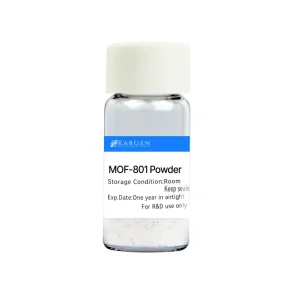
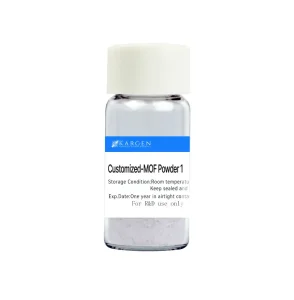
Explore specialized grades optimized for water harvesting, hydrocarbon separation, environmental remediation, and tailored industrial applications.