
Engineered Metal-Organic Frameworks (MOFs)
Commercial-grade nanoporous powders and dispersions optimized for molecular separation, gas storage, and catalytic applications.








Demystifying Nanoporous Frameworks: Structural Engineering at the Atomic Level
An engineering breakdown of coordination chemistry, pore geometry optimization, and mass transport kinetics in modern industrial MOFs.
Coordination Chemistry & Topological Control
Metal-Organic Frameworks (MOFs) represent a distinct class of advanced crystalline porous materials composed of metal ions or clusters coordinated to organic linkers (ligands). Unlike traditional inorganic adsorbents such as zeolites or activated carbons, MOFs possess ultra-high Brunauer-Emmett-Teller (BET) specific surface areas (ranging from 1,000 to over 7,000 m²/g), tailorable pore aperture dimensions, and customizable inner-wall chemical functionalities.
At Guangdong Advanced Carbon Materials Co., Ltd. (KARGEN), our scientific team—led by returning scholars from prestigious research institutions in the United States, Germany, and Sweden—focuses on manipulating secondary building units (SBUs) to engineer targeted reticular topologies (e.g., sod, pcu, tbo). By precisely pairing transition metal nodes (such as Zn²⁺, Al³⁺, Fe³⁺, Zr⁴⁺, and Cr³⁺) with rigid carboxylate or azolate organic linkers, we achieve precise control over pore apertures ranging from 0.3 nm to 3.0 nm, matching the kinetic diameters of target gas and liquid molecules.
Information Gain Insight: Traditional solvent-intensive solvothermal synthesis yields high operational costs and environmental overhead. KARGEN has pioneered continuous mechanochemical and low-solvent green synthesis routes in China, dropping mass-production costs by up to 65% while maintaining batch BET surface area consistency within ±3% variance.
| Framework Designation | Metal Node / Organic Linker | Pore Aperture (Å) | BET Surface Area (m²/g) | Primary Industrial Vector |
|---|---|---|---|---|
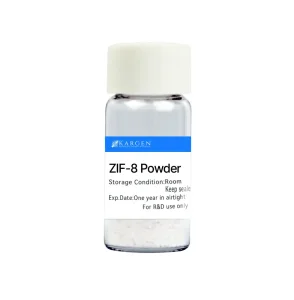
| ZIF-8 (Zn-based) | Zinc / 2-Methylimidazole | 3.4 Å (Window) / 11.6 Å (Cage) | 1,600 - 1,900 | CO₂ Capture, Li-ion Separators, Catalyst Supports |
| Al-FUM (Al-based) | Aluminium / Fumaric Acid | 5.7 Å × 6.0 Å | 1,000 - 1,300 | Atmospheric Water Harvesting, Desiccant Wheels |
| HKUST-1 (Cu-based) | Copper / Trimesic Acid (BTC) | 9.0 Å × 9.0 Å | 1,800 - 2,200 | Specialty Gas Storage, Olefin/Paraffin Separation |
| MIL-101(Cr) | Chromium / Terephthalic Acid | 29 Å / 34 Å (Dual Cages) | 3,000 - 3,800 | VOC Abatement, Liquid-Phase Pollutant Adsorption |
| MOF-303 (Al-based) | Aluminium / 1H-pyrazole-3,5-dicarboxylate | 6.0 Å | 1,200 - 1,400 | Low-Humidity Water Generation, Acidic Gas Scrubbing |
China Factory 4.0: Supply Chain Resilience & Cost-Efficiency Advantages
Bridging the critical gap between milligram laboratory discovery and metric-ton industrial commercialization.
Ton-Scale Continuous Scalability
Operating out of our 10,000 m² modern manufacturing base in Zhuhai, Guangdong, KARGEN was the first enterprise in China to achieve commercial mass production of MOF powders. Our automated continuous microfluidic and mechanochemical lines eliminate lot-to-lot thermal gradients.
Vertical Raw Material Integration
By securing upstream synthesis of specialized organic ligands (such as fumaric acid derivatives, imidazole complexes, and tricarboxylic acids) within China's robust chemical ecosystem, we protect international enterprise buyers from supply chain shocks and volatile spot pricing.
Digital Batch Quality Traceability
Every single production lot undergoes rigorous digital inspection. We provide complete Certificate of Analysis (CoA) documentation detailing Powder X-Ray Diffraction (PXRD) crystallinity, N₂ adsorption isotherm BET surface area, Thermogravimetric Analysis (TGA), and ICP-OES metal purity metrics.
Macro Industry Solutions: Transforming Global Process Engineering
How engineered nanoporosity solves complex thermodynamic challenges across key industrial sectors.
1. Point-Source CO₂ Capture & Direct Air Capture (DAC)
Conventional liquid amine scrubbing (MEA/DEA) suffers from excessive thermal regeneration penalties (3.5 - 4.5 GJ/ton CO₂) and severe equipment corrosion. KARGEN’s targeted ZIF-8, MIL-101, and custom amine-functionalized MOFs provide high working capacities for low-concentration CO₂ streams.
Our hydrophobic MOF crystallites demonstrate high CO₂/N₂ selectivity (>35) under wet flue gas conditions, lowering thermal desorption temperatures to under 90°C and cutting system parasitic energy consumption by up to 40%.
2. Lithium-Ion Battery Separator Coatings & Solid-State Electrolytes
Thermal runaway and lithium dendrite growth remain critical hurdles for high-energy density storage. By coating PE/PP battery separators with sub-micron ZIF-8 or MIL-53(Al) dispersions, battery manufacturers create homogeneous sub-nanometer ion channels.
The lewis-acidic metal sites immobilize target anions (PF₆⁻), accelerating Li⁺ transference numbers (tLi⁺ > 0.75), suppressing dendrite nucleation, and preventing cathode transition-metal leaching during extended fast-charging cycles.
3. Atmospheric Water Harvesting (AWH) & Ultra-Efficient HVAC
Addressing global water scarcity, frameworks such as Al-FUM and MOF-303 feature steep S-shaped water sorption isotherms, enabling rapid water uptake at relative humidity (RH) levels as low as 10-30%. Desorption is triggered by low-grade thermal solar or waste heat (< 65°C).
When integrated into commercial HVAC heat exchangers and desiccant wheels, MOF coatings handle latent moisture loads independently from sensible cooling, slashing compressor electrical power demand by over 50% in warm, humid climates.
4. Semiconductor Specialty Gas Purification & Olefin Separation
Sub-ppb purification of electronic gases (Ar, N₂, Silane, Ammonia) is paramount for advanced node semiconductor fabrication. MOFs with open metal sites (such as HKUST-1) selectively trap trace reactive impurities (H₂O, O₂, CO, H₂S).
Furthermore, in petrochemical processing, materials like TYUT-12 deliver groundbreaking ethane/ethylene and propane/propylene separation kinetic factors, replacing traditional energy-intensive cryogenic distillation columns.
Technology Roadmap & Future Outlook: The Next Decade of Nanomaterials
Anticipating market requirements and scientific breakthroughs for scalable porous matrix materials through 2035.
Phase I: AI-Driven Crystal Discovery (2025–2027)
Integrating Density Functional Theory (DFT) calculations and generative AI screening models to predict optimal metal-linker binding energies prior to wet lab synthesis. This accelerates custom OEM formulation cycles from months to days.
Phase II: COF & MOF-Hybrid Composites (2027–2030)
Merging the ultra-high chemical stability of Covalent Organic Frameworks (COFs) with the versatile catalytic power of MOFs. Commercializing binderless structured monoliths, extrudates, and thin-film membranes tailored for continuous process flow units.
Phase III: Smart Dynamic Frameworks (2030–2035)
Developing stimulus-responsive "breathing" frameworks that alter pore dimensions under external electric, magnetic, or light signals—enabling zero-thermal-penalty adsorption-desorption industrial separation systems.
Global Enterprise Procurement & Regulatory Assurance
Streamlining international compliance, supply chain auditing, and seamless technical integration for global buyers.
Regulatory Compliance & Certifications
Navigating global chemical control legislation is paramount for international supply chain security. KARGEN ensures full export and import compliance for all bulk shipments:
- EU REACH & UK REACH: Full registration and pre-registration protocols for exported metal nodes and specialized organic linkers.
- RoHS & SVHC Compliance: Absolute elimination of restricted heavy metals and Substances of Very High Concern.
- ISO Management Standards: Certified under ISO 9001 (Quality Control), ISO 14001 (Environmental Management), and ISO 45001 (Occupational Health & Safety).
- Global Dangerous Goods (DG) Handling: Full GHS-compliant SDS labeling, UN-certified moisture-proof anti-static packaging, and air/sea freight documentation.
Enterprise SLA & Supply Chain Guarantees
To support corporate procurement teams and continuous manufacturing lines, KARGEN executes transparent Service Level Agreements (SLAs):
- Sample-to-Scale Pipeline: 1-5g free evaluation samples provided for qualified B2B projects, backed by lab batch validation reports.
- Guaranteed Lead Times: Standard grades shipped within 3-5 business days; custom synthesis orders delivered within 4-6 weeks.
- Vendor-Managed Inventory (VMI): Buffer stock agreement options available for high-volume contract enterprise customers.
- 1 Business-Day Response Commitment: Dedicated application engineering support for technical inquiries regardless of global time zones.
Advanced Industrial MOF Powders & Formulations
High-selectivity sorbents, catalytic matrices, and tailor-made framework structures available for export.





Frequently Asked Questions for Engineering & Procurement Teams
Direct technical answers regarding MOF sampling, scale-up logistics, thermal stability, and custom synthesis.
What is the procedure for obtaining evaluation samples of KARGEN MOFs?
We supply 1–5 g free evaluation sample lots for qualified corporate R&D and institutional projects. Buyers only cover international express shipping fees. Please email our scientific sales team with a brief outline of your target application parameters (e.g., pore size requirement, operating temperature, gas/liquid medium) to qualify for immediate dispatch.
In what physical forms can KARGEN supply MOF materials?
Standard grades are supplied as fine dry crystallite powders (D50 adjustable from 500 nm to 20 µm). Additionally, we provide customized liquid dispersions (in water, ethanol, NMP, or organic solvents for battery separator roll-to-roll slurry coating), extruded cylindrical pellets (1.5 mm - 3.0 mm for fixed-bed adsorption columns), and structured ceramic/metallic honeycomb coatings.
How do KARGEN MOFs maintain moisture and thermal stability in industrial flue gas environments?
Thermal degradation temperatures (Td) for frameworks like ZIF-8 and MIL-101(Cr) exceed 400°C in inert atmospheres and 300°C in air. For high-humidity gas streams, hydrophobic frameworks (e.g., ZIF-8, ZIF-93) maintain crystalline structural integrity without pore collapse even after prolonged exposure to condensed steam or acidic gas contaminants (SOx/NOx up to threshold levels).
Can KARGEN develop proprietary or patented MOFs under OEM/ODM terms?
Yes. Our R&D division—comprising over 60% of our total personnel—regularly undertakes custom synthesis agreements. We execute Non-Disclosure Agreements (NDAs) to engineer tailor-made organic linkers, perform solvent screening, optimize reaction kinetics, and scale synthesis recipes from lab flasks to metric-ton reactor vessels under full client IP ownership.
What packaging and shelf-life guarantees are provided for bulk international exports?
All powder shipments are vacuum-sealed inside double-layer anti-static aluminum foil barrier bags with desiccant inserts, housed within heavy-duty UN-rated fiber drums. Sealed containers store indefinitely in ambient warehouse conditions without BET surface area loss. Each shipment includes a batch-specific Certificate of Analysis (CoA) and GHS Safety Data Sheet (SDS).