High-Purity MOF Powders & Engineered Nanomaterials
Direct factory sourcing for laboratory evaluation, pilot testing, and industrial mass production. Select a product grade to review technical specs.
1. Global Nanoparticle Manufacturing & Industrial MOF Landscape
An executive overview of the shift from benchtop synthesis to ton-scale advanced nanomaterial supply chains.
The Paradigm Shift in Porous Material Synthesis
The global chemical and materials industry is undergoing a structural transition toward reticular chemistry and 3D porous crystalline architectures. Nanoparticle manufacturing—specifically the production of Metal-Organic Frameworks (MOFs), Zeolitic Imidazolate Frameworks (ZIFs), and Covalent Organic Frameworks (COFs)—has progressed from high-cost, milligram-scale university research into high-throughput, industrial-scale bulk manufacturing.
Modern energy systems, decarbonization networks, and advanced electronics demand ultra-high surface area materials with tailored pore topologies. Frameworks such as ZIF-8, MOF-801, UIO-66, and MIL-53(Al) offer BET surface areas ranging from 1,000 to over 5,000 m²/g, vastly outperforming legacy adsorbents like activated carbon or traditional zeolites in selective molecular separation and catalytic reactivity.
Bottlenecks in Traditional Supply & Strategic Sourcing
Historically, global adoption of MOF nanoparticles was constrained by three critical barriers: high organic linker costs, organic solvent waste during solvothermal processing, and batch-to-batch inconsistency. Procurement managers and chemical engineers faced prohibitive costs exceeding $5,000 to $10,000 per kilogram for laboratory-grade powders.
To overcome these hurdles, enterprise buyers now seek specialized tier-1 manufacturing suppliers capable of delivering ton-scale production volume, continuous quality assurance, and validated environmental compliance. As an industry pioneer, Guangdong Advanced Carbon Materials Co., Ltd. (KARGEN) established China’s first dedicated ton-scale MOF production plant, driving commercial viability across carbon capture, HVAC desiccant systems, and energy storage markets.
2. Technical Roadmap & Synthesis Engineering
A comprehensive scientific breakdown of industrial scale-up methodologies: Solvothermal, Mechanochemical, and Continuous Flow Microfluidic Synthesis.
Mechanochemical Green Synthesis
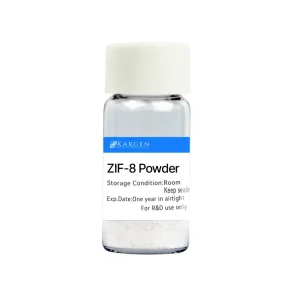
KARGEN utilizes solvent-free or solvent-deficient mechanochemical extrusion and ball-milling techniques for flagship products like ZIF-8. By applying mechanical energy directly to metal oxides/salts and organic linkers (such as 2-methylimidazole), chemical coordination occurs rapidly at room temperature.
- Eliminates hazardous DMF/DEF solvents by >90%
- Lowers carbon footprint of manufacturing processes
- Produces highly crystalline micro-powders with predictable pore size
Hydrothermal & High-Pressure Scale-Up
For hydrothermally stable frameworks like Al-FUM (Aluminium Fumarate) and MIL-53(Al), continuous-agitated industrial reactors are engineered to regulate crystal growth kinetics. Precise control over temperature ramp rates, precursor ratios, and pH levels prevents grain boundary defects.
- Guarantees narrow particle size distribution (PSD)
- Optimizes thermal stability up to 400°C–500°C
- Enables consistent water sorption isotherm metrics
AI-Assisted Reticular Engineering
Looking toward the future roadmap (2025–2030), KARGEN combines AI molecular simulation with continuous-flow microfluidic reactors. Machine learning models predict host-guest binding energies for targeted gas molecules (such as CO₂, CH₄, N₂, and toxic VOCs) to customize organic ligands prior to physical batch production.
- Automated high-throughput screening of metal nodes
- Rapid customization under OEM/ODM parameters
- Seamless transition from lab milligram scale to ton supply
Industrial Technology Scaling Roadmap
Quantum Chemical Modeling
DFT simulation of pore diameters, open metal site density, and binding affinity to select optimal precursors.
50kg–500kg Validation
Pilot scale-up using continuous stirred-tank reactors (CSTR) to verify heat transfer and crystallization kinetics.
Automated Mass Production
Mass synthesis with online NIR and XRD monitoring, automated washing, spray-drying, and vacuum activation.
Powders, Pellets & Dispersions
Processing raw powders into liquid dispersions, extrudates, monoliths, or separator coatings based on customer specs.
3. Localized Industrial Application Scenarios
How engineered MOF nanoparticles solve critical efficiency challenges in climate tech, energy storage, and industrial gases.
A. HVAC Desiccant Wheels & Adsorption Cooling
In commercial building HVAC units and industrial dehumidification systems, latent heat management consumes vast amounts of electrical energy. Standard silica gel or molecular sieve desiccants require high regeneration temperatures (120°C–160°C).
Al-FUM (Aluminium Fumarate) nanoparticles feature a steep S-shaped water sorption isotherm. They adsorb up to 50 wt% water vapor at 60–80% RH and regenerate efficiently at ultra-low heat (below 75°C). Coating HVAC heat exchangers with Al-FUM reduces compressor power consumption by over 50%, facilitating integration with waste heat sources or solar thermal collectors.
B. Lithium-Ion Battery Separator & Electrolyte Coatings
Next-generation EV batteries demand enhanced thermal stability and extended cycle life. Coating polyolefin battery separators with ultra-fine ZIF-8 nanoparticles creates a homogeneous sub-nanometer ion channel network.
ZIF-8 micropores act as selectivity filters: they accelerate Li+ solvation sheath desolvation, regulate lithium-ion flux to suppress dendrite formation, and scavenge trace HF moisture and transition-metal ions dissolved from NCM/LFP cathodes. This results in significantly higher C-rate performance, improved safety under thermal abuse, and enhanced SEI layer durability.
C. Point-Source CO₂ Capture & Direct Air Capture (DAC)
Industrial decarbonization requires efficient capture of carbon dioxide from coal/gas power station flue streams, cement kilns, and ambient air. Traditional liquid amine scrubbing (MEA/MDEA) suffers from high boiling energy losses and solvent degradation.
Specifically engineered frameworks like ZIF-8, UIO-66, and MOF-303 provide high CO₂/N₂ and CO₂/CH₄ selectivity. Operating in Vacuum Pressure Swing Adsorption (VPSA) or Temperature Swing Adsorption (TSA) beds, MOF nanoparticles cut the energy penalty of carbon capture by 30–45% compared to wet chemical absorption systems.
D. Semiconductor Specialty Gas Purification & Storage
Microelectronic fabrication plants mandate ultra-high purity (99.9999% UHP) electronic gases, such as phosphine (PH₃), arsine (AsH₃), silane (SiH₄), and ammonia (NH₃). Trace contaminants cause devastating yield loss in sub-3nm chip nodes.
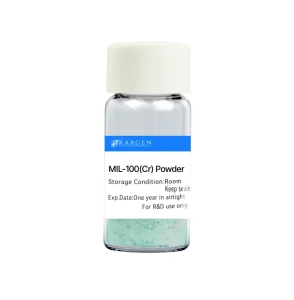
HKUST-1 (Copper BTC) and MIL-100(Cr) contain accessible open metal sites (unsaturated coordination centers) that strongly bind targeted polar impurity molecules while maintaining high gas throughput. Furthermore, sub-atmospheric MOF gas storage cylinders improve safety when handling toxic hydride gases.
4. China Supply Chain Resilience & Manufacturing Efficiency
Why international OEM/ODM procurement managers partner with KARGEN for long-term commercial contract manufacturing.
Upstream Chemical Cluster Integration
KARGEN’s facility in Zhuhai, Guangdong, sits at the heart of China's advanced chemical and electronics manufacturing corridor. We maintain direct backward integration with primary producers of organic linkers (terephthalic acid, fumaric acid, imidazole derivatives) and metal precursor salts (zinc, aluminum, copper, zirconium).
This proximity guarantees raw material availability, insulates international buyers from global supply shocks, and delivers a 30%–50% cost advantage over Western suppliers.
Agile Pilot-to-Ton Scaling Speed
While traditional European or American specialized chemical vendors often require 12 to 18 months to transition a novel nanomaterial formulation from lab to industrial scale, KARGEN’s unified 10,000 m² campus housing PhD-led R&D labs and production lines reduces this cycle to under 8 weeks.
Our infrastructure supports custom particle size tuning (d50 from 200nm up to 10 microns) and continuous liquid dispersion milling for seamless integration into customer binder matrices.
Digital Quality Control & Traceability
Every production batch undergoes mandatory analytical validation via Powder X-ray Diffraction (PXRD), BET N₂/CO₂ surface area analysis, Thermogravimetric Analysis (TGA), Inductively Coupled Plasma (ICP) metal analysis, and Scanning Electron Microscopy (SEM).
Batch-specific Certificates of Analysis (COA) and complete quality documentation accompany every sea or air freight shipment to ensure effortless regulatory approval.
5. Standard MOF Nanoparticle Specifications Comparison
Use this technical decision matrix to match your application requirements with the appropriate metal node, linker structure, and performance parameters.
| Framework Grade | Metal Center & Linker | BET Surface Area (m²/g) | Pore Volume / Size | Thermal Stability | Primary Industrial Application |
|---|---|---|---|---|---|
| ZIF-8 | Zn²⁺ / 2-Methylimidazole | 1,300 – 1,800 | 0.65 cm³/g | 0.34 nm window / 1.16 nm cage | Up to 400°C (N₂) | Li-ion separator coating, CO₂ capture, catalyst support |
| MOF-801 | Zr⁴⁺ / Fumaric Acid | 800 – 1,100 | 0.45 cm³/g | 0.56 nm pore diameter | Up to 300°C | Atmospheric water harvesting, low-RH dehumidification |
| Al-FUM | Al³⁺ / Fumaric Acid | 1,000 – 1,300 | 0.50 cm³/g | 0.60 nm micropore | Up to 350°C | HVAC desiccant wheels, heat pump adsorption cooling |
| HKUST-1 (Cu-BTC) | Cu²⁺ / 1,3,5-BTC | 1,500 – 2,100 | 0.75 cm³/g | 0.90 nm & 1.30 nm pores | Up to 250°C | Semiconductor gas purification, acetylene & H₂ storage |
| MIL-53(Al) | Al³⁺ / Terephthalic Acid | 1,100 – 1,500 | 0.60 cm³/g | Breathing pore structural flex | Up to 500°C | VOC sorption, benzene/toluene separation, gas storage |
| UiO-66 | Zr⁴⁺ / Terephthalic Acid | 1,100 – 1,600 | 0.60 cm³/g | 0.60 nm & 1.10 nm cages | Up to 500°C (Air/H₂O) | Corrosive chemical filtration, toxic agent degradation |
* Custom modifications (metal doping, defect engineering, functionalized linkers like -NH₂, -NO₂, -SO₃H) are available via KARGEN OEM services.
6. Global Regulatory Compliance & Engineering Support
Ensuring frictionless international trade, environment safety, and technical integration for enterprise clients.
International Chemical Regulations
All KARGEN MOF products are manufactured under strict environmental safety protocols. We provide comprehensive Safety Data Sheets (SDS / MSDS) compliant with GHS, EU REACH registration documentation, RoHS certifications, and Heavy Metal test certificates.
Specialized Packaging & Logistics
Because high-surface-area porous materials readily absorb ambient moisture and air contaminants, our nanomaterials are packaged under vacuum/inert gas in multi-layer aluminum-foil moisture barrier bags, ranging from 100g sample containers to 25kg industrial drums and 500kg super sacks.
Dedicated Application Engineering Team
Our service does not end at powder delivery. KARGEN’s doctoral engineering team provides client support for slurry formulation, dispersion optimization in organic solvents/aqueous systems, wash-coating methodologies on ceramic or metal substrates, and extrusion pelletization.
7. Technical & Procurement FAQ
Clear answers to key questions asked by R&D scientists, material engineers, and strategic procurement officers.
Does KARGEN provide free MOF samples for lab validation?
Yes. Qualified commercial enterprise projects and university R&D institutes can request 1g to 5g free evaluation samples of our standard MOF products (such as ZIF-8, Al-FUM, MOF-801, or MIL-53). Customers only cover DHL/FedEx courier shipping charges. Please send your material requirements and application context to our sales engineering team at [email protected].
What product physical forms can KARGEN deliver?
We supply materials in multiple physical forms tailored to client downstream processing:
- Dry Powders: Microcrystalline activated powders with controlled d50 particle sizes.
- Liquid Dispersions: Pre-dispersed nano-slurries in NMP, Water, Ethanol, or Isopropanol for battery separator coating.
- Formed Pellets & Extrudates: 1mm–3mm cylindrical granules or spherical beads prepared with inert binders for packed-bed adsorption columns.
What is KARGEN's annual manufacturing capacity and batch scalability?
KARGEN operates a 10,000 m² R&D and production facility in Zhuhai, China. As the first company in China to achieve commercial ton-scale production of Metal-Organic Frameworks, our annual capacity exceeds tens of metric tons across primary MOF lines, supporting rapid scale-up from 1kg trial lots to full multi-ton contract supply.
Can KARGEN synthesize custom or proprietary MOF structures under OEM/ODM Non-Disclosure Agreements?
Absolutely. Our scientific leadership team includes PhD scholars returning from the United States, Germany, and Sweden. We have successfully commercialized over 40 distinct MOF structures. Under strict NDA protection, we offer custom organic linker synthesis, pilot route optimization, scale-up engineering, and dedicated tolling capacity for your proprietary porous material.
How do MOFs compare with legacy adsorbents like zeolites and active carbon?
While active carbons feature random pore distributions and zeolites have rigid inorganic silicate backbones, MOFs are tuneable hybrid organic-inorganic materials. Their specific surface area is 2x to 5x higher than silica gel/carbons, their pore chemistry can be chemically functionalized for specific gas binding, and their regeneration temperature is significantly lower, offering operational energy savings of up to 50%.
What is the standard order lead time and international inquiry response SLA?
We guarantee an engineering team response to all international email inquiries within 1 business day. In-stock standard powders ship within 3 to 5 business days via air express. Bulk ton-scale production orders typically carry a 3 to 6-week production lead time depending on raw material sourcing and custom packaging requirements.
Specialized Frameworks & Industrial Powder Formulations
Explore additional factory-direct framework grades for gas separation, water harvesting, catalytic abatement, and research.
Accelerate Your Commercial Nanomaterial Deployment
Whether you are optimizing a lithium battery separator slurry, designing a low-energy carbon capture unit, or developing an HVAC desiccant wheel, KARGEN provides the scientific expertise and ton-scale capacity you need.