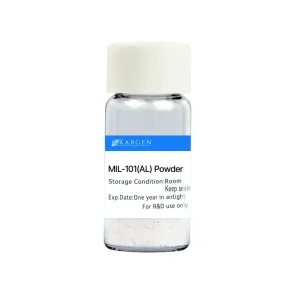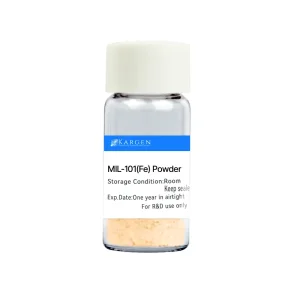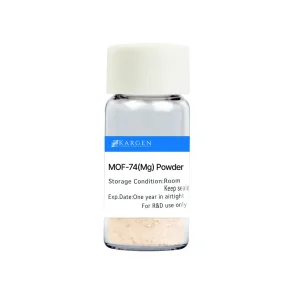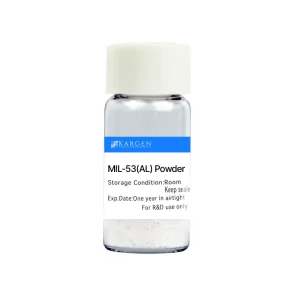
Industrial-grade metal-organic framework powders verified by 77K N₂ sorption isotherms for maximal micropore volume and gas selectivity.
1. The Physics and Chemistry of Ultra-High MOF Surface Area
Metal-Organic Frameworks (MOFs) represent a revolutionary paradigm in nanostructured porous materials. Constructed via coordinate bonds between inorganic metal nodes (secondary building units, or SBUs) and organic linkers, MOFs possess record-breaking gravimetric and volumetric surface areas that far surpass traditional porous media such as zeolites, activated carbons, and mesoporous silica.
When procurement managers and chemical engineering teams evaluate high-quality MOF surface area suppliers, understanding the metric nuances of porous structures is paramount. The internal surface area of a MOF material directly determines its active site accessibility, guest molecule storage capacity, and kinetic diffusion rate.
Information Gain Metric: While traditional activated carbon typically caps out at 1,000 to 1,500 m²/g, engineered MOF architectures like MOF-177, MIL-101, and HKUST-1 consistently achieve Brunauer-Emmett-Teller (BET) surface areas ranging from 1,800 m²/g to well over 4,500 m²/g, with theoretical limits exceeding 7,000 m²/g.
Key Metrics for Evaluating MOF Surface Area & Porosity
- BET Surface Area (m²/g): Measured using liquid nitrogen physisorption at 77 K across low relative pressure ranges ($P/P_0 = 0.05 - 0.3$). It accounts for monolayer and multilayer adsorption on accessible framework surfaces.
- Langmuir Surface Area (m²/g): Assumes localized monolayer adsorption. While often higher than BET numbers for microporous solids, BET remains the global industrial benchmark for comparative supplier qualification.
- Total Pore Volume ($cm^3/g$): Indicates the cumulative internal free volume available for gas uptake or solvent retention. High-quality MOF-177 powders reach pore volumes up to 1.59 $cm^3/g$.
- Pore Size Distribution (PSD): Micro-porosity (< 2 nm) drives selective gas molecular sieving (e.g., $CO_2/N_2$ or $CH_4/N_2$), whereas meso-porosity (2–50 nm) enables rapid diffusion for liquid-phase catalysis and macromolecular storage.
2. Global Industrial & Commercial Landscape of High-Surface-Area MOFs
The global commercialization of metal-organic frameworks has transitioned from boutique laboratory synthesis to high-volume industrial deployment. As decarbonization mandates, energy efficiency targets, and advanced semiconductor manufacturing requirements accelerate worldwide, demand for consistent, high-surface-area MOF suppliers has surged.
Historically, early Western chemical manufacturers produced academic-grade MOFs at prohibitive costs (exceeding $5,000–$10,000 per kilogram). This bottleneck severely restricted industrial validation. Today, leading Chinese manufacturing hubs—spearheaded by enterprise leaders like KARGEN (Guangdong Advanced Carbon Materials Co., Ltd.)—have disrupted the cost structure through continuous flow synthesis, solvent recycling, and local precursor integration.
| MOF Framework Class | Metal Node / Linker Structure | Typ. BET Surface Area (m²/g) | Pore Volume ($cm^3/g$) | Primary Industrial Benchmark |
|---|---|---|---|---|
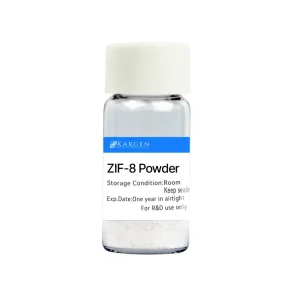
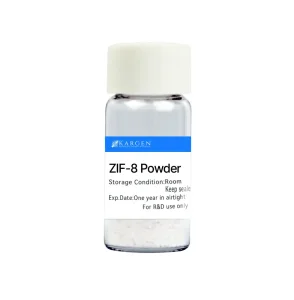
| ZIF-8 Grade | Zinc / 2-Methylimidazole | 1,600 – 1,900 | 0.65 – 0.75 | Hydrophobic $CO_2$ Capture & Battery Separator Coating |
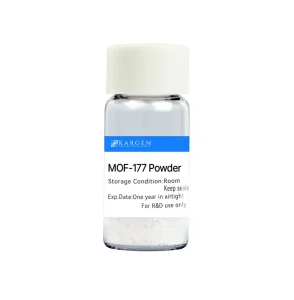
| MOF-177 Grade | Zinc / BTB (Trimesic Acid derivative) | 4,200 – 4,700 | 1.50 – 1.65 | Ultra-High Gravimetric Gas Storage ($CH_4, H_2$) |
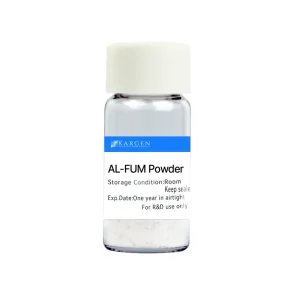
| Al-FUM Grade | Aluminium / Fumaric Acid | 1,100 – 1,300 | 0.45 – 0.55 | Atmospheric Water Harvesting & HVAC Dehumidification |
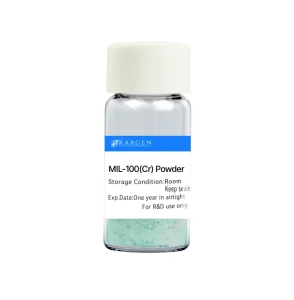
| MIL-101(Cr/Al) | Chromium/Aluminium / BDC | 3,000 – 3,800 | 1.30 – 1.50 | VOC Adsorption & Liquid Phase Catalytic Separation |
| HKUST-1 (Cu-BTC) | Copper / Trimesic Acid | 1,800 – 2,100 | 0.75 – 0.85 | Semiconductor Specialty Gas Sieving & Storage |
By establishing rigorous quality control metrics based on surface area preservation post-activation, qualified global suppliers can now guarantee batch-to-batch thermal stability exceeding 400°C and structural longevity under cyclic pressure swings.
3. Technology Roadmap & Pore Structure Architecture (2025–2035)
Achieving maximum effective surface area requires controlling structural defects, solvent evacuation dynamics, and framework collapse during activation. The technical roadmap for next-generation MOF manufacturing focuses on three key engineering pillars:
1. Green Mechanochemical & Continuous Flow Synthesis
Transitioning away from batch solvothermal reactors to solvent-free mechanochemical grinding and continuous twin-screw extrusion. This process minimizes chemical waste, reduces energy consumption by up to 60%, and prevents crystal agglomeration, thereby maintaining higher accessible BET surface area.
2. Defect Engineering & Pore Hierarchy Design
By selectively introducing linkers or node vacancies during crystal growth, engineers create hierarchical micro-mesoporous networks. This pore architecture prevents molecular clogging, accelerates mass transport, and maximizes usable kinetic surface area during high-flow gas separation.
3. AI-Guided High-Throughput Reticular Discovery
Leveraging machine learning models and molecular dynamics simulations to predict structural stability, activation conditions, and nitrogen uptake prior to physical scaling. This ensures predictable BET metrics across scaled production lots.
4. Localized Application Scenarios & Industrial Integration
High-surface-area MOF materials are not standardized commodities; their utility depends heavily on localized operating conditions, thermal activation boundaries, and feed gas moisture content. Below are key industrial applications where high BET surface area MOFs deliver transformative gains:
A. Direct Air Capture (DAC) & Flue Gas Decarbonization
Capture plants require ultra-high density of accessible amine-functionalized or open metal sites. High surface area frameworks (e.g., ZIF-8, Mg-MOF-74) maximize the volumetric adsorption of low-concentration $CO_2$ (400 ppm atmospheric up to 15% flue gas), drastically reducing thermal regeneration energy down to < 80°C.
B. Atmospheric Water Harvesting (AWH) in Arid Zones
Materials like Al-FUM utilize specialized micro-pore step-isotherms ($S$-shaped adsorption curve). Under low relative humidity (10%–30% RH in desert regions), high surface area aluminum fumarate captures moisture during the night and desorbs clean drinking water using ambient solar heat during the day.
C. Lithium-Ion & Solid-State Battery Coatings
Coating battery separators with sub-micron ZIF-8 or MIL powders creates an ionically conductive, high-surface-area porous barrier. This layer traps dissolved transition metal ions, regulates uniform $Li^+$ flux, suppresses dendrite growth, and extends cycle life in high-voltage energy storage systems.
D. Ultra-Pure Semiconductor Gas Purification
In microelectronics fabrication, gas purifiers utilizing HKUST-1 and ZIF-93 leverage intense surface-area contact to remove moisture, oxygen, and trace silane impurities down to sub-ppb (parts-per-billion) levels, protecting sensitive wafer lithography steps.
E. Desiccant Wheels & Adsorption Cooling
Integrating high-surface-area MOF powders directly onto heat exchanger coils removes latent moisture load prior to sensible cooling, slashing commercial HVAC power consumption by up to 40%–50% compared to legacy silica gel systems.
F. Solid-State Hydrogen & Methane Storage
Ultra-porous networks such as MOF-177 provide volumetric gas storage densities comparable to compressed tanks at fractionally lower operating pressures, lowering compression hazard risk in fuel-cell vehicles.
5. China Supply Chain Resilience & Factory Efficiency Advantages
Establishing a dependable, long-term procurement partnership for advanced MOF powders requires evaluating supplier ecosystem depth, raw material vertical integration, and quality management robustness.
China has emerged as the premier manufacturing center for scalable MOF supply due to strategic industrial advantages:
- Upstream Linker & Metal Salt Integration: Direct proximity to domestic production facilities for organic ligands (fumaric acid, terephthalic acid, trimesic acid, 2-methylimidazole) and high-purity metal salts ($Zn, Al, Cu, Fe$) eliminates global shipping delays and lowers raw material costs by 35%–50%.
- Mechanochemical Scale-Up Infrastructure: Facilities such as KARGEN’s 10,000 m² R&D and manufacturing campus in Zhuhai feature custom multi-ton reactors capable of operating continuous solvent-free processes, ensuring rapid turnaround on order volumes from 1 kg evaluation lots to multi-ton container shipments.
- Digital Quality Assurance Protocols: Every production batch undergoes automated gas physisorption (BET), Powder X-Ray Diffraction (PXRD), and Thermogravimetric Analysis (TGA). Inspection records are digitally tracked to guarantee zero deviation from agreed porosity specifications.
- Global Export & Regulatory Compliance: Comprehensive support for REACH registration, ISO 9001 quality standards, ISO 14001 environmental safety compliance, and global GHS-compliant Safety Data Sheets (SDS).
6. Regulatory Compliance, COA Safeguards & OEM/ODM Workflow
Navigating global regulatory landscapes is critical for corporate engineering teams integrating MOF materials into commercial hardware. Leading MOF surface area suppliers provide complete transparency and validation support at every step of project scale-up:
Step 1: Application Screening
Technical consultation with PhD scientists to match target pore diameters, BET surface area metrics, thermal limits, and chemical stability requirements with the ideal framework grade.
Step 2: Sample Validation (1–5 g)
Provision of certified lab evaluation samples accompanied by full Certificate of Analysis (COA) containing 77K $N_2$ adsorption curves, pore volume calculations, and PXRD pattern matches.
Step 3: Pilot Scale-Up & OEM Customization
Tuning particle size distributions (sub-micron to granule pellets), solvent dispersion forms, or ligand modifications under strict non-disclosure (NDA) and OEM/ODM agreements.
Expert technical answers covering BET surface area testing, moisture stability, custom synthesis, and bulk procurement protocols.
Explore our full line of metal-organic framework powders engineered for catalytic, environmental, and specialty gas storage applications.