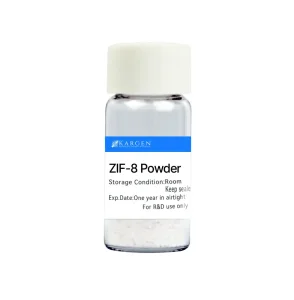
Featured Industrial MOF Powders & Crystals
Explore our top-tier benchmark Metal-Organic Framework materials validated for scale-up, carbon capture, and catalytic processes.







1. The Material Science Foundation: Reticular Chemistry Meets Industrial Scale
Understanding why Metal-Organic Frameworks are outperforming traditional porous solids like activated carbon, zeolites, and silica gels in commercial deployment.
Atomic Precision & Pore Engineering
Metal-Organic Frameworks (MOFs) are hybrid crystalline materials composed of inorganic metal nodes (clusters or ions such as Zr⁴⁺, Zn²⁺, Fe³⁺, Cu²⁺) coordinated with organic linkers (such as carboxylates, azoles, or tetrazoles). Unlike amorphous porous materials, reticular synthesis enables sub-nanometer control over pore geometry, channel apertures, and internal chemical functionalization. This crystalline precision delivers unprecedented selectivity coefficients in molecular separations.
Surface Area & Volumetric Density
Commercial MOFs synthesized under optimized hydrothermal or mechanochemical pathways achieve BET specific surface areas ranging from 1,000 m²/g (e.g., ZIF-8) up to 6,000+ m²/g (e.g., MOF-177, UIO-67). One gram of high-purity MOF material contains an internal surface area equivalent to multiple football pitches. This immense internal area translates directly into ultra-high storage capacities for compressed gases and target adsorbates per unit volume.
Thermodynamic vs Kinetic Sieving
MOF engineering leverages two primary separation mechanisms: thermodynamic selectivity (where open metal sites or polar functional groups bind specific molecules preferential to others, such as CO₂ over N₂) and kinetic sieving (where pore apertures act as molecular gates, allowing smaller kinetic diameter gases like H₂ to pass while excluding larger hydrocarbons like CH₄).
2. Transformative Commercial Applications of MOF Powders & Dispersions
From post-combustion carbon capture to solid-state energy storage, examine where MOFs provide a decisive technological edge.
Industrial CO₂ Capture & Direct Air Capture (DAC)
Traditional amine scrubbing systems incur prohibitive energy penalties (3.5 - 4.5 GJ/ton CO₂) during thermal regeneration. Specialized MOF adsorbents like KAUST-7, ZIF-8, and CALF-20 demonstrate steep adsorption isotherms at low partial pressures, allowing selective flue gas CO₂ capture (10-15% CO₂ stream) and ambient Direct Air Capture (420 ppm CO₂). MOF-based Vacuum Swing Adsorption (VSA) cuts regeneration energy requirements by up to 40% compared to aqueous monoethanolamine (MEA).
Lithium-Ion Battery Separator Coatings & Solid-State Electrolytes
In high-energy lithium batteries, metal dendrite growth and thermal runaway pose severe safety challenges. Nano-ZIF-8 and UIO-66 coated onto polyolefin separators serve as ion-sieving membranes that homogenize Li-ion flux, effectively suppressing lithium dendrite formation. Furthermore, incorporating functionalized MOF nanofillers into solid polymer electrolytes (SPEs) immobilizes anions, resulting in high single-ion lithium transference numbers (tLi+ > 0.7) and exceptional room-temperature ionic conductivity.
Atmospheric Water Harvesting (AWH) & Climate Control
Hydrothermally resilient aluminium fumarate (Al-FUM) and MOF-303 exhibit characteristic S-shaped water sorption isotherms. They absorb significant moisture under low relative humidity conditions (RH < 20%) and release potable water at low solar-thermal desorptive temperatures (60°C - 75°C). Integrating MOF coatings into HVAC desiccant wheels reduces humidity load independently of sensible cooling, delivering up to 50% energy savings in global commercial climate systems.
Semiconductor Gas Purification & Hydrocarbon Separation
Semiconductor fabrication facilities require ultra-pure gases (99.9999% 6N purity). HKUST-1 and MIL-53(Al) possess specific unsaturated open metal sites capable of removing trace sub-ppm moisture, phosphine, arsine, and volatile organics from hydride gases. In petrochemical refining, MOF membranes replace energy-intensive cryogenic distillation by achieving single-pass separation of ethylene/ethane and propylene/propane mixtures at ambient temperatures.
Catalytic Wastewater Remediation & VOC Encapsulation
Iron-based MOFs, such as MIL-101(Fe) and MIL-88A(Fe), function as highly efficient heterogeneous Fenton-like catalysts. Under ambient light, they generate reactive hydroxyl radicals (•OH) that completely mineralize recalcitrant organic pollutants, dyes, pharmaceutical residues, and toxic heavy metals in industrial effluent streams. Additionally, hydrophobic MOFs excel at trapping carcinogenic volatile organic compounds (VOCs) like benzene, toluene, and formaldehyde from indoor and industrial exhaust gases.
Solid-State Hydrogen & Natural Gas Storage
High-surface-area frameworks like MOF-177 and UIO-66 enable safe, low-pressure volumetric storage of green hydrogen and compressed natural gas (ANG) for clean fuel cell vehicles. By densifying gas molecules within crystalline pores via physisorption, MOF-filled fuel tanks achieve high volumetric storage capacities at lower working pressures (35-100 bar) compared to conventional 700 bar compressed gas cylinders.
3. Technical Benchmarking of Key Commercial MOF Frameworks
A comparative evaluation of crystal structures, surface parameters, chemical stabilities, and target commercial applications.
| MOF Designation | Metal Center & Linker | BET Surface Area (m²/g) | Thermal Stability (°C) | Primary Industrial Application | Key Performance Metric |
|---|---|---|---|---|---|
| ZIF-8 | Zn²⁺ / 2-Methylimidazole | 1,300 - 1,800 | Up to 450°C | CO₂ Capture & Battery Separators | Hydrophobic, High pH Stability |
| Al-FUM | Al³⁺ / Fumaric Acid | 1,000 - 1,400 | Up to 350°C | Atmospheric Water Harvesting & HVAC | Stepwise Water Sorption at <20% RH |
| UIO-66 | Zr⁴⁺ / 1,4-Dicarboxybenzene | 1,100 - 1,600 | Up to 500°C | Acid-Gas Removal & Catalyst Support | Extreme Mechanical & Chemical Resilience |
| HKUST-1 | Cu²⁺ / Benzene-1,3,5-tricarboxylate | 1,500 - 2,000 | Up to 250°C | Semiconductor Gas Purification | High Density of Open Copper Sites |
| MOF-177 | Zn⁴O²⁺ / BTB Linker | 4,000 - 5,000 | Up to 300°C | High-Capacity H₂ & CH₄ Storage | Ultra-High Gravimetric Surface Area |
| MIL-101(Fe) | Fe³⁺ / Terephthalic Acid | 2,200 - 3,200 | Up to 320°C | Fenton Catalysis & Water Treatment | Non-toxic, Biocompatible Iron Center |
4. Global Enterprise Sourcing Demands & Procurement Considerations
Addressing the critical requirements of Fortune 500 chemical buyers, battery manufacturers, and EPC engineering firms.
Batch-to-Batch Consistency & Quality Assurance
For multinational procurement leads, transitioning from gram-scale academic evaluation to multi-ton industrial sourcing presents significant risk regarding batch variance. Key quality parameters must be guaranteed per shipment: nitrogen physisorption isotherms (BET metrics ± 5%), PXRD crystallinity indexing (>95% phase purity), dynamic light scattering (DLS) particle size distribution control, and TGA thermal degradation profiles.
Total Cost of Ownership (TCO) & Cost Curves
Historically, commercialization of MOFs was constrained by high synthesis costs ($500 - $2,000 per kilogram). Modern manufacturing breakthroughs—specifically continuous flow hydrothermal reactors, solvent recovery systems, and green mechanochemical milling—have disrupted the cost structure. High-volume contract pricing for benchmark grades like ZIF-8 and Al-FUM can now achieve economic parity with high-end specialty zeolites.
Form Factor Engineering & Processing
Industrial applications rarely utilize loose sub-micron MOF powders due to high pressure drops, dust formation, and system elutriation. Advanced suppliers provide engineered post-processing services, delivering MOF materials as extrudates, spherical beads, monolithic structures, wash-coated ceramic honeycombs, or liquid dispersions in NMP, water, and ethanol for battery slurries.
5. The China Supply Chain Advantage: Raw Materials to Ton-Scale Production
How Chinese advanced nanomaterial ecosystems are enabling scalable, reliable, and cost-effective MOF mass manufacturing.
Upstream Chemical Integration
China holds a dominant global position in the production of core precursor chemicals required for reticular synthesis. Key organic ligands—such as 2-methylimidazole, terephthalic acid (PTA), trimesic acid (BTC), and fumaric acid—are mass-produced domestically with complete raw material independence. This direct access mitigates global supply disruption risks and reduces precursor cost by 30 - 50% compared to Western counterparts.
10,000 m² Advanced Production Infrastructure
Leading Chinese MOF enterprises, such as KARGEN (Guangdong Advanced Carbon Materials Co., Ltd.), operate comprehensive research campuses combining high-throughput automated synthesis, pilot scale-up lines, and ton-scale production facilities. Operating continuous 1,000L to 5,000L reaction vessels under automated PLC feedback loops ensures consistent crystal morphology and strict batch uniformity.
Mechanochemical Solvent-Free Scale-Up
Pioneering Chinese manufacturers are replacing conventional solvothermal synthesis—which requires massive quantities of toxic DMF (dimethylformamide)—with low-solvent or mechanochemical reactive extrusion processes. This green synthesis approach dramatically lowers effluent treatment costs, minimizes environmental footprint, and enhances process scalability for international regulatory alignment.
6. Localization Support, Compliance & Enterprise Risk Mitigation
Navigating international chemical regulations, custom OEM synthesis, and seamless global delivery logistics.
Global Regulatory Compliance (REACH, RoHS, SDS)
Full commercial deployment mandates strict adherence to international safety standards. Leading Chinese exporters provide comprehensive compliance documentation, including EU REACH registrations, GHS-compliant Safety Data Sheets (SDS), RoHS Directive certification (verifying absence of hazardous heavy metals), and UN38.3 transport safety documentation for battery-grade MOF materials.
OEM/ODM Custom Synthesis & IP Protection
Top-tier suppliers offer tailored custom synthesis under strict Non-Disclosure Agreements (NDAs). Whether modifying organic linkers with specific functional groups (-NH₂, -SO₃H, -F) to target specific gas molecules or adjusting particle sizes (from 100 nm colloidal dispersions to 50 µm industrial powders), robust OEM/ODM engineering teams shield customer intellectual property during commercial scale-up.
Rapid Sampling & Localized Technical Engineering
To reduce evaluation friction, qualified B2B customers receive complimentary 1 - 5 gram testing samples complete with Certificate of Analysis (CoA), PXRD patterns, and N₂ adsorption isotherms. Localized technical support guarantees 24-hour turnaround times for technical inquiries, aiding R&D units in initial bench-scale validation.
7. Future Trends: AI-Driven Reticular Discovery & Next-Gen MOFs
Emerging technological shifts that will shape the porous materials market over the coming decade.
AI-Powered High-Throughput Screening
The integration of machine learning algorithms and density functional theory (DFT) calculations allows researchers to screen millions of hypothetical MOF structures in silico. AI models accurately predict target gas adsorption capacities, mechanical moduli, and water stability prior to laboratory synthesis, accelerating product development cycles from years to weeks.
Mixed-Matrix Membranes (MMMs)
The boundary between pure polymeric membranes and ceramic inorganic membranes is being blurred by Mixed-Matrix Membranes. Dispersing nano-MOF crystals (such as ZIF-8 or UIO-66) into polymers (such as polyimides or polysulfones) solves the classic "trade-off" between permeability and selectivity, unlocking industrial scale-up for natural gas sweetening and carbon capture.
Covalent Organic Frameworks (COFs) & Metal-Organic Polyhedra (MOPs)
Beyond traditional MOFs, advanced reticular laboratories are scaling metal-free Covalent Organic Frameworks (COFs) and discrete soluble Metal-Organic Polyhedra (MOPs). These next-generation porous materials offer enhanced chemical resistance in extreme acidic/alkaline environments, broadening applications into harsh chemical processing and advanced electronics.
8. Frequently Asked Questions (FAQ) for MOF Buyers & Engineers
Direct technical and commercial answers for procurement directors, application scientists, and plant managers.
Explore Additional High-Purity Commercial MOFs
Complete your evaluation with our extended catalogue of iron, aluminium, and zinc framework products.