
Featured Nanoporous MOF Powders for Gas Adsorption & Storage
Direct factory supply of benchmark Metal-Organic Frameworks optimized for maximum crystalline density, tuned pore apertures, and exceptional gas physisorption kinetics.







The Engineering Challenge of Hydrogen Storage Density
As global energy transitions accelerate toward zero-emission economies, hydrogen ($H_2$) stands out as the ultimate clean energy vector with a gravimetric energy density of approximately 120 MJ/kg—nearly three times that of standard gasoline. However, the physical bottleneck preventing widespread commercial deployment across automotive, heavy freight, maritime, and stationary energy grids lies in its physical volumetric density. At ambient temperature and pressure, hydrogen gas occupies an astonishing 11.2 cubic meters per kilogram.
To overcome this dimensional limitation, conventional industrial paradigms rely on high-pressure gas compression (350 to 700 bar in Type IV carbon fiber cylinders) or cryogenic liquefaction (-253°C at ambient pressure). Both modalities suffer from intense thermodynamic inefficiencies: compression consumes up to 15% of the hydrogen's lower heating value (LHV), while liquefaction requires up to 30% to 35% of the total energy content, alongside boiling-off losses during extended transport.
Compressed Gas (700 Bar)
Volumetric capacity caps around 39 g/L. Requires expensive carbon-fiber composite vessels and extreme compression energy input.
Liquid H₂ (-253°C)
Volumetric capacity reaches ~71 g/L, but thermal insulation overhead, boil-off rate losses, and liquefaction capital costs limit localized agility.
Solid-State MOF Physisorption
Achieves volumetric storage densities exceeding 50–70 g/L under moderate operating pressure (30–100 bar) via ultra-porous nanostructures.
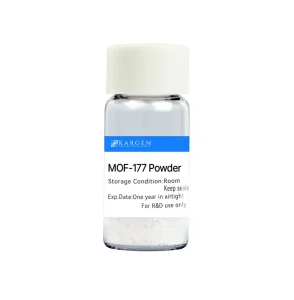
As premier global suppliers and technical exporters of porous advanced carbon materials, our enterprise bridges the gap between laboratory synthesis and large-scale industrial deployment. By engineering high-surface-area Metal-Organic Frameworks (MOFs) such as MOF-5, MOF-177, HKUST-1, UiO-66, and MIL-101 variants, we provide materials that condense hydrogen gas into a quasi-liquid adsorbate phase inside micropores, drastically boosting total volumetric storage density while operating under safer, lower-pressure regimes.
Benchmarked Material Capacity Targets
Empirical quantitative performance metrics driving next-generation clean energy storage architectures.
Global Hydrogen Storage Density Market Trends
Key macroeconomic and technological forces shaping the global demand for advanced nanoporous sorbents.
Transition to Medium-Pressure Physisorption
Global automotive OEMs and vessel system integrators are shifting from extreme 700 bar systems toward hybrid MOF-assisted pressure vessels (sub-100 bar). This movement slashes compression energy costs, lowers risk profiles, and drastically reduces tank wall thickness.
Pore Aperture & Binding Energy Tuning
Recent scientific developments prioritize tuning the isosteric heat of adsorption ($Q_{st}$) from standard physisorption level (~4-6 kJ/mol) to optimal binding energy windows (15-25 kJ/mol) using open metal sites, allowing high room-temperature storage capacities.
Industrial Scaling & Green Synthesis
The market demands solvent-free, mechanochemical, or continuous aqueous synthesis routes to bring down unit pricing of high-performance MOFs (such as ZIF-8, MIL-100, MOF-5) to commercial threshold prices supporting OEM volume integration.
Solid-State Hydrogen Storage Density Performance Benchmarks
Comprehensive quantitative comparison of standard storage methods versus engineered Metal-Organic Framework matrices.
| Storage Mechanism | Operating Temp (°C) | Operating Pressure (bar) | Volumetric Density (g H₂/L) | Gravimetric Capacity (wt%) | Thermodynamic Energy Loss |
|---|---|---|---|---|---|
| 700 Bar Compressed Gas | Ambient (25°C) | 700 bar | ~39 g/L | ~4.5 wt% (System) | High (~15% LHV) |
| Cryogenic Liquid H₂ | -253°C | 1 - 4 bar | ~71 g/L | ~7.0 wt% (System) | Very High (>30% LHV) |
| MOF-5 Powder (Cryo-Adsorption) | -196°C (77 K) | 30 - 100 bar | 66 g/L | 7.1 wt% (Material) | Moderate (<8% LHV) |
| UiO-66 (Moisture Stable) | -196°C to 25°C | 50 - 100 bar | 50 g/L | 4.5 wt% | Low (<5% LHV) |
| HKUST-1 / Cu-BTC (Open Metal Sites) | -196°C (77 K) | 60 bar | 60 g/L | 5.5 wt% | Low (<6% LHV) |
| MIL-101(Cr) (Ultra-High Surface Area) | -196°C (77 K) | 80 bar | 58 g/L | 8.1 wt% (Material) | Moderate (<7% LHV) |
*Note: Material-level volumetric values calculated based on packed crystallographic density. System-level performance depends on heat-exchanger design, binder ratio, and thermal conductivity compaction.
Enterprise Procurement Demands & Integrated Solutions
How global engineering procurement teams overcome material integration challenges using customized technical grades.
Key Procurement Requirements for MOF Sourcing
- BET Surface Area Consistency: Strict batch-to-batch tolerance (<±3% variation in nitrogen adsorption BET measurement).
- Thermal Conductivity Management: Pelleted MOF beds engineered with expanded natural graphite (ENG) or carbon nanotube networks to facilitate rapid dissipation of adsorption heat during refueling.
- Hydrothermal & Chemical Robustness: Selection of water-stable frameworks (e.g., Zr-based UiO-66, Fe-based MIL-100) to resist trace moisture contamination in commercial hydrogen streams.
- Mechanical Integrity & Densification: High-density compacts and pellets engineered to withstand mechanical vibrations without attrition or loss of surface area.
Macro Industrial Application Vectors
- Heavy Freight & Locomotive Mobility: Maximizing fuel storage in constrained chassis dimensions without adding excessive dead weight.
- Stationary Renewable Micro-Grids: Buffer storage for green hydrogen generated via intermittent solar and wind electrolysis.
- Cryo-Adsorptive Vessel Integration: Optimized 77 K storage systems for long-haul maritime vessels and bulk transport ISO containerized trailers.
- Semiconductor High-Purity Gas Delivery: Utilizing MOFs like HKUST-1 for safe sub-atmospheric delivery and purification of reactive gaseous fuels.
Quality Assurance, Global Compliance & Export Infrastructure
Empowering international industrial clients with rigorous certification, batch traceability, and seamless global export logistics.
Full Analytical Dossier
Every export shipment includes Powder X-ray Diffraction (PXRD) patterns, Thermogravimetric Analysis (TGA) reports, and high-precision N₂/H₂ sorption isotherms.
Hazardous & Inert Logistics
Specialized moisture-barrier, vacuum-sealed argon-flushed drums ensuring zero structural hydrolysis or atmospheric degradation during international sea and air transit.
Regulatory Authorization
Full compliance with REACH, RoHS, ISO 9001:2015 manufacturing standards, and customized customs documentation for North American, European, and Asia-Pacific markets.
Technology Roadmap: Next-Gen Hydrogen Storage Materials (2025–2035)
Strategic development pathways advancing volumetric capacity toward theoretical crystalline limits.
Commercial Scalability & Mechanochemical Synthesis (Present - 2026)
Transitioning primary MOF production lines (ZIF-8, MIL-100, MOF-5) to green solvent-free mechanochemistry, reducing manufacturing costs below $25/kg while preserving >95% of theoretical pore volume and crystalline phase purity.
Open Metal Site Engineering & Doping (2026 - 2029)
Incorporating unsaturated transition metal centers (e.g., Ni, Co, V open sites) and light alkali metal ion doping (Li⁺, Mg²⁺) into framework architectures to enhance hydrogen binding energies ($Q_{st}$) to 15–20 kJ/mol, enabling high ambient-temperature storage capacity at moderate pressures.
Hybrid Ultra-Dense Monolithic Frameworks (2030+)
Deployment of binderless monolithic MOF matrices combined with aligned graphene thermal conduits, surpassing 70 g H₂/L system-level volumetric capacity and fulfilling long-term global automotive energy density targets.
Additional High-Density Gas Storage & Adsorption Products
Explore our full line of functionalized MOFs, metal organic frames, and nanoporous materials engineered for industrial gas separation and storage.






Technical & Procurement FAQ
In-depth answers from our material scientists and export specialists on hydrogen storage density, material integration, and custom synthesis.
Accelerate Your Clean Energy Storage Architecture
Partner with China's leading factory direct supplier of high-density MOF adsorbents and nanoporous materials. Request a full product catalog, batch specifications, or schedule a technical call with our engineering team today.
Request Technical Consultation & Samples