
Engineered Metal-Organic Framework Powders
Select from our high-purity, pilot-validated MOF structures available for immediate global export and industrial sample testing.







Reticular Chemistry & High-Precision MOF Design
Metal-Organic Frameworks (MOFs) represent a transformative paradigm in porous material science, combining inorganic Secondary Building Units (SBUs)—such as transition metal ions or oxo-clusters—with multi-dentate organic linkers via robust coordination bonds. Unlike traditional amorphous activated carbons or rigid zeolites, MOF design operates on the principles of reticular chemistry, allowing precise atomic control over pore geometry, aperture dimensions, surface functionalization, and internal chemical environments.
As a premier MOF design supplier and global exporter, our engineering methodology centers on maximizing accessible Brunauer-Emmett-Teller (BET) surface areas (ranging from 1,000 m²/g up to theoretical limits exceeding 7,000 m²/g) while customizing framework stability against hydrothermal, acidic, and basic stresses. By tuning pore chemistry via post-synthetic modification (PSM) or direct ligand functionalization (e.g., amino-functionalized NH2-MIL-101(Fe) or open-metal site frameworks like HKUST-1), we provide targeted adsorption kinetics and thermodynamic selectivities essential for enterprise-scale industrial deployments.
Achieving target performance metrics requires overcoming historical limitations in structural collapse upon solvent evacuation. Through super-critical drying strategies and continuous-flow mechanochemical activation, our manufacturing protocols yield crystalline powders with ultra-high pore volume integrity, precise pore-size distribution (PSD), and uniform crystal morphology.
The industrial evolution of Metal-Organic Frameworks transitions from boutique laboratory synthesis to high-throughput, green, and digitized manufacturing ecosystems. As enterprise buyers seek sustainable supply chains, our technical roadmap defines the next decade of advanced porous materials:
1. Continuous Flow & Mechanochemistry
Phasing out energy-intensive solvothermal batch synthesis in favor of twin-screw extrusion mechanochemistry and continuous microfluidic synthesis. This reduces organic solvent consumption (DEF/DMF) by up to 90%, lowers carbon footprint, and guarantees batch-to-batch reproducibility for industrial orders.
2. AI-Driven Computational Screening
Integrating Density Functional Theory (DFT) calculations with machine learning algorithms to screen millions of hypothetical MOF structures. This accelerates customized ligand design for niche applications—predicting adsorption isotherms, binding energies, and hydrolytic stability prior to physical synthesis.
3. Advanced Shaping & Structuring
Moving beyond fine powders to industrial-grade extrudates, monoliths, beads, and thin-film coatings. Utilizing polymer binder systems (e.g., PVDF, Matrimid) without pore blockage ensures zero pressure drop in fixed-bed industrial adsorption columns and dynamic gas treatment systems.
China Industry 4.0: Supply Chain Resilience & Cost Superiority
Global deployment of MOFs has historically been constrained by prohibitive raw material costs and lab-scale batch production. Based in Zhuhai's high-tech industrial corridor, our facilities bridge the gap between academic innovation and commercial scale. By pioneering ton-scale MOF manufacturing in China, we leverage complete upstream integration for ligand synthesis (fumaric acid, terephthalic acid, imidazole derivatives) and metal precursor sourcing.
Our Industry 4.0 smart factory features automated crystallization reactors, inline powder X-ray diffraction (PXRD) tracking systems, closed-loop solvent recovery units, and continuous thermal activation ovens. This infrastructure minimizes production variance, provides competitive unit pricing, and guarantees export-ready volume stability.
Key Supply Chain Safeguards
- ✓ Upstream Linker Integration: Direct synthesis of organic linkers reduces raw material lead times by 60%.
- ✓ Closed-Loop Green Solvent Recovery: 95%+ recovery rate of reaction solvents compliant with international ESG standards.
- ✓ Rigorous QC Protocols: Batch-specific Certificate of Analysis (CoA) including BET surface area, TGA degradation curves, and PSD analysis.
- ✓ Export Packaging Assurance: Inert-gas sealed, moisture-proof vacuum packing for international air and ocean freight stability.
Macro-Industry Solutions & Engineered Frameworks
Matching structural design parameters with high-impact global industrial challenges.
CO₂ Capture & Carbon Management
Customized amine-functionalized frameworks like NH2-MIL-101(Fe) and high-stability UiO-66 provide exceptional CO₂/N₂ selectivity in flue gas streams and direct air capture (DAC). Their low regeneration energy requirements significantly outshine traditional liquid amine scrubbing processes.
Li-Ion Battery Separator Coatings
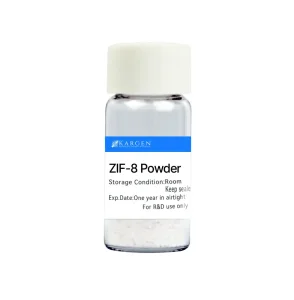
Incorporating hydrophobic ZIF-8 nano-powders into ceramic lithium battery separators enhances electrolyte wettability, homogenizes lithium-ion flux, traps trace moisture, and prevents dendrite formation, vastly extending cycle life and thermal safety.
Atmospheric Water Harvesting (AWH)
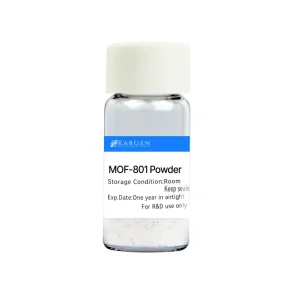
Hydrothermally stable aluminum fumarate (Al-FUM) and zirconium-based MOF-801 exhibit steep S-shaped water vapor adsorption isotherms. They capture potable moisture from low-humidity desert air using natural sunlight for desorptive harvesting.
Semiconductor Specialty Gas Purification
Open metal site structures like HKUST-1 and high-porosity MOF-177 enable sub-ppm level purification of hydride gases (phosphine, arsine) and selective adsorption of volatile organic compounds (VOCs) in advanced fab cleanrooms.
Green HVAC & Dehumidification
Coating MOF desiccants onto heat exchangers allows low-temperature waste heat (<70°C) to drive desiccant regeneration. This reduces the electrical cooling load of commercial air conditioning units by over 45-50%.
Solid-State Gas & Hydrogen Storage
Ultra-high surface area MOFs offer high volumetric and gravimetric storage capacities for methane (ANG) and solid-state hydrogen at lower operating pressures, replacing heavy high-pressure gas cylinders.
Industrial MOF Specification Matrix
To assist procurement officers, process engineers, and R&D directors in selecting optimal materials for trial and scale-up, the table below provides key physical and chemical metrics for flagship standard frameworks.
| Framework Grade | Metal Node / Linker | BET Surface Area (m²/g) | Pore Volume (cm³/g) | Thermal Stability (°C) | Primary Industrial Application |
|---|---|---|---|---|---|
| UiO-66 | Zr / 1,4-BDC | 1,100 - 1,500 | 0.45 - 0.60 | > 450°C | Acid Catalysis, Water Treatment, CO₂ Capture |
| ZIF-8 | Zn / 2-Methylimidazole | 1,300 - 1,800 | 0.60 - 0.75 | > 400°C | Battery Separators, Hydrophobic Gas Adsorption |
| HKUST-1 (Cu-BTC) | Cu / 1,3,5-BTC | 1,500 - 2,000 | 0.70 - 0.85 | > 250°C | Gas Storage (CH₄/H₂), Specialty Gas Purification |
| MIL-101(Cr) | Cr / 1,4-BDC | 2,800 - 3,600 | 1.30 - 1.65 | > 300°C | High-Capacity VOC Capture, Catalysis |
| Al-FUM | Al / Fumaric Acid | 1,000 - 1,300 | 0.45 - 0.55 | > 350°C | Atmospheric Water Harvesting, Dehumidification |
| MOF-177 | Zn / BTB | 4,000 - 4,800 | 1.50 - 1.90 | > 300°C | High-Pressure Gas Storage & Trapping |
Localized Regulatory Support & Quality Assurance
Navigating international chemical transport laws requires complete regulatory transparency. As a leading exporter of specialized metal-organic framework powders, we ensure every shipment meets strict global standards:
- • EU REACH & US TSCA Compliance: Provision of comprehensive REACH registration support, pre-registration numbers, and TSCA inventory alignment for smooth customs clearance.
- • Safety Data Sheets (GHS SDS): Multi-lingual 16-section SDS formatted to regional regulations (CLP, OSHA).
- • ISO 9001 / 14001 Certification: Certified quality management and environmental systems overseeing every synthesis batch.
- • Technical Field Engineering: On-demand technical consulting with PhD-level chemists for integration, slurry formulation, and extrusion optimization.
Seamless Global Logistics
Whether delivering 100g trial lots for pilot validation or multiple metric tons for commercial manufacturing plants, our dedicated logistics hub manages dangerous goods (DG) classification, humidity-controlled air express shipping (DHL/FedEx), and full container load (FCL) sea freight with live temperature-tracking capabilities.
High-Performance MOF Solutions for Global Export
Explore additional specialized metal-organic framework grades designed for catalysis, gas separation, and advanced sorption applications.



Frequently Asked Questions by Industrial Buyers
Technical answers for procurement officers, chemical engineers, and R&D leaders.