
1 / 2
Best MOF-801 Powder Metal Organic Frameworks (MOFs) Service, Exporters
Product Description
Product Name
MOF-801
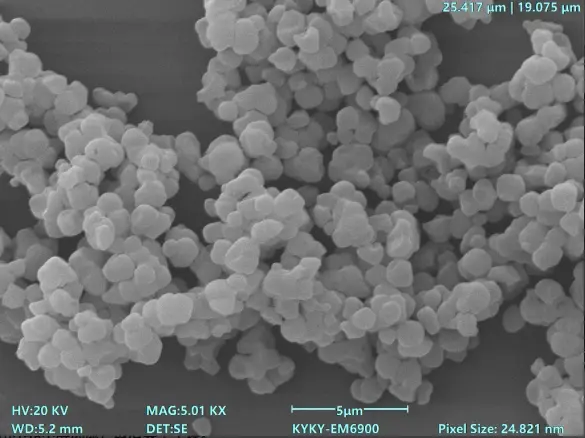
Particle Size
≈600 nm
Specific Surface Area
≥900 ㎡/g
Pore Size
≈0.4 nm
Overview & Applications
Since then, the research interest in MOF-801 has significantly increased. This is particularly driven by its promising application as a water harvester which utilises the surrounding humidity to produce fresh water and as an adsorbent for cooling system. Besides, Many potential applications of MOF-801 were reported in hydrogen and water storage, photocatalytic degradation, adsorbent for pollutants removal, the removal of fluoride and poisonous metals, nanoscale drug delivery, and separation of propylene/propane mixture.
Structural & Chemical Properties
The SBU of MOF-801 is a zirconium oxide [Zr6(μ3–O)4(μ3–OH)4] octahedral cluster in which six Zr cations reside at the six polyhedron vertices of the octahedron are held together by eight μ3‑oxygen atoms. The eight equivalent equilateral faces are alternately capped by four μ3-OH and four μ3-O groups. The SBUs are connected to each other by ligands forming a net topology of ‘fcu’ type where each SBU is connected to twelve carboxylate groups from twelve ligands. It is a highly hydrostable MOF due to the strong bonding of zirconium with the oxygen atom of the carboxylate, acting as hard acid and base, respectively.
Frequently Asked Questions
What is the primary particle size and surface area of MOF-801?
MOF-801 features an average particle size of ≈600 nm, a specific surface area of ≥900 ㎡/g, and a pore size of approximately 0.4 nm.
How does MOF-801 work in atmospheric water harvesting?
MOF-801 utilizes surrounding ambient humidity as a water harvester to adsorb and produce fresh water, making it suitable for water generation systems.
What makes MOF-801 highly hydrostable?
Its exceptional hydrostability stems from the strong chemical bonding between the zirconium cations (hard acid) and the oxygen atoms of the carboxylate ligands (hard base).
What are the main industrial applications of MOF-801?
MOF-801 is utilized in hydrogen/water storage, cooling system adsorbents, photocatalytic degradation, pollutant/heavy metal removal, nanoscale drug delivery, and propylene/propane gas separation.
What is the structural composition of the SBU in MOF-801?
The Secondary Building Unit (SBU) consists of a zirconium oxide [Zr₆(μ₃–O)₄(μ₃–OH)₄] octahedral cluster arranged in an 'fcu' net topology, connected to twelve carboxylate groups.









