
Featured New Air System MOF Nanomaterials
High-grade crystalline powders engineered for unprecedented adsorption capacity, targeted kinetic selectivity, and extreme thermal resilience.
The Paradigm Shift in Industrial Air Processing & Nanotechnology
Modern industrial environments require radical efficiency leaps in air purification, gas fraction separation, and moisture management.
Executive Summary: The Rise of Nanoporous "New Air Systems"
The global demand for energy-efficient New Air Systems has entered an accelerated trajectory driven by stringent carbon-neutrality mandates, increasing semiconductor manufacturing standards, and urgent atmospheric water scarcity challenges. Traditional air treatment technologies—relying on energy-intensive chillers, silica gel desiccants, and activated carbon beds—are reaching their thermodynamic efficiency ceilings.
As a leading global supplier and exporter, our engineering paradigm leverages Metal-Organic Frameworks (MOFs). These synthetic porous materials, characterized by ultra-high surface areas (up to 7,000 m²/g), atomic-level pore customization, and adjustable open metal centers, are transforming the architecture of advanced air processing. From commercial HVAC latent-load removal to point-of-use industrial gas purification, MOF-driven air systems deliver up to 50% thermal energy savings and micro-PPM gas selectivity.
Global Commercial Status of Advanced Air Processing
Understanding regional market dynamics and deployment density across industrial sectors worldwide.
North America & EU Clean-Tech Adoption
Strict European Green Deal regulations and US IRA subsidies have accelerated the adoption of MOF-based Direct Air Capture (DAC) and low-energy desiccant HVAC wheels. Industrial exporters are pivoting toward verified low-carbon synthetic routes like mechanochemical production.
Asia-Pacific High-Tech Manufacturing
The concentration of semiconductor fabs and lithium-ion battery mega-factories in East Asia demands absolute air moisture control (dew points below -40°C) and VOC filtration. MOF-coated heat exchangers are seeing exponential deployment in cleanroom air handling units (AHUs).
Middle East & Arid Region Water Systems
Off-grid Atmospheric Water Harvesting (AWH) powered by waste solar heat has transitioned from academic trial to commercial reality. Materials such as Al-FUM and MOF-303 yield liters of potable water per kilogram of material daily under low relative humidity (RH 15–30%).
Macro Industry Trends Shaping New Air Technology
Four pivotal technology and policy vectors driving the transition to nanostructured gas-liquid air contactors.
1. Decoupling Latent & Sensible HVAC Loads
Air conditioning historically over-cools air to condense moisture. MOF desiccant coatings adsorb moisture directly from ambient air without deep cooling, reducing electrical compressors' thermal load dramatically.
2. Ton-Scale Continuous Synthesis
Transitioning from batch solvothermal synthesis to solvent-free mechanochemistry or continuous flow-reactor models has reduced MOF manufacturing costs by up to 70%, unlocking global commercial scalability.
3. Ultra-Pure Industrial Gas Purification
As semiconductor node sizes shrink below 3nm, trace contaminants like CO, CO₂, or volatile organosilicates must be scrubbed to sub-PPB levels. Open-metal MOF variants provide kinetic sieving unmatched by zeolites.
4. ESG & ESG-Compliant Export Supply Chains
Global B2B procurement officers now evaluate suppliers based on digital quality control, raw material supply chain transparency, carbon footprint per kg, and reach compliance verification.
Localized Application Scenarios
Tailored material engineering solving unique site-specific challenges across diverse operational conditions.
1. Desiccant Wheels & Commercial HVAC
By applying Al-FUM (Aluminium Fumarate) onto aluminum rotors, commercial AHUs achieve water sorption desorption cycles at temperatures as low as 50°C–65°C. This allows low-grade industrial waste heat or solar thermal hot water to power dehumidification, slashing chiller power overhead.
2. Direct Air Capture (DAC) Units
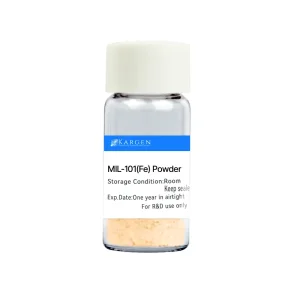
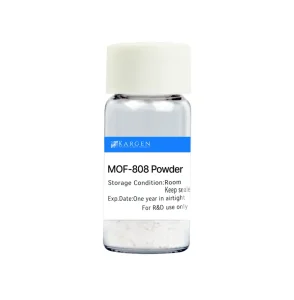
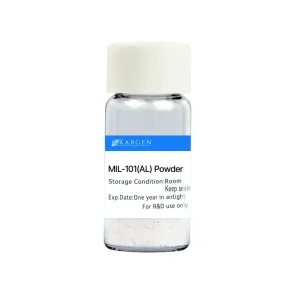
Utilizing high-stability amine-functionalized Zr-MOFs (MOF-808, MIL-101), modular DAC systems extract carbon dioxide directly from atmospheric air at 400 PPM background levels. The low binding energy enables thermal desorption with unprecedented energy efficiency per ton of captured CO₂.
3. Lithium-Ion Separator & Dry Rooms
ZIF-8 (Zinc Imidazolate Framework) powders and liquid dispersions coated on polyolefin separators trap trace moisture and transition metal ions. Simultaneously, MOF-filled air dehumidifiers maintain ultra-low humidity dry rooms necessary for EV battery cell assembly.
Technology Roadmap & Future Outlook (2025–2030)
Charting the transition from powder synthesis to structured mixed-matrix monoliths and smart digital material design.
Phase 1: Pore Engineering & Scalability
Optimization of green, solvent-free synthesis pathways. Industrialization of staple frameworks (ZIF-8, HKUST-1, Al-FUM) at multi-ton annual scales with batch-to-batch BET surface area variance controlled under ±3%.
Phase 2: Hybrid Matrix Membranes (MMMs)
Integration of nano-MOF powders into polymeric membranes, ceramic honeycombs, and metallic foam exchangers. Overcoming phase-boundary resistance to enable continuous-flow gas separation cascades.
Phase 3: AI-Driven Generative Material Selection
Deploying machine learning models to screen millions of virtual MOF structures for target gas pairs (e.g., C₂H₄/C₂H₆, CO₂/N₂), accelerating custom OEM/ODM development cycles from years to weeks.
New Air System Material Selection Matrix
A comprehensive comparison of premier framework materials for industrial procurement and R&D engineering teams.
| MOF Grade Code | Metal Center / Linker | BET Surface Area | Primary Property Trait | Target Air System Application |
|---|---|---|---|---|
| ZIF-8 | Zinc / 2-Methylimidazole | 1,300 - 1,800 m²/g | Hydrophobic pores, extreme chemical & thermal stability | CO₂ capture support, battery separators, hydrophobic air scrubbers |
| Al-FUM | Aluminium / Fumaric Acid | 1,000 - 1,300 m²/g | Steep water adsorption isotherm, hydrothermal stability | Atmospheric water harvesting, low-temperature HVAC desiccant |
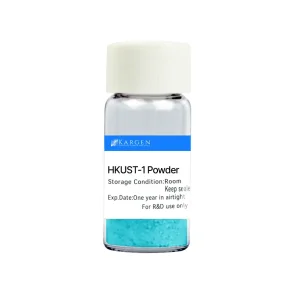
| HKUST-1 | Copper / Trimesic Acid (BTC) | 1,500 - 2,000 m²/g | High density of unsaturated open Cu metal sites | Specialty gas purification, high-capacity gas storage, CO separation |
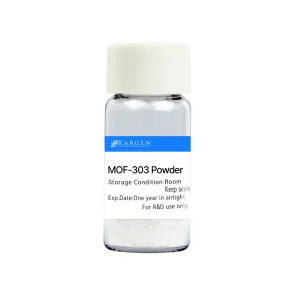
| MOF-303 | Aluminium / Pyrazole-Dicarboxylic Acid | 1,100 - 1,400 m²/g | Ultra-fast water adsorption kinetics at low RH (<20%) | Arid region water generation, ultra-dry air system desiccant |
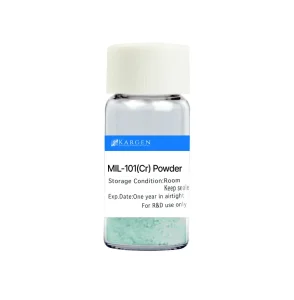
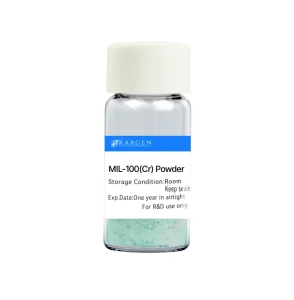
| MIL-101(Cr) | Chromium / Terephthalic Acid | 2,800 - 3,500 m²/g | Exceptional pore volume, giant cage structural network | High-humidity VOC recovery, industrial solvent air treatment |
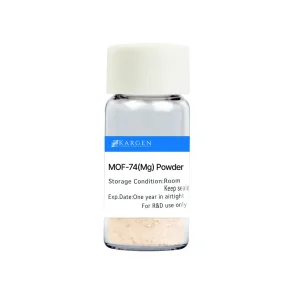
| MOF-74(Mg) | Magnesium / DOBDC | 1,200 - 1,500 m²/g | Unmatched open metal site density for strong gas binding | Flue-gas carbon capture, low-pressure gas separation |
Frequently Asked Questions
Technical, operational, and commercial insights for engineering teams and procurement specialists.
How do MOF-based New Air Systems compare to conventional silica gel or zeolite desiccants?
Can MOFs be integrated into existing coating lines for HVAC coils and heat exchangers?
What sample sizes are available for B2B evaluation and feasibility testing?
How does your factory ensure batch-to-batch consistency for bulk ton-scale orders?
What is the typical technical lead time for custom OEM/ODM framework developments?
Explore Additional Specialty Frameworks
Browse our extended product inventory optimized for targeted adsorption, catalysis, and gas storage applications.
Partner with the Leading MOF Air System Exporter
Request comprehensive material safety data sheets (MSDS), pilot evaluation samples, or consult directly with our senior application scientists for custom system integration.