
Featured Commercial MOF Nanoparticles
Industrial-scale porous crystalline framework materials optimized for gas adsorption, water harvesting, battery separator coatings, and advanced catalysis.





Executive Whitepaper: Industrial Scale Commercial Nanoparticles
Analyzing the Paradigm Shift from Lab-Scale Nanoscience to Global Multi-Ton Nanomaterial Supply Chains.
The global commercial advanced materials domain is undergoing a profound structural evolution. Transitioning from traditional low-surface-area metal oxide powders toward hyper-porous, crystalline Metal-Organic Frameworks (MOFs) and engineered nanoparticle dispersions, modern industrial applications demand strict batch-to-batch structural integrity, custom particle size distributions, and verified thermal/chemical endurance.
As an established High-Quality Commercial Nanoparticles Service & Supplier, Guangdong Advanced Carbon Materials Co., Ltd. (KARGEN) bridges the critical historical gap between bench-scale academic chemistry and reliable, ton-scale industrial manufacturing. Operating China’s pioneering mass-production facility for MOFs in Zhuhai, Guangdong, KARGEN delivers precision-engineered crystalline nanoparticles tailored for next-generation decarbonization, clean energy storage, semiconductor gas purification, and atmospheric moisture control.
Industrial procurement of commercial nanoparticles requires an uncompromising emphasis on Information Gain and technical clarity. Selecting a commercial MOF supplier is no longer just about purchasing chemical CAS numbers; it involves evaluating specific surface area profiles (BET surface areas up to 3,000+ m²/g), thermal degradation kinetics (TGA curves), hydro-thermal stability regimes, and crystal structure maintenance under extreme industrial fluid velocities.
Enterprise Procurement Demands & Industrial Intent Matrix
Aligning Procurement Criteria with Rigorous Analytical Chemistry & Quality Control Standards.
Consistent BET Surface Area
Multi-ton batches engineered to maintain uniform micropore volume. Guaranteed high N₂/CO₂ adsorption capacities with tight tolerance variance across production lots.
Mechanochemical Synthesis
Utilizing low-solvent, green mechanochemical synthesis pathways to reduce organic solvent residues, lower unit cost structure, and drastically reduce carbon footprint.
Full Characterization Dossier
Every shipment is accompanied by complete PXRD (Powder X-ray Diffraction) spectra, TGA curves, SEM micro-imaging, and ICP-OES elemental analysis certificates.
| Nanomaterial Grade | Metal Node / Organic Linker | BET Surface Area (m²/g) | Pore Volume (cm³/g) | Key Industrial Intent / Application |
|---|---|---|---|---|
| HKUST-1 (Cu-BTC) | Copper / Trimesic Acid | 1,500 – 1,900 | 0.70 – 0.85 | Specialty gas separation, acetylene storage, electronic gas purification |
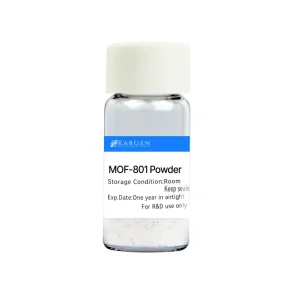
| MOF-801 | Zirconium / Fumaric Acid | 800 – 1,000 | 0.45 – 0.55 | Atmospheric water harvesting (AWH), adsorption chiller cooling |
| MIL-101 (Fe) | Iron / Terephthalic Acid | 2,200 – 3,400 | 1.10 – 1.60 | Fenton catalysis, organic pollutant degradation, drug carrier delivery |
| MOF-74 (Mg) | Magnesium / 2,5-DHBDC | 1,300 – 1,600 | 0.60 – 0.72 | Flue gas CO₂ capture, trace gas capture, olefin/paraffin separation |
| ZIF-8 | Zinc / 2-Methylimidazole | 1,300 – 1,800 | 0.65 – 0.75 | Lithium battery separator coating, hydrophobic CO₂ capture, catalysis |
| MOF-808 | Zirconium / Trimesic Acid | 1,600 – 2,100 | 0.80 – 0.95 | Heavy metal ion removal (Pb, As, Cr), Lewis acid catalysis, water treatment |
Technical Roadmap: Synthesis Engineering & Custom Processing
From Atomic Coordination Assembly to Industrial Pelletization and Liquid Dispersions.
Metal-Organic Frameworks are crystalline hybrid materials comprising metal ions or clusters coordinated to organic ligands, creating three-dimensional porous networks with ultra-high internal surface areas. Unlike conventional zeolites or activated carbons, the modular nature of MOFs enables atomic-level customization of pore geometry, aperture size, open metal sites, and surface chemistry.
1. Mechanochemical Scale-Up
By substituting traditional high-temperature solvothermal methods with solvent-free or solvent-deficient mechanochemical milling, KARGEN achieves rapid, high-yield MOF crystal growth while dramatically lowering production costs and eliminating toxic waste streams.
2. Particle Size & Morphological Tuning
Different industrial processes require distinct particle sizes. We control nanoparticle crystal nucleation down to 50–200 nm for battery separator slurries, or scale up to 1–5 µm powders for fluidized bed reactors and desiccant wheel coating systems.
3. Shaping & Engineered Formulations
Raw fine powders can create pressure drops in packed bed columns. KARGEN offers binder-integrated shaping techniques including extrudates, spherical granules, monoliths, and specialized liquid dispersions without blocking micropores.
Proprietary OEM / ODM Custom Synthesis Capabilities
Beyond standard catalog framework grades, KARGEN collaborates directly with corporate research labs to synthesize proprietary metal-organic structures. Whether modifying linkers with amino (-NH₂) or sulfonic (-SO₃H) functional groups or scaling pilot-stage patents into metric ton batches, our Ph.D. technical team ensures complete confidentiality and rapid industrialization.
Macro Industry Solutions & Commercial Nanomaterial Deployment
Empowering Global Enterprises Across Energy Storage, Carbon Management, Semiconductor, and HVAC Sectors.
CO₂ Capture & Decarbonization
Engineered MOFs such as ZIF-8 and MOF-74(Mg) deliver low energy-penalty adsorption for flue gas capture (post-combustion) and Direct Air Capture (DAC). Low thermal regeneration temperatures (< 100°C) reduce operational expenditure compared to liquid amine scrubbers.
Lithium-Ion Battery Coatings
Applying uniform ZIF-8 dispersions onto lithium-ion battery polyolefin separators improves electrolyte wettability, mechanically suppresses lithium dendrite formation, traps dissolved transition metal ions, and significantly improves thermal run-away safety limits.
Atmospheric Water Harvesting (AWH)
Hydrothermally resilient frameworks like MOF-801 and Al-FUM capture potable water from ambient air in hyper-arid desert conditions (RH < 20%) using solar-thermal regeneration, enabling decentralized water generation and energy-efficient HVAC cooling.
Gas Separation & Semiconductor Gases
Open metal center MOFs such as HKUST-1 and ZIF-93 achieve high selective separation factors for C₂H₂/C₂H₄, CO₂/CH₄, and electronic specialty gas purification, replacing energy-intensive cryogenic distillation columns in chemical processing plants.
Environmental Remediation
Iron-based framework nanoparticles including MIL-101(Fe), MIL-100(Fe), and MIL-88A(Fe) serve as non-toxic, biocompatible Fenton catalysts for advanced oxidation processes (AOPs), removing complex organic dyes, pharmaceuticals, and heavy metals from industrial wastewater.
Custom OEM/ODM Formulation
Tailored liquid suspensions, surface-functionalized nanomaterial slurries, and specialty porous additives engineered specifically to integrate into existing OEM automated manufacturing lines with minimal process re-engineering.
Commercial Status & E-E-A-T Quality Assurance Guarantee
Demonstrated Experience, Deep Technical Expertise, Authoritative Intellectual Property, and Uncompromising Reliability.
Founded by returning scientific scholars from elite research institutions in the United States, Germany, and Sweden, Guangdong Advanced Carbon Materials Co., Ltd. (KARGEN) maintains a scientific leadership core where over 60% of personnel are dedicated to R&D, and more than 80% hold Master's or Ph.D. degrees in Materials Science, Chemical Engineering, and Crystallography.
10,000 m² Integrated Base
Our Zhuhai facility houses a 1,800 m² R&D center, a 1,000 m² engineering test station, and ton-scale automated production reactors under unified ISO-certified management.
20 Granted Inventions
Protected intellectual property covering mechanochemical synthesis methods, porous crystal stabilization, and targeted application patents for industrial energy systems.
Digital QA/QC Tracing
Every industrial shipment is logged digitally with batch-specific PXRD patterns, nitrogen physisorption isotherms, moisture content analysis, and trace heavy metal screening.
With over 100 peer-reviewed scientific publications authored by our core technical team and active research collaborations spanning 70+ global universities, KARGEN offers institutional buyers absolute technical transparency and Freedom-To-Operate (FTO) assurance across global markets.
Global Logistics, Compliance & Localized Engineering Support
Seamless Procurement Protocols for Enterprise Buyers Across North America, Europe, and Asia-Pacific.
Regulatory Compliance Support
Full support for international chemical regulatory documentation, including EU REACH compliance dossiers, US TSCA inventory matching, RoHS/REACH certificates, and standardized GHS Safety Data Sheets (SDS).
Rapid Sample Evaluation Program
To streamline industrial qualified supplier verification, KARGEN provides 1–5 gram free evaluation sample lots for qualified corporate R&D teams, complete with Certificate of Analysis (COA) data.
1 Business-Day Service SLA
Our dedicated international application engineering desk guarantees detailed technical responses to inquiries, custom quotation requests, and safety clearance questions within 24 business hours.
Commercial Nanoparticles Procurement FAQ
Addressing Common Technical, Scale-Up, and Commercial Procurement Questions from Enterprise Customers.
What is the typical lead time for ton-scale commercial MOF shipments?
Standard catalog grades such as ZIF-8, HKUST-1, and Al-FUM are maintained in stock for pilot sample quantities (1 kg – 50 kg) with dispatch within 3 business days. Ton-scale custom manufacturing orders typically require 2 to 4 weeks depending on particle shaping requirements and batch quality verification steps.
How does KARGEN ensure hydro-thermal crystal stability in moist industrial environments?
Hydrothermal stability is heavily dependent on the metal-ligand coordination bond strength. Zirconium-based MOFs (e.g., MOF-801, MOF-808) feature strong Zr-O bonds providing extreme stability in water and acidic media. For less moisture-stable frameworks, KARGEN offers hydrophobic polymer surface coating technologies to preserve framework integrity.
Can KARGEN supply MOFs pre-dispersed in organic solvents or aqueous solutions?
Yes. In addition to dry powder forms, we manufacture stabilized liquid dispersions (such as ZIF-8 dispersed in ethanol, NMP, or water) engineered with precise viscosity profiles for direct slot-die coating onto battery separators or industrial membranes.
How can enterprise buyers request evaluation samples for custom testing?
Qualified corporate R&D teams and procurement managers can request 1–5 gram evaluation samples by contacting our technical engineering desk. Please submit your application focus, target performance metrics, and required solvent/thermal parameters to receive a custom sample evaluation kit.
Additional Commercial Nanomaterials & Custom MOF Solutions
Explore our complete inventory of industrial-grade powders, customized frameworks, and specialized catalytic nanomaterials.





