
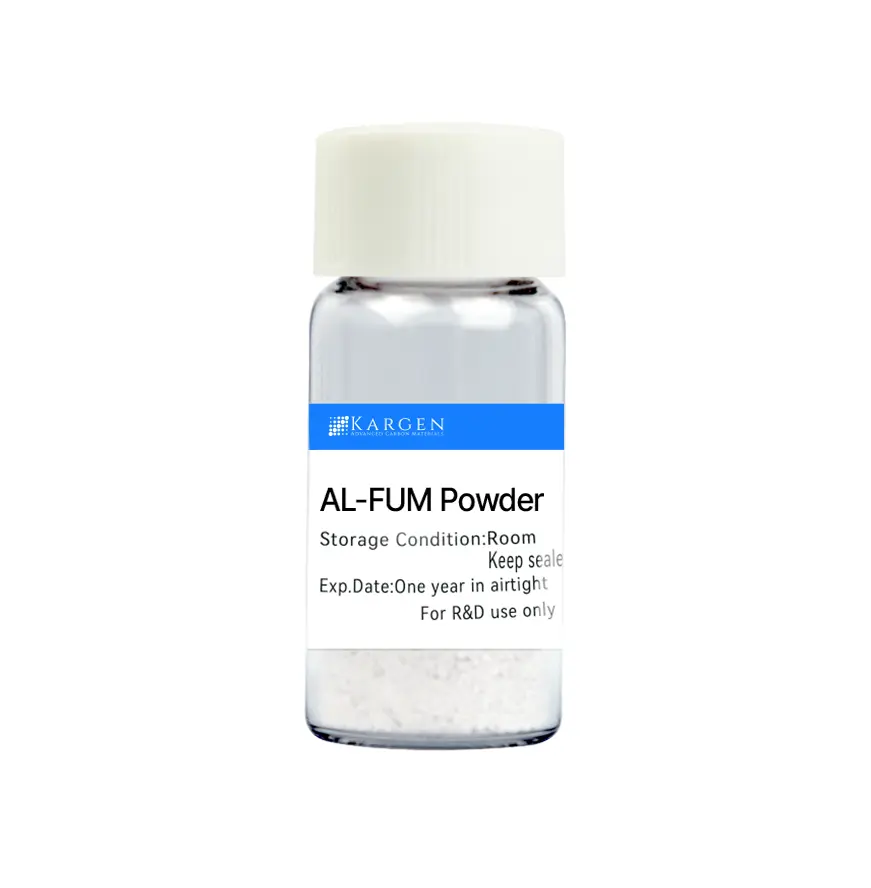
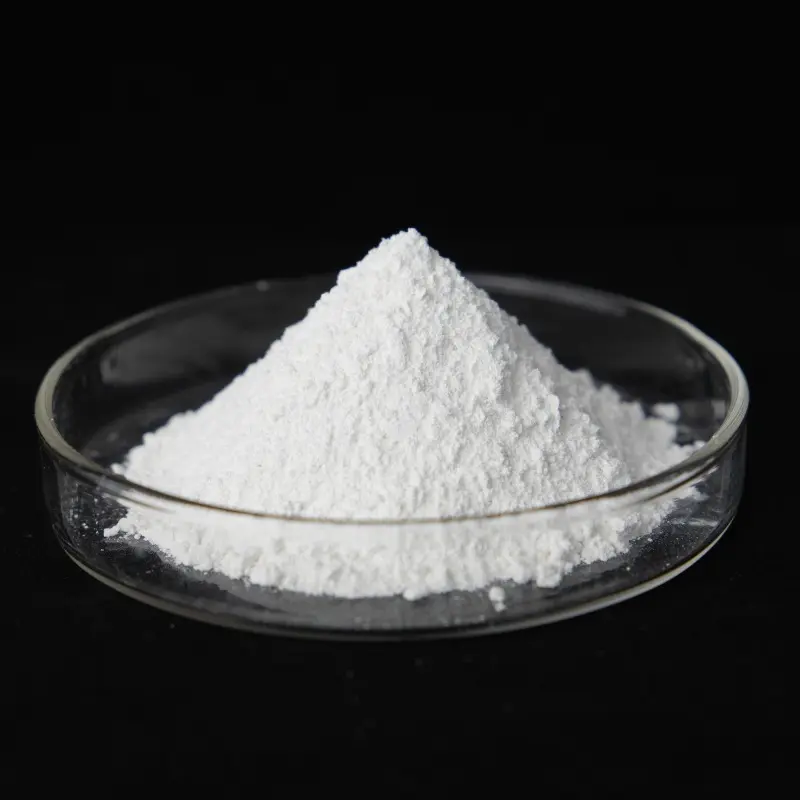
Best Al-FUM Powder Metal Organic Frameworks (MOFs) Supplier, Exporter
Product Description
| Product Name | Al-Fum |
| Particle size | 5~20 μm |
| Specific surface area | ≥900 ㎡/g |
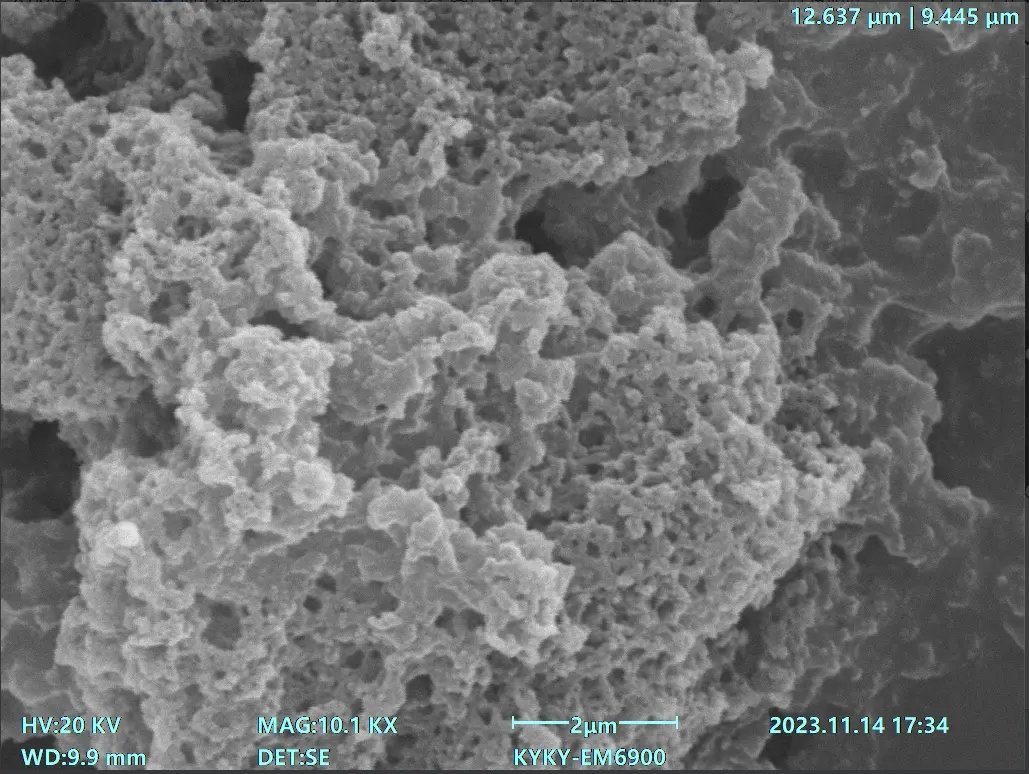
| Pore size | 0.3~1 nm |
Al-Fumaric Acid MOF, commonly referred to as Al-FUM, is a Metal Organic Framework (MOF) characterized by its chemical formula Al(OH)(fum).xH2O, where x is approximately 3.5 and FUM represents the fumarate ion. Al-FUM shares an isoreticular structure with the renowned MIL-53(Al)-BDC (where BDC stands for 1,4-benzenedicarboxylate). This MOF is constructed from chains of corner-sharing metal octahedra interconnected by fumarate ligands, creating lozenge-shaped one-dimensional (1D) pores with free dimensions of about 5.7×6.0 Å2.
Exceptional hydrothermal and chemical stability, facilitating large-scale production for liquid adsorption, separation, and catalysis.
Outstanding water stability making it suitable for condensation, purification, nanofiltration, and desalination processes.
Non-toxic, abundant, and cost-effective nature positions it perfectly for detecting and removing harmful contaminants.
One of the key advantages of Al-MOFs, including Al-FUM, is their exceptional hydrothermal and chemical stability, which facilitates their large-scale production and makes them suitable for a range of industrial applications. Particularly, they excel in the fields of liquid adsorption, separation, and catalysis, where their stability and structural integrity are paramount.
Al-FUM's outstanding water stability is a significant asset in the production of potable water. It can be utilized in condensation and purification processes to ensure the safety and quality of drinking water. This feature is particularly important in regions where access to clean water is limited or where water sources are contaminated.
The non-toxic nature of Al-FUM, coupled with its abundance and cost-effectiveness, positions it as a promising material for applications in food safety. Its use could potentially enhance the safety of the food supply chain by providing a means to detect and remove harmful contaminants.
In terms of physical properties, Al-FUM is available as a fine powder with a particle size of less than or equal to 20 μm. This particle size, combined with a specific surface area exceeding 800 ㎡/g, contributes to its high adsorption capacity. The pore size of 0.4 to 0.8 nm allows for precise molecular sieving and selective adsorption, making Al-FUM an ideal candidate for various separation processes.
In summary, Al-FUM is a versatile and robust MOF with a wide range of potential applications, from water treatment and purification to the creation of advanced membranes for filtration and desalination. Its non-toxic, abundant, and affordable nature also makes it a strong candidate for use in the food industry, enhancing safety and quality. With ongoing research and development, Al-FUM is poised to play a significant role in addressing some of the world's most pressing challenges, particularly in the areas of water and food safety.
Al-FUM stands for Al-Fumaric Acid MOF, a Metal Organic Framework with the chemical formula Al(OH)(fum).xH₂O (x ≈ 3.5). It consists of chains of corner-sharing metal octahedra linked by fumarate ligands, forming 1D lozenge-shaped pores.
Al-FUM is a fine powder with a particle size of 5–20 μm, a high specific surface area of ≥900 m²/g (exceeding 800 m²/g), and pore sizes ranging from 0.3 to 1 nm (0.4 to 0.8 nm), providing high adsorption capacity and molecular sieving capabilities.
Due to its exceptional hydrothermal and water stability, Al-FUM is used in condensation and purification processes to generate clean drinking water. It can also be fabricated into MOF-based membranes for desalination and nanofiltration.
Yes. Al-FUM is non-toxic, abundant, and cost-effective, making it a promising candidate for food safety applications, particularly in detecting and removing harmful contaminants from the supply chain.
Al-FUM excels in liquid adsorption, separation, and catalysis processes thanks to its remarkable chemical and hydrothermal stability, which maintains structural integrity under industrial conditions.









